Table of Contents
What Foam Fractionation Does
Foam fractionation (sometimes called surfactant-assisted flotation) exploits the amphiphilic nature of PFAS molecules to concentrate them at the air-water interface of finely dispersed bubbles. Rising bubbles carry PFAS to a foam layer, which is collected as a small-volume concentrate. Typical volume-reduction factors are 20:1 to 1000:1 depending on chain length and feed matrix (Science of the Total Environment, 2025). This concentration is what makes downstream destruction technologies — electrochemical oxidation, supercritical water oxidation (SCWO), hydrothermal alkaline treatment (HTA) — economically viable, because destruction cost scales with volume rather than with total water throughput.
In the PFAS treatment train now taking shape at landfill and industrial sites, foam fractionation typically sits between biological treatment and the destruction reactor. Its job is to shrink the treated water into a manageable slug of hazardous concentrate.
Where Turbidity Enters the Picture
Foam fractionation is a surface chemistry process. PFAS molecules adsorb at the air-water interface of the bubbles, and the total interface area available depends on bubble size and stability. When the feed water carries suspended solids or colloids, three problems arise:
- Interface competition. Colloidal organic particles adsorb to the same air-water surfaces PFAS want to occupy, reducing the effective loading of PFAS onto the foam.
- Bubble destabilization. Surface-active biosolid fragments alter bubble stability, causing premature coalescence or excessive drainage, both of which reduce the concentration factor.
- Concentrate contamination. A turbid feed produces a concentrate that carries not only PFAS but also biosolids and colloidal COD, complicating the destruction step downstream.
For these reasons, foam fractionation designers target feed turbidity in the low single-digit NTU range for stable operation. Once feed turbidity climbs well above that, PFAS removal efficiency degrades quickly and the concentrate quality suffers with it.
The Three-Point Turbidity Strategy
To operate foam fractionation reliably, Shanghai ChiMay’s application team commonly recommends turbidity monitoring at three points.
Point 1: Column feed. This is the primary control point. If feed turbidity climbs above the design threshold, the upstream MBR or clarifier is not doing its job, and operators can respond in real time — either by adjusting coagulant dose, extending sedimentation time or partially bypassing the column until conditions recover.
Point 2: Column effluent. The effluent should be substantially clearer than the feed if the column is running correctly. When effluent turbidity approaches or exceeds feed turbidity, it signals that the column is short-circuiting or that foam is collapsing back into the water phase, releasing carried solids. Continuous monitoring at this point provides early warning of column upsets before they show up as compliance excursions downstream.
Point 3: Concentrate line. The foam concentrate itself is highly turbid, but tracking its turbidity trend gives operators a signal about foam quality. A stable, high turbidity indicates a well-loaded foam. A drop in concentrate turbidity often coincides with a drop in PFAS concentration factor, offering a low-cost surrogate for foam performance without needing PFAS lab analysis for every batch.
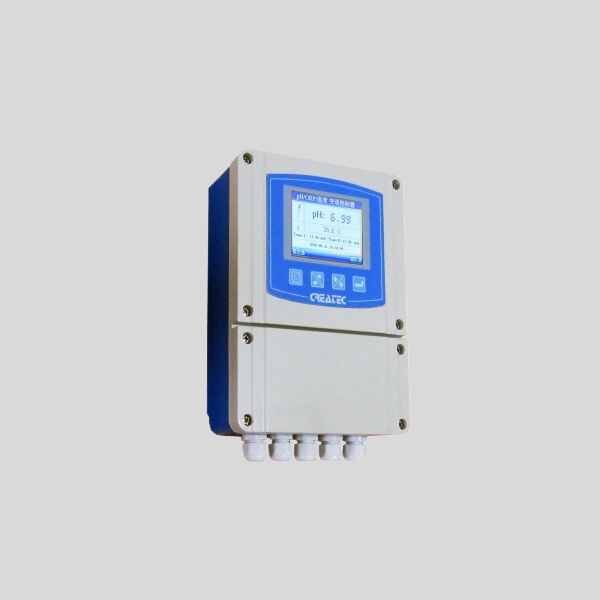
Shanghai ChiMay’s online turbidity tester family offers instruments spanning the low range (0–10 NTU) suitable for Points 1 and 2, and a higher range (0–1000 NTU or greater) suitable for Point 3. The transmitter can be configured with dual-range settings for streams that swing widely.
Why Continuous, Not Grab Samples
Foam fractionation is dynamic. Bubble generation rate, feed chemistry, water temperature and dissolved gas content all influence performance on time scales of minutes to hours. Grab sampling at, say, four-hour intervals misses transient events entirely. A single upstream biological reactor upset — for example, a partial nitrification collapse — can push feed turbidity up by an order of magnitude within an hour, and by the time the grab sample lab result returns, the foam column has already produced hours of substandard concentrate.
Continuous turbidity monitoring closes this gap. With inline turbidity data flowing into the plant SCADA at one-minute intervals, operators can trigger automatic actions: dose additional coagulant, temporarily divert feed to storage, or lower foam column feed rate to compensate.
Fouling Countermeasures for Turbidity Sensors on Foam Fractionation
Foam fractionation is a fouling-prone application because it inherently produces surfactants and biofilm-favoring conditions. Turbidity sensors placed on foam columns need active cleaning to stay credible.
Shanghai ChiMay’s online turbidity tester units for this service typically ship with:
- Automatic ultrasonic cleaning integrated into the sensor body.
- Mechanical wiper option for the optical windows.
- Two-color LED optics that self-diagnose window transmission and alarm before the reading drifts.
- Chemical cleaning port for scheduled acidic or hypochlorite flushes.
Operators still need a defined cleaning schedule, but the goal is that the sensor never becomes the weakest link in the control loop.
Interaction with the PFAS Destruction Stack
Downstream destruction reactors — whether electrochemical oxidation with boron-doped diamond anodes, SCWO or HTA — have their own inlet quality specifications. Excess colloidal load in the foam concentrate reduces the current efficiency of electrochemical oxidation and fouls SCWO feed nozzles. By using continuous turbidity monitoring on both the concentrate and post-column effluent, operators can enforce the inlet spec of the destruction reactor rather than discovering violations after damage has been done.
Shanghai ChiMay’s turbidity data typically feeds into the same historian as the multi-parameter and COD data around the destruction reactor, allowing a unified compliance and operations dashboard.
Regulatory Context
The documentation bar across the PFAS treatment train keeps rising. EPA’s 2024 proposal to list nine PFAS as RCRA hazardous constituents was withdrawn in May 2026, but state permits and disposal facilities have continued to tighten requirements independently of that rulemaking (Fox Rothschild). Turbidity is not a PFAS parameter per se, but its role as a surrogate for concentrate quality means that turbidity records are part of the defensible operations file for many landfill sites. Regulators reviewing a foam fractionation performance record expect to see continuous turbidity trends alongside PFAS lab data, not one or the other.
Conclusion
Foam fractionation is a surface chemistry process, and surface chemistry is exquisitely sensitive to feed water quality. Continuous turbidity monitoring at column feed, column effluent and concentrate line is the practical way to hold performance stable under real landfill leachate conditions. Shanghai ChiMay’s online turbidity tester family provides instruments and self-cleaning features matched to this application, and its transmitter integration slots into the broader monitoring architecture that modern compliance demands. For operators building or upgrading a PFAS destruction stack, turbidity monitoring is not an accessory — it is a core part of making foam fractionation work as advertised.