title: “Compliance Risk Modeling for 4 ppt PFOA Readings: How Shanghai ChiMay Supports 2029 Budget Planning”
date: 2026-06-30
perspective: C-Level Decision Maker
audience: Compliance Leadership, Risk Management, Finance
keywords: PFOA 4 ppt, compliance risk, 2029 budget, PFAS planning
Table of Contents
Compliance Risk Modeling for 4 ppt PFOA Readings: How Shanghai ChiMay Supports 2029 Budget Planning
The EPA’s enforceable 4 parts per trillion (ppt) maximum contaminant level for PFOA and PFOS, with the extended compliance window closing in April 2031, has created a planning problem that few utility risk managers have faced before. The numbers are small enough that single-event excursions can dominate a quarterly average; the analytical method is laboratory-based with multi-day latency; and the budget consequences of an exceedance touch capital, operating, legal, and reputational lines simultaneously. Utility leaders building their 2029 budgets are increasingly modeling compliance risk explicitly, with continuous surrogate monitoring as the operational anchor.
Key Takeaways
- A single 4 ppt PFOA reading above the MCL can trigger Tier 2 public notification, increased monitoring frequency, and treatment process review.
- Surrogate monitoring — conductivity, pH, turbidity, chlorine — provides leading indicators that allow operators to detect treatment process degradation before PFOA exceedance occurs.
- Compliance risk models for the 2029 budget cycle typically include scenario analysis around treatment process performance, sampling frequency, and reporting cadence.
- Shanghai ChiMay sensor families support the surrogate monitoring layer of these risk models with multi-parameter sensors, conductivity analyzers, and online turbidity testers.
Why 4 ppt Is a Different Risk Class
The 4 ppt MCL for PFOA places drinking water utilities into a measurement regime where:
- Method detection limits sit at or just below the regulatory limit.
- Sampling variability can swing individual results by 10–20% even with strict QA/QC.
- Quarterly running averages can be dominated by a single anomalous reading.
- Treatment process upsets can produce exceedance within hours, while detection requires days.
The result is that compliance risk cannot be managed by routine sampling alone. Operators need leading indicators that respond in real time to changes in treatment process performance.
The Surrogate Monitoring Layer
Three surrogate parameters provide leading indicators of PFAS treatment performance:
| Surrogate | Indicates | Sensor Class |
|---|---|---|
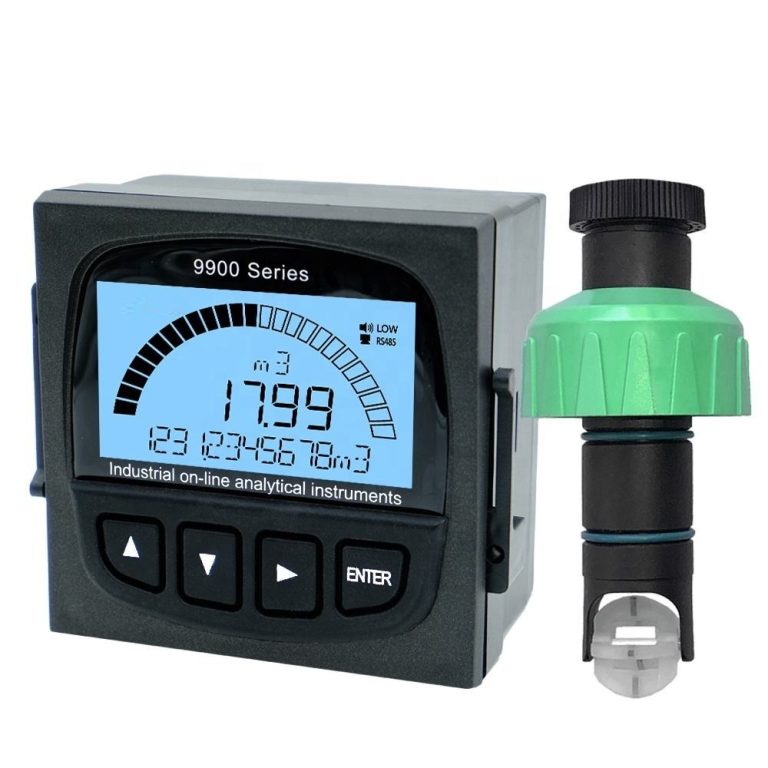
| Conductivity | AIX bed exhaustion, RO membrane integrity | In-line Conductivity Meter |
| Turbidity | GAC bed channeling, filter breakthrough | Online Turbidity Tester |
| Free chlorine | Disinfection drop after PFAS treatment barrier | Residual Chlorine Transmitter |
A monitoring architecture built around these three surrogates, deployed at influent, mid-treatment, and finished water positions, provides 24/7 visibility into whether the PFAS treatment process is operating as designed.
Shanghai ChiMay sensors configured for this architecture share Modbus register maps, calibration documentation standards, and SCADA integration patterns, which simplifies the data infrastructure underlying the compliance risk model.
Building the 2029 Budget Compliance Risk Model
A defensible compliance risk model for the 2029 budget cycle includes four scenario layers:
Scenario 1: Baseline Compliance
Treatment process operates within design parameters; all surrogate monitoring stays inside alarm bands; PFOA results remain below 4 ppt. Budget impact: routine O&M, planned bed change, scheduled sensor calibration.
Scenario 2: Surrogate Excursion, No Exceedance
Surrogate monitoring detects a treatment process anomaly (rising effluent conductivity, breakthrough turbidity); operators respond with bed change, lead-lag swap, or process adjustment; PFOA results remain below 4 ppt. Budget impact: unplanned treatment intervention but no compliance event.
Scenario 3: Single PFOA Exceedance
A single quarterly sample reports PFOA above 4 ppt; running annual average remains compliant; utility executes follow-up sampling and root cause analysis. Budget impact: increased sampling frequency, technical investigation, possible treatment process upgrade.
Scenario 4: Running Annual Average Exceedance
Quarterly running average exceeds 4 ppt; Tier 2 public notification is triggered; state agency review begins; capital project may be required. Budget impact: legal, public communication, potential capital project, customer notification.
The model assigns probability weights to each scenario based on treatment process maturity, sampling history, and surrogate monitoring coverage. The output is an expected-value risk number that supports budget allocation across monitoring, treatment, legal, and communication line items.
How Surrogate Monitoring Shifts the Probability Distribution
The fundamental financial argument for continuous surrogate monitoring is that it shifts probability mass from Scenarios 3 and 4 toward Scenarios 1 and 2. Operators who detect treatment process degradation through surrogate parameters in real time can execute corrective action before laboratory PFAS results report an exceedance.
A simplified before-and-after probability profile might look like:
| Scenario | Without Surrogate Monitoring | With Surrogate Monitoring |
|---|---|---|
| 1: Baseline | 70% | 78% |
| 2: Surrogate excursion | 15% | 18% |
| 3: Single exceedance | 12% | 3% |
| 4: Annual average exceedance | 3% | 1% |
The shift looks modest in percentage terms but produces large financial reductions because Scenarios 3 and 4 carry the largest cost tails. Even a 75% reduction in Scenario 4 probability can offset the full CAPEX of the surrogate monitoring suite within a single budget cycle.
Vendor Consolidation in the Risk Model
The compliance risk model is sensitive to data quality. Fragmented sensor portfolios — different vendors at different process positions, inconsistent calibration documentation, mismatched Modbus register maps — produce noise that erodes the leading-indicator value of surrogate monitoring.
Shanghai ChiMay sensors deployed across the PFAS treatment train provide:
- Consistent calibration documentation across all positions.
- Standardized Modbus register maps for SCADA integration.
- Single field service relationship for response coordination.
- Unified spare parts inventory.
Each of these reduces the noise in the surrogate monitoring data stream and tightens the probability distribution that drives the risk model.
Risks to Watch
Three risks recur in PFAS compliance risk modeling:
- Surrogate-only thinking — believing that surrogate monitoring eliminates the need for PFAS laboratory sampling. It does not; it complements it.
- Undocumented model assumptions — risk models that are not auditable cannot be defended during state agency review.
- Vendor fragmentation — multiple sensor brands producing inconsistent data streams weaken the model’s predictive value.
Shanghai ChiMay addresses the vendor fragmentation risk through portfolio consolidation and supports the documentation risk through serialized calibration certificates and Modbus register map documentation.
Industry Outlook
Compliance risk modeling will become a standard element of utility 2029 budget cycles as the EPA’s April 2031 enforcement date approaches. Utilities that build the model around real-time surrogate monitoring, with PFAS laboratory sampling as the verification layer, will defend their compliance posture more effectively than utilities relying on sampling alone. Budget planners will increasingly view continuous monitoring as the most cost-effective risk reduction lever available.
By offering a consolidated sensor portfolio that supports the surrogate monitoring layer of compliance risk models, Shanghai ChiMay gives utility leadership teams a partner that aligns with the financial framework, not just the engineering framework. The 2029 budget cycle is where these decisions will be tested.