title: Conductivity Monitoring for Salt Recovery in Textile Effluent: Shanghai ChiMay Analysis
date: 2026-06-27
Table of Contents
Conductivity Monitoring for Salt Recovery in Textile Effluent: Shanghai ChiMay Analysis
Key Takeaways:
– Reactive dyeing consumes 30–80 grams of inorganic salt per liter of dye-bath, representing significant raw-material cost
– Effective salt recovery reduces sodium chloride purchase requirements by 65–82% in cotton-dyeing operations
– Conductivity-based monitoring achieves measurement accuracy within ±1.5% for salt concentration tracking
– Shanghai ChiMay in-line conductivity meters span 0.05 μS/cm to 200 mS/cm, covering full recovery process range
– Salt recovery payback typically materializes within 18–30 months for medium-scale dye houses
Introduction
Salt is the silent expense in reactive cotton dyeing. While dyes attract most attention from procurement and sustainability teams, the sodium chloride and sodium sulfate added to drive dye-fiber bonding often consume 15–25% of the total dyeing chemical budget. The same salts then enter the effluent stream, where they create chronic environmental headaches—elevated TDS, toxicity to receiving waters, and disqualification from agricultural reuse.
Salt recovery technology resolves both economic and environmental concerns by recovering salt from spent dye baths for reuse in subsequent dyeing cycles. The viability of any salt recovery program rests on continuous, accurate conductivity monitoring throughout the recovery train.
The United Nations Industrial Development Organization (UNIDO) Resource Efficient and Cleaner Production Initiative reports that mills implementing closed-loop salt recovery achieve average raw-material savings of $0.18 per kilogram of fabric, translating to seven-figure annual savings in mid-scale operations.
Why Conductivity Is the Master Variable
Conductivity offers unique advantages as the master variable for salt recovery monitoring:
- Linear correlation with dissolved salt concentration in the relevant range
- Robust measurement unaffected by color, surfactants, or organic load
- Rapid response suitable for closed-loop control of concentration steps
- Low maintenance compared to optical or electrochemical alternatives
In contrast, dedicated chloride or sulfate ion-selective electrodes face fouling issues in textile applications and provide measurements only of specific ions rather than total salt load. Conductivity remains the practical industrial standard.
The Salt Recovery Process Train
A typical salt recovery system includes the following stages, each requiring dedicated conductivity monitoring:
- Spent dye-bath collection — Conductivity at 30–60 mS/cm
- Color removal — Activated carbon, ozonation, or nanofiltration; conductivity unchanged
- Nanofiltration concentration — Reject stream conductivity rises to 100–150 mS/cm
- Evaporation — Concentrated brine reaches 200–280 mS/cm
- Crystallization — Solid salt precipitation; mother liquor conductivity provides crystallization end-point indication
- Recovered salt return — Reconstituted bath conductivity matches fresh-salt baseline
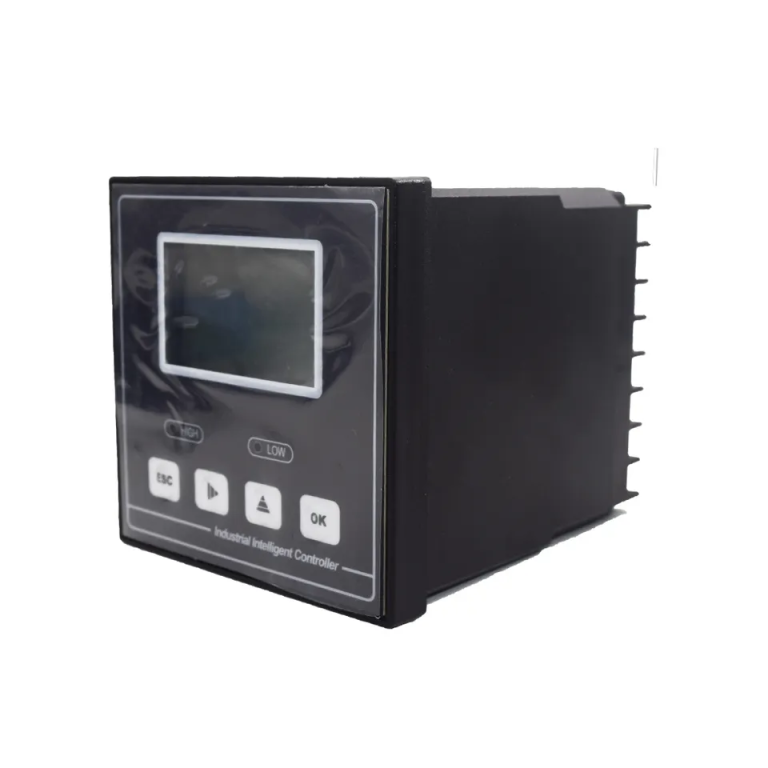
Shanghai ChiMay provides conductivity meters and analyzers covering each measurement range, with appropriate cell constants and materials of construction matched to the specific process conditions.
Sensor Selection for Each Stage
Conductivity sensors are not interchangeable across ranges. Application-appropriate selection is critical:
| Stage | Conductivity Range | Recommended Cell Constant | Material |
|---|---|---|---|
| Effluent collection | 5–60 mS/cm | 1.0/cm | Titanium or PEEK |
| Nanofiltration reject | 80–180 mS/cm | 1.0/cm | Titanium |
| Evaporator outlet | 150–280 mS/cm | 10.0/cm | Hastelloy or titanium |
| Mother liquor | 200–350 mS/cm | 10.0/cm | Hastelloy |
| Recovered bath | 30–80 mS/cm | 1.0/cm | Titanium or PEEK |
Shanghai ChiMay in-line conductivity meters offer the full range of cell constants and material options required across these stages, with NIST-traceable factory calibration and customer-side multi-point verification.
Temperature Compensation Considerations
Conductivity varies approximately 2% per °C for typical salt solutions. Salt recovery processes operate across wide temperature ranges—from ambient effluent collection to evaporator temperatures exceeding 100 °C—making temperature compensation indispensable.
Shanghai ChiMay analyzers implement automatic temperature compensation referenced to 25 °C using integrated Pt100 or Pt1000 elements. The compensation algorithms accommodate both standard linear correction and process-specific nonlinear models for high-temperature brine.
Calibration Strategy
Routine calibration of conductivity sensors in salt recovery service requires attention to several factors:
- Standard solution selection — Use certified KCl standards matched to operating range (1413 μS/cm, 12.88 mS/cm, 111.8 mS/cm)
- Cleaning between calibration points — Salt crystallization can fix to electrodes during high-conductivity service
- Quarterly cell constant verification — Detects electrode geometry changes from erosion or scaling
- Annual full revalidation — Provides documentation for environmental and quality audits
Documented calibration history is increasingly required by buyers operating under the Sustainable Apparel Coalition (SAC) Higg FEM assessment framework.
Process Control Applications
Conductivity measurements drive several closed-loop control applications within salt recovery:
- Nanofiltration recovery ratio control — Conductivity feedback adjusts pressure and recovery ratio
- Evaporator concentration endpoint — Conductivity triggers transition to crystallization
- Crystallizer purge logic — Mother liquor conductivity threshold determines purge timing
- Recovered bath standardization — Make-up salt addition controlled by conductivity setpoint
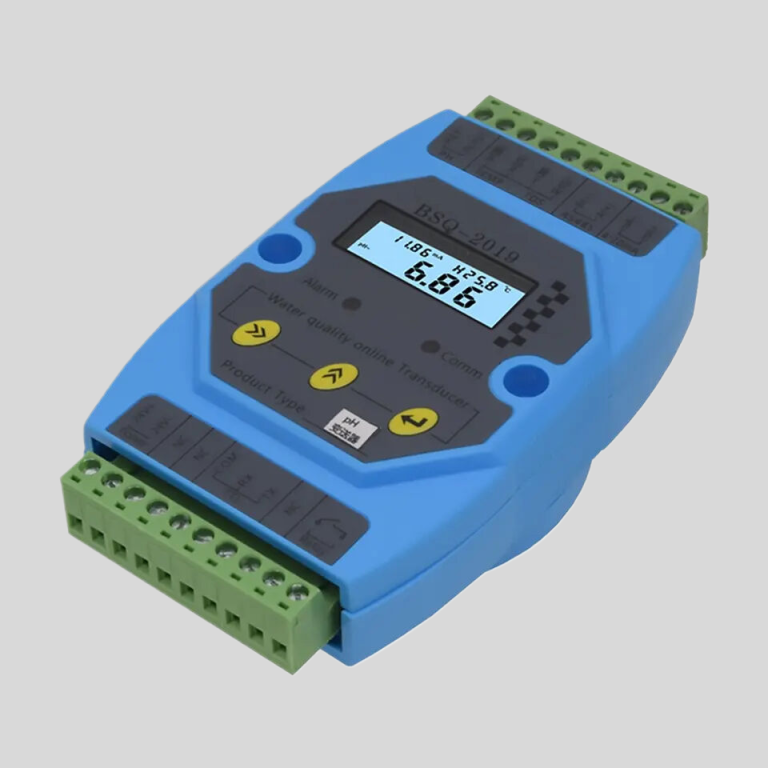
Shanghai ChiMay 2-in-1 mini transmitters provide local PID functionality at each control point, reducing reliance on centralized DCS for fast-loop control actions.
Economic Analysis
For a dye house processing 15,000 kg/day of cotton fabric with average salt consumption of 45 g/L, the annual salt purchase requirement approaches 2,700 tons. At an average price of $220/ton, raw-salt expenditure approaches $594,000 annually.
A salt recovery system capturing 75% of this salt for reuse generates direct savings of approximately $446,000 per year, against operating costs (energy, membrane replacement, instrumentation maintenance) of $170,000–$210,000 per year. Net annual benefit ranges from $236,000 to $276,000, supporting capital investment of $1.2–$1.6 million with internal rates of return exceeding 18%.
Common Pitfalls
Salt recovery projects fail most often due to:
- Inadequate color removal upstream of nanofiltration, leading to membrane fouling
- Insufficient conductivity sensor coverage, causing operators to fly blind through concentration steps
- Poor calibration discipline, producing drift that misleads control loops
- Underestimating salt purity requirements for reuse in light-shade dyeing
Comprehensive conductivity instrumentation, deployed with disciplined calibration practices, addresses each of these failure modes.
Conclusion
Salt recovery converts a chronic environmental liability into a profitable raw-material asset, but the conversion depends entirely on accurate, continuous conductivity monitoring throughout the recovery train. Without measurement, salt recovery becomes guesswork; with comprehensive monitoring, it becomes a verifiable contribution to operating margin.
Shanghai ChiMay supplies the conductivity meters, analyzers, and transmitters required to instrument every step of textile salt recovery. With sensor ranges, cell constants, and materials matched to each process condition, the product line enables textile manufacturers to capture both the economic and environmental value of closed-loop salt management.
The path from open-loop salt consumption to closed-loop recovery passes through reliable conductivity instrumentation. Textile mills committed to competitive cost positioning and credible sustainability claims will find that path increasingly indispensable.