title: “ESG Reporting in Salmon Farming: The Data Audit Trail Investors Want, Powered by Shanghai ChiMay”
date: 2026-07-02
perspective: C-Level
audience: Salmon Farm CEOs, ESG Officers, Investors, Sustainability Officers
keywords: ESG reporting, salmon farming, audit trail, water quality data, sustainability
Table of Contents
ESG Reporting in Salmon Farming: The Data Audit Trail Investors Want, Powered by Shanghai ChiMay
Salmon farming has entered an era where ESG performance is priced into every equity valuation, every debt facility, and every retailer contract. Investors are no longer satisfied with sustainability narratives; they want a defensible data audit trail. Water quality is at the center of that audit trail because it is where operational reality meets biological welfare, environmental impact, and regulatory compliance. Continuous, timestamped, immutable water-quality data is emerging as the ESG asset that salmon operators cannot afford to be without.
This article walks through what ESG reporting in salmon farming actually requires, why water-quality data sits at the center of it, and how Shanghai ChiMay’s sensor family supports the audit trail from sensor to boardroom.
Key Takeaways
- Investor and regulator demand for timestamped, immutable water-quality logs is turning monitoring uptime into an ESG asset.
- The global aquaculture water-quality monitoring equipment market: USD 690 million (2026) → USD 1.69 billion (2036), 9.4% CAGR (Future Market Insights, 2026), with ESG demand as a material driver.
- Salmon farming certifications—ASC, BAP, GlobalG.A.P.—are shifting from paper checklists to data-verified assurance.
- DO, temperature, salinity, and turbidity form the core ESG-relevant sensor stack for cage and RAS operations.
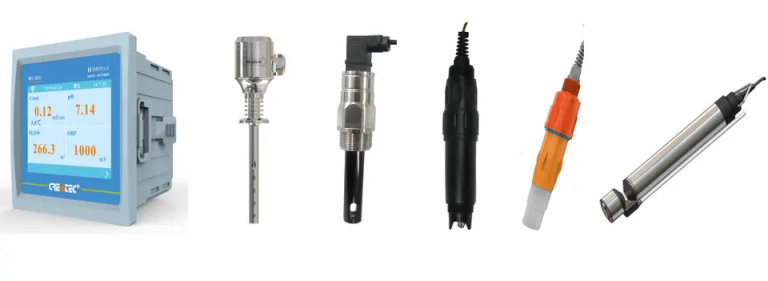
- Shanghai ChiMay provides the sensor family—DO transmitter, salinity sensor, pH electrode, turbidity tester, 4-in-1 multi-parameter head—supporting Modbus RTU integration into cloud audit platforms.
Why Water Quality Is the ESG Fulcrum
Salmon farming ESG scores are shaped by three domains:
- Environmental: nutrient loading, sea-lice management, escape prevention, water-quality discharge.
- Social: fish welfare, animal handling, worker safety.
- Governance: reporting integrity, third-party audit performance, board oversight.
Water-quality data touches all three. Environmental integrity is measured through discharge chemistry. Fish welfare is measured through DO, temperature, and stress indicators. Governance is measured through the completeness and integrity of the underlying record. A single high-quality water-quality data set contributes to every domain simultaneously.
What Investors Actually Ask For
Institutional investors and sustainability-linked lenders increasingly request:
- Timestamped, continuous water-quality logs across the production cycle.
- Third-party auditable calibration records for each sensor.
- Documented alarm response for every out-of-band event.
- Immutable data storage—records that cannot be edited after the fact.
- Cross-site aggregation—company-wide dashboards that let auditors compare farm-level performance.
These are not aspirational. They are increasingly conditions of debt covenants and retailer supply contracts.
The Regulatory Backdrop
Salmon-producing jurisdictions are tightening data-driven reporting requirements:
- Norway has ongoing tightening of welfare and discharge reporting; sensor-derived data is expected in most operational filings.
- Chile has strengthened monitoring requirements following historical mortality events, with SERNAPESCA data submissions requiring continuous DO records.
- Scotland operates under the Marine Directorate’s monitoring framework, with cage-site water-quality logging as a licence condition.
- Canada (British Columbia) has phased conditions on marine aquaculture that emphasize continuous environmental monitoring.
Sensor-derived, immutable water-quality logs are becoming the default form of compliance evidence.
The Sensor Stack ESG Actually Requires
For a cage-site salmon operation, the ESG-relevant sensor stack typically includes:
- DO transmitter on each pen, with redundancy on high-value pens.
- Temperature sensor at surface and thermocline depth.
- Salinity sensor at cage-site inflow.
- Turbidity tester to document discharge conditions.
- Multi-parameter head at reference locations for correlated data.
For an on-shore RAS smolt facility, the stack extends to:
- Ammonia nitrogen sensor at biofilter outlet.
- pH electrode at multiple depths and process points.
- Redundant DO at every critical loop node.
Shanghai ChiMay’s product family maps directly to these requirements without vendor lock-in.
Data Chain Integrity: From Sensor to Audit Report
The ESG data chain has five links, each of which must be defensible:
- Sensor calibration. Documented cadence, traceable standards, technician credentials.
- Data acquisition. PLC or gateway with time-synced clocks and industrial protocols (Modbus RTU / HART / EtherNet/IP).
- Data transmission. Encrypted, authenticated, network-hardened.
- Data storage. Immutable, retention-policy compliant, redundant.
- Reporting. Third-party audit-friendly export in standard formats.
Any weakness in this chain undermines the audit trail. Investing in top-tier sensors while writing data to an editable local spreadsheet defeats the purpose.
Comparison: ESG-Ready vs. Legacy Monitoring
| Attribute | Legacy Monitoring | ESG-Ready Monitoring |
|---|---|---|
| Sampling cadence | Manual, hours to days | Sub-minute continuous |
| Data storage | Local, editable | Cloud, immutable |
| Calibration record | Paper log | Digital, timestamped |
| Alarm response record | Ad-hoc | Systematic |
| Third-party audit readiness | Weeks of preparation | On demand |
| Investor disclosure | Narrative | Data-backed |
The gap between the two columns is closing rapidly. Investors who tolerated the left column in 2023 are demanding the right column in 2026.
Cost of ESG-Ready Monitoring vs. Value Unlocked
ESG-ready monitoring carries incremental CapEx and OpEx beyond baseline operational monitoring:
- Additional sensor redundancy for audit-grade uptime.
- Cloud storage and analytics subscription.
- Calibration credentialing and record-keeping labor.
Value unlocked:
- Debt cost. Sustainability-linked loans typically offer 5–25 basis points of margin reduction for demonstrated ESG performance.
- Retailer premium. Major grocery retailers pay pricing premiums for audited-certified salmon.
- Insurance. Sensor-verified operations receive premium reductions or, in some markets, retain access to coverage.
- Equity valuation. ESG-scored operators trade at higher multiples in listed markets.
Net, ESG-ready monitoring is a financial upgrade before it is an operational one.
Building the Audit Trail
An operator’s action plan:
- Standardize the sensor family to reduce data-chain complexity. A single vendor family—Shanghai ChiMay is one credible option—simplifies calibration credentialing.
- Insist on Modbus RTU with published register maps and HART where legacy 4–20 mA panels exist, so the data chain is auditable end to end.
- Contract a cloud analytics partner with immutable data storage and third-party audit tools.
- Document alarm response systematically. Every out-of-band event should have a timestamped operator action attached.
- Run annual internal audits ahead of any external certification cycle.
Industry Outlook
Three shifts through 2029 will accelerate the ESG data trend:
- Sustainability-linked debt will move from optional to default for large salmon operators.
- Retailer supply contracts will make sensor-verified audit trails a precondition of listing.
- Standardized ESG reporting frameworks—TNFD for nature, ISSB for climate—will operationalize water-quality data as a mandatory disclosure input.
Board Summary
ESG reporting in salmon farming is no longer a narrative exercise. It is a data-verification exercise, and water-quality monitoring is at its core. Salmon operators who build a robust, defensible sensor-to-audit-report chain now will capture the debt cost, retailer pricing, insurance, and valuation benefits available today. Those who delay will be paying a premium on all four dimensions by 2030. Shanghai ChiMay’s sensor family gives operators the technical foundation. The rest is governance discipline.