Table of Contents
How to Choose the Right Sensors for Your Cooling Tower Monitoring System
Key Takeaways
- Selecting inappropriate sensors causes 65% of cooling tower monitoring failures within the first year
- Shanghai ChiMay sensors are engineered specifically for cooling tower environments with high mineral content and chemical treatment
- Proper sensor selection reduces maintenance costs by 40% and improves data reliability to 99%+ availability
Introduction
Cooling tower water quality monitoring depends fundamentally on sensor quality. Cooling towers present unique challenges: variable water chemistry, chemical treatment programs, biological growth, and environmental exposure all affect sensor performance. This guide provides the knowledge necessary to select sensors that deliver reliable measurements, minimal maintenance, and long service life in cooling tower applications.
Understanding Cooling Tower Challenges
Water Chemistry Complexity
Cooling tower water contains dissolved minerals, suspended solids, and treatment chemicals:
| Component | Concentration Range | Impact on Sensors |
|---|---|---|
| Calcium hardness | 100-500 ppm | Scale formation on electrodes |
| Chlorides | 50-300 ppm | Corrosion of metal components |
| Free chlorine | 0.5-2.0 ppm | Reference cell contamination |
| Suspended solids | 10-100 ppm | Physical coating |
Environmental Factors
Sensors installed outdoors face temperature extremes (0-45°C), UV exposure, humidity, and dust that degrade performance and longevity.
Conductivity Sensor Selection
Cell Constant Matching
Conductivity sensor selection begins with matching cell constant to expected measurement range:
| Cell Constant (K) | Ideal Range | Best Application |
|---|---|---|
| K=1.0 | 10-2,000 μS/cm | Cooling towers, moderate TDS |
| K=10 | 1,000-20,000 μS/cm | High cycles, concentrated blowdown |
Recommendation for cooling towers: K=1.0 or K=10 depending on expected cycles of concentration.
Electrode Material Selection
| Material | Advantages | Best For |
|---|---|---|
| Graphite | Excellent chemical resistance | Chlorinated cooling water |
| Hastelloy | Superior corrosion resistance | Aggressive chemistry |
| Stainless Steel 316 | Durable, economical | Clean water applications |
Recommendation: Graphite electrodes for most cooling tower applications with chlorine treatment.
Temperature Considerations
Cooling tower conductivity sensors must handle temperature variations:
- Operating range: 0-50°C minimum
- Temperature compensation: Automatic compensation essential
- Temperature coefficient: 1.5-2.5% per °C
pH Sensor Selection
Reference System Design
pH sensor longevity depends heavily on reference design:
| Reference Type | Expected Life | Best For |
|---|---|---|
| Single junction | 2-4 months | Limited budget applications |
| Double junction | 4-8 months | Standard cooling towers |
| Pressurized reference | 8-12 months | Critical protection loops |
Recommendation: Double junction reference minimum; pressurized reference for critical applications.
Membrane Selection
| Membrane Type | Advantages | Application |
|---|---|---|
| Glass bulb | Excellent accuracy | Laboratory, clean water |
| Flat glass | Durable, self-cleaning | Industrial applications |
| Polymer (ISFET) | Unbreakable | Harsh environments |
Recommendation: Flat glass for cooling tower installations where durability matters.
Chemical Compatibility
pH sensors must withstand cooling water treatment chemicals. Verify chemical compatibility when free chlorine exceeds 1 ppm; specify chlorine-resistant options.
Turbidity Sensor Selection
Measurement Technology
| Technology | Principle | Best For |
|---|---|---|
| Nephelometric | 90° light scattering | ISO-compliant monitoring |
| Turbidimetric | Light attenuation | Economical applications |
Recommendation: Nephelometric sensors meeting ISO 7027 for accurate cooling tower basin monitoring.
Cleaning Options
| Cleaning Method | Effectiveness | Maintenance |
|---|---|---|
| Mechanical wiper | Excellent | Monthly inspection |
| Ultrasonic | Very good | Annual cleaning |
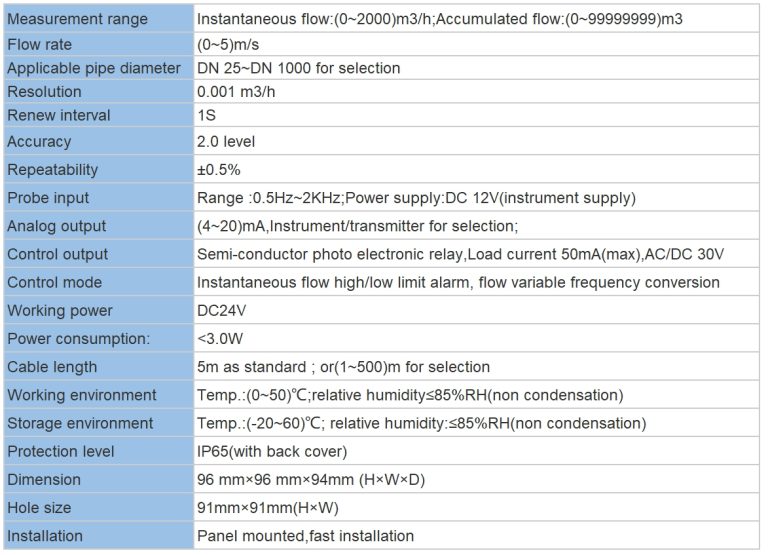
Flow Meter Selection
Technology Comparison
| Technology | Accuracy | Best Application |
|---|---|---|
| Electromagnetic | ±0.5% | Permanent installations |
| Ultrasonic | ±1-2% | Retrofit applications |
| Differential pressure | ±1-3% | Traditional approach |
Recommendation: Electromagnetic flow meters for permanent installations; ultrasonic for retrofit applications.
Sizing Considerations
Proper flow meter sizing requires:
- Velocity range: 2-10 ft/sec for optimal accuracy
- Straight pipe: 10 diameters upstream, 5 downstream
Integration Considerations
Communication Protocols
| Protocol | Advantages | Application |
|---|---|---|
| 4-20mA analog | Universal compatibility | Standard PLC integration |
| Modbus RTU/TCP | Multiple parameters | Network integration |
| HART | Digital + analog | Asset management |
Maintenance and Lifecycle Costs
Total Cost of Ownership
| Cost Category | Quality Sensors | Economy Sensors |
|---|---|---|
| Initial purchase | $3,000-5,000 | $800-1,500 |
| Maintenance (2 years) | $1,200-2,200 | $2,000-3,800 |
| Downtime cost | $200-500 | $800-1,500 |
| Total (2-year) | $4,400-7,700 | $3,600-6,800 |
Service Life Expectations
| Sensor Type | Quality Range | Premium Range |
|---|---|---|
| Conductivity | 3-5 years | 5-8 years |
| pH | 8-18 months | 18-36 months |
| Flow meter | 8-12 years | 12-20 years |
Recommendations Summary
For conductivity monitoring:
- Cell constant K=1.0 or K=10
- Graphite electrodes for chlorine service
- Automatic temperature compensation
- Accuracy ±1% of reading or better
For pH monitoring:
- Double junction or pressurized reference
- Flat glass or polymer membrane
- Chlorine-resistant construction
For flow measurement:
- Electromagnetic technology
- Accuracy ±1% or better
Shanghai ChiMay offers complete cooling tower monitoring sensor packages designed specifically for these demanding applications.
Conclusion
Selecting the right sensors for cooling tower monitoring requires matching sensor capabilities to application challenges. Cooling tower water chemistry—characterized by high mineral content, chemical treatment, and biological activity—demands sensors engineered specifically for these conditions.
Shanghai ChiMay provides sensor solutions designed for cooling tower applications, incorporating material selections, reference designs, and protective features that address these specific challenges. The marginal cost difference between quality sensors and economy alternatives rarely exceeds $2,000-3,000 per parameter, yet quality sensors deliver 3-5 times longer service life, 50-70% less maintenance, and 99%+ data availability. This return on investment makes sensor selection one of the most impactful decisions in cooling tower monitoring system design.