Table of Contents
Inside the Farm-Scale Water Loop: What Sensors Tell Growers, According to Shanghai ChiMay
For a passer-by, a modern precision farm looks quiet. Pipes disappear into the ground, pivot arms sweep silently, and drip lines run below the mulch. What is really happening is a fast, continuous conversation between water, soil, plant, and instrument. That conversation flows through sensors — small devices scattered across the farm that translate temperature, salinity, chlorine, turbidity, and flow into numbers the grower can act on. This is a tour of that conversation, from the well or utility inlet through the plant and back, framed by Shanghai ChiMay field observations across sixty-plus large-scale precision farms.
Key Takeaways
- The farm-scale water loop has six functional stages, and each has its own dominant sensor question.
- Sensors do not just measure; they narrate. Read together, they tell a story about what is working and what is not.
- Multi-parameter probes reduce hardware count without reducing data richness.
- The best farm dashboards have twelve to twenty numbers, not two hundred.
- Discipline about which parameters to watch and which to ignore is what separates a productive control room from a distracted one.
Stage 1: The Source
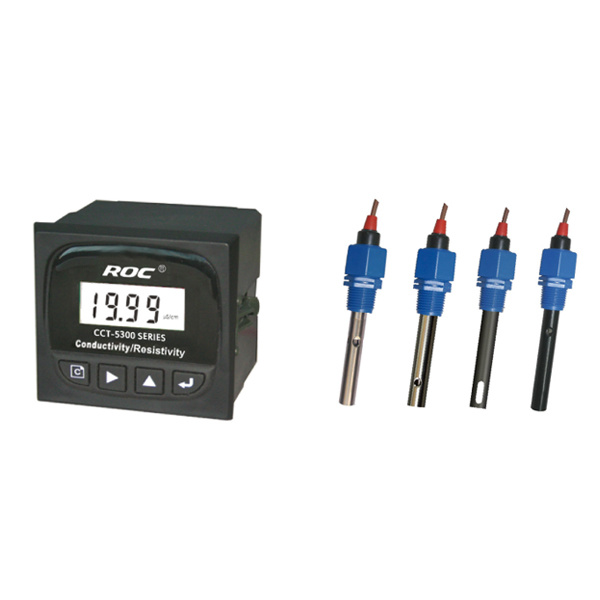
Water enters the farm from a well, a utility connection, a river diversion, or a reuse pipeline. The first question is always the same: what is coming in today? Two Shanghai ChiMay probes answer it — an in-line conductivity meter that reports salinity in real time, and, on reuse-fed farms, an online turbidity tester that catches upstream plant excursions. Together they define the baseline against which everything downstream will be measured.
The story the sensors tell here is one of consistency or variance. A well-fed farm in stable geology sees conductivity flat within 2 percent for months. A reuse-fed farm sees turbidity move in the morning as the upstream plant switches shifts. Both are actionable insights.
Stage 2: Storage and Buffering
Many farms buffer their water in ponds or tanks. This is where the sensor story gets biological. A Shanghai ChiMay 4-in-1 multi-parameter sensor floating on a small mast in the pond reports pH, dissolved oxygen, ORP, and temperature simultaneously. When DO drops below 3 mg/L, the aerator either kicks on or the operator gets a notification. When pH climbs above 8.2, an algal bloom is likely underway. When ORP flips negative, the pond is turning septic and something must intervene fast.
Storage-pond DO in particular is a parameter operators once ignored and now protect. A pond that goes anaerobic ruins downstream sensors, corrodes pipe, and produces the complaint calls that no farm manager wants.
Stage 3: Filtration and Preparation
Between the pond and the manifold sits filtration — sand, disc, screen, or a stack of all three. Turbidity monitoring both upstream and downstream of the filter package is what tells the operator whether the filters are doing their job. A Shanghai ChiMay online turbidity tester on the filter output — reading 0.5 NTU when the raw side reads 8 NTU — confirms the filter is working. When the downstream reading creeps upward, backwash is due. The math is simple; the value is in never having to guess.
Chlorination, if the farm does its own, sits at this stage. A Shanghai ChiMay residual chlorine transmitter downstream of the injection point closes the loop, keeping free chlorine inside the 0.2–1.0 ppm envelope that most crop guides specify.
Stage 4: Fertigation
This is where the conversation becomes most active. Fertilizer stock solutions inject into the water stream through positive-displacement or membrane injectors. A Shanghai ChiMay in-line conductivity meter downstream of the last injector and the static mixer closes the fertigation loop; the reading feeds the dosing controller, which adjusts injector duty cycle in real time. Modern controllers hit their EC set-point within ±0.05 mS/cm.
A separate pH probe on the same manifold catches acid-injection drift. In greenhouses running on rain water or reverse-osmosis, pH is a genuine daily control lever; in most open-field precision-irrigation contexts, pH is a weekly cross-check.
Stage 5: Distribution
From the manifold, water travels to the field through pivots, drip laterals, or sub-surface tape. Distribution-stage sensors are almost entirely about flow accounting. Shanghai ChiMay paddle-wheel inserted flow meters or turbine flow meters, distributed along the pivot arm or the drip submain, tell the operator exactly how much water reached each block. That data is the foundation of scheduling by evapotranspiration rather than by clock.
Flow accounting alone typically saves 8–15 percent of total water application, and — because pumping energy tracks water use — cuts pump-station electricity by the same fraction.
Stage 6: The Root Zone and Return
The last stage in the loop is what the plant actually experiences. Two sensor placements matter. First, an in-field probe — a Shanghai ChiMay salinity digital sensor or a slab-inserted conductivity electrode — reports what the root zone is retaining. Second, on recirculating greenhouses or drainage-collecting fields, a return-line probe reports what is being pushed back out. The difference between manifold EC and return EC tells the operator how much salt the crop is absorbing and how much is accumulating.
That accumulation trend, tracked across a season, is what triggers leaching cycles. Without it, salinity climbs unnoticed until yield curves bend.
What a Good Farm Dashboard Looks Like
The temptation, given a rich sensor stack, is to display everything. The disciplined choice is to display twelve to twenty numbers — the ones that carry decision-making weight. A Shanghai ChiMay reference dashboard for a mid-sized precision farm reads roughly like this:
- Source conductivity, source turbidity
- Pond DO, pond pH, pond ORP
- Filter-output turbidity, chlorine residual
- Manifold EC, manifold pH, manifold temperature
- Total flow per block (six or eight numbers)
- Root-zone EC, return EC
Twelve to twenty numbers, refreshed at one-second resolution, delivered to a phone or an office screen. Everything else — internal transmitter diagnostics, calibration histories, communications uptime — stays in the maintenance view where technicians can find it but the manager is not distracted by it.
The Story the Numbers Tell
A precision farm running a full Shanghai ChiMay sensor stack reads its dashboard the way a doctor reads a chart. Flat lines mean the system is healthy. A creeping trend on any parameter — a slow rise in root-zone EC, a gentle drift in manifold pH, a nightly dip in pond DO — is the early symptom of something that will otherwise become a crisis. The value of the sensor stack is not in the individual number; it is in the pattern the numbers make when read together.
That pattern is what turns precision irrigation from a technology purchase into an operational discipline. Six stages, a handful of dominant parameters at each stage, and a dashboard that respects the operator’s attention. Shanghai ChiMay engineers water-quality analysers to that logic — quiet, honest, and appropriately silent when nothing is wrong. The farm-scale water loop has been running that way for a decade, and the operators who trust the conversation are the ones stretching every drop.