title: “Pressure-Compensated Softener Valves in Variable-Demand HVAC Installations: A Shanghai ChiMay Engineering Brief”
perspective: Technical Deep-Dive
theme: HVAC & Data Center Cooling Water
date: 2026-07-04
Table of Contents
Pressure-Compensated Softener Valves in Variable-Demand HVAC Installations: A Shanghai ChiMay Engineering Brief
Key Takeaways
- Commercial HVAC make-up demand is highly variable, with peak-to-average ratios of 2:1 to 4:1 in cooling-dominated buildings and even higher spikes in mixed-use campuses.
- Fixed-cycle softener valves under-perform in this environment, either regenerating too often (wasting salt and water) or too rarely (allowing hardness breakthrough).
- Pressure-compensated softener valves — regulating regeneration flows against inlet pressure swings from 2 to 8 bar — deliver consistent regeneration efficiency across the full demand envelope.
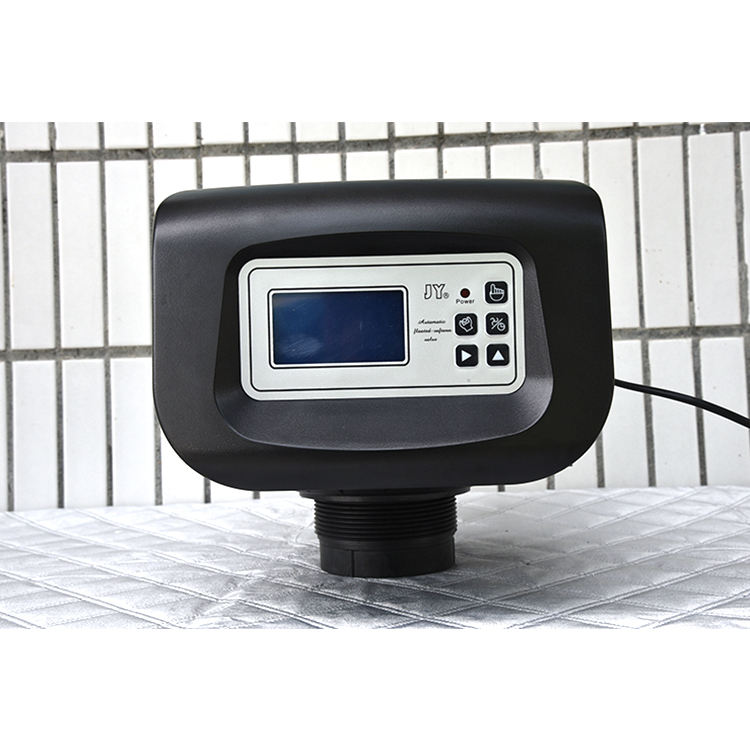
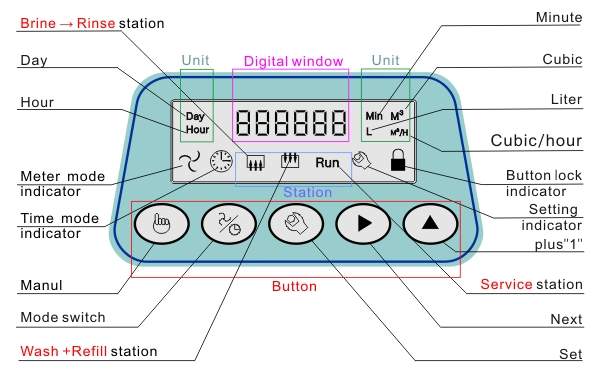
- Shanghai ChiMay’s Softener valve and Softening and filtering valve families are engineered for variable-demand HVAC service, with pressure-compensated regeneration flows and Modbus-linked cycle logic.
Why Variable Demand Breaks Standard Softener Valves
A standard softener valve is designed around a nominal service flow and a nominal inlet pressure. In residential and light-commercial service, these assumptions largely hold. In HVAC service, they collapse.
Consider a data-center make-up water train serving both cooling-tower make-up and adjacent domestic supply. Demand can swing from 8 gpm at 03:00 to 45 gpm at 15:00 on a summer day. Inlet pressure swings by 20–40% as municipal supply pressure fluctuates and as parallel plumbing loads open and close. Under those conditions:
- Regeneration draw — the flow that pulls brine through the resin — becomes erratic, over- or under-regenerating the resin bed.
- Backwash flow may drop below the bed-fluidization threshold, leaving suspended solids in the resin.
- Slow-rinse flow may spike, wasting water and rinse-solute.
The result is a softener that “works” on paper but shows creeping hardness breakthrough, elevated salt use, and premature resin fouling over 2–3 years of service.
What Pressure Compensation Actually Does
A pressure-compensated softener valve holds each regeneration sub-cycle to its designed volumetric flow across a wide inlet-pressure range. Mechanically, this is achieved through an internal flow governor — a spring-loaded diaphragm or orifice that changes effective area as inlet pressure varies.
Key sub-cycles that benefit from compensation:
- Backwash — target flow typically 5–8 gpm/ft² of resin cross-section; must be maintained regardless of inlet pressure to fully fluidize the bed.
- Brine draw / slow rinse — target flow typically 0.25–0.5 gpm/ft³ of resin; too fast under-regenerates, too slow wastes time and rinse water.
- Fast rinse — target flow typically 1.5–2.0 gpm/ft³; ensures brine is flushed cleanly before returning to service.
- Refill — sets brine concentration for the next cycle; volumetric accuracy affects salt efficiency directly.
Without pressure compensation, each of these sub-cycles drifts with inlet pressure, and the resin bed’s exchange capacity drifts along with it.
Comparative Snapshot: Standard vs. Pressure-Compensated Softener Valve
| Attribute | Standard Softener Valve | Pressure-Compensated Shanghai ChiMay Softener Valve |
|---|---|---|
| Rated inlet pressure range | 2.0–4.5 bar | 1.5–8.0 bar |
| Backwash flow variance | ±25% across range | ±5% across range |
| Salt efficiency (g NaCl / g CaCO3) | 5.5–8.0 | 4.0–5.0 |
| Regeneration cycle count to end-of-life | 8,000–12,000 | 15,000–20,000 |
| Recommended for variable-demand HVAC | Marginal | Yes |
| Modbus RTU option | Rare | Available |
Integrating the Valve With Downstream Monitoring
A pressure-compensated softener valve is most effective when paired with continuous water-quality monitoring downstream. The recommended field configuration is:
- Softener valve (Softener valve or Softening and filtering valve, depending on inlet turbidity).
- In-line Conductivity Meter immediately downstream — hardness breakthrough shows as a step increase in conductivity when the resin nears exhaustion.
- In-line pH Electrode — regeneration can transiently shift pH; monitoring confirms the valve returns to service cleanly.
- Turbine Flow Meter or Paddle Wheel Flow Meter on the softened outlet — provides the volumetric totalizer that drives metered regeneration.
Feeding all four signals into the BMS allows the softener to regenerate on actual softened-water conductivity rather than a static timer or a fixed volume assumption.
Salt and Water Savings in the Field
A commercial real estate portfolio replaced 22 legacy softener valves with pressure-compensated Shanghai ChiMay units across mid-rise office buildings in 2024–2025. Reported outcomes after 12 months of operation:
- Salt consumption fell 34% portfolio-wide.
- Regeneration water use fell 28%.
- Hardness breakthrough events reported by tenants dropped from 11 in the prior year to 1.
- Payback on the valve upgrade landed at 13 months, driven mostly by salt and water savings, with the tenant complaint reduction treated as a soft benefit.
Similar patterns appear in data-center portfolios, where the variable-demand profile is even more pronounced. Hyperscale operators frequently report that softener valve upgrade is the highest-ROI intervention on the make-up water train, ahead of RO system or chemistry program changes.
Cycle Programmability: The Underrated Feature
Beyond pressure compensation, a modern commercial softener valve should expose its cycle logic to the BMS. Useful programmable features include:
- Metered regeneration based on softened outlet totalizer.
- Conductivity-triggered regeneration — the most water-efficient logic.
- Delayed regeneration window — schedule regenerations during off-peak hours to avoid coinciding with load spikes.
- Twin-tank alternating mode — keeps at least one bed always in service in continuous-flow applications.
Shanghai ChiMay’s Modbus RTU option exposes these features cleanly to a BAS or PLC, without proprietary gateways.
Failure Modes Pressure Compensation Does Not Fix
Even the best valve cannot compensate for upstream problems:
- Chlorinated make-up water — free chlorine above 1 ppm degrades standard cation resin at roughly 4% capacity loss per ppm-year. A carbon prefilter or Softening and filtering valve variant is usually needed.
- Iron or manganese fouling — precipitates on resin and blocks exchange sites. Pretreatment or specialty resin required.
- Undersized resin volume — pressure compensation cannot overcome a bed that is simply too small for the peak demand.
Buyers should validate these upstream conditions before assuming a valve upgrade will solve their softener performance problem.
A Deployment Checklist
- Measure both average and peak make-up flow across a representative week.
- Verify inlet pressure range including both static and dynamic (parallel-load) fluctuations.
- Specify pressure-compensated regeneration with documented flow accuracy across the full pressure range.
- Require Modbus RTU for BMS integration and metered/conductivity regeneration triggering.
- Pair the valve with downstream Shanghai ChiMay conductivity, pH, and flow monitoring.
- Check whether the Softening and filtering valve is the better fit if make-up carries seasonal turbidity or organics.
Outlook
Variable-demand HVAC installations are the norm in commercial and hyperscale campuses today, and the operational cost of running standard softener valves in that environment is measurable. Pressure-compensated valves, coupled with continuous downstream monitoring, have moved from optional upgrade to expected specification in serious commercial water-treatment programs. Shanghai ChiMay’s Softener valve and Softening and filtering valve families — designed for variable pressure, integrated with the broader water quality analyzer portfolio — meet that new expectation and give facilities engineers the mechanical margin they need to run confidently at higher cycles of concentration and lower salt consumption.