Table of Contents
Key Takeaways
- Industrial IoT sensor deployments in water utilities grew 34% in 2025, with average facilities now operating 450+ sensors compared to 180 in 2020
- Data latency below 5 seconds is achievable for 89% of sensor-to-platform connections, enabling real-time process control applications
- OPC-UA has emerged as the dominant protocol, adopted by 76% of new industrial IoT installations in the water sector
- Edge computing reduces cloud data transmission by 70-85% while maintaining sub-second latency for critical analytics
The promise of digital twin technology for water treatment depends fundamentally on the quality, reliability, and timeliness of data flowing from field instrumentation into virtual models. Sensor networks represent the nervous system of digital twin deployments—without comprehensive, accurate, and timely data, even the most sophisticated simulation engines produce unreliable predictions. Understanding the technical landscape of sensor integration is essential for engineers designing and operating modern water treatment facilities.
The Evolving Sensor Landscape
Instrumentation Density Trends
Modern water treatment facilities are experiencing dramatic increases in instrumentation density. The drive toward digital transformation has motivated utilities to deploy sensors at unprecedented density, enabling finer visibility into process behavior.
The International Water Association's 2026 Smart Infrastructure Survey documents average sensor counts of 450 per facility for utilities with mature digital programs, compared to 180 sensors in 2020—a 150% increase in five years. This growth reflects both expansion of traditional parameter monitoring and adoption of new sensor categories including acoustic sensors for leak detection, spectroscopic analyzers for organic carbon measurement, and particle counters for particle size distribution characterization.
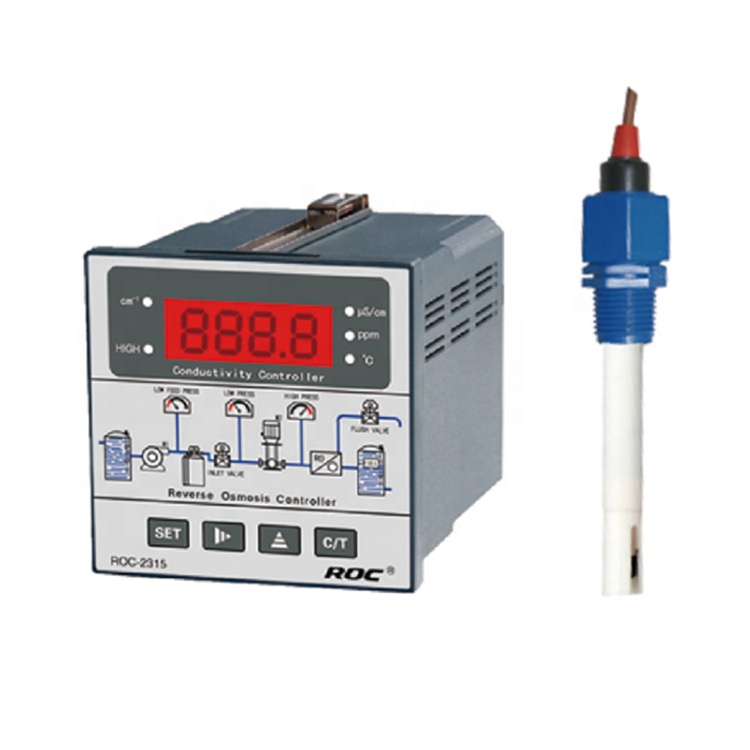
ChiMay's multi-parameter sensors exemplify the density trend, with 4-in-1 sensors measuring pH, ORP, conductivity, and temperature from a single installation point. This approach reduces deployment complexity while providing correlated measurements that support cross-validation and process insight.
Emerging Sensor Technologies
Technology evolution continues expanding the analytical frontier for water treatment monitoring.
In-situ spectroscopic analyzers using UV-visible absorbance, fluorescence, or Raman spectroscopy provide real-time measurements of organic contaminants, nutrients, and specific chemical species without sample extraction or reagent consumption. These instruments enable monitoring previously requiring laboratory analysis.
Microelectromechanical systems (MEMS) sensors based on miniaturized mechanical structures offer new capabilities for pressure, flow, and acoustic measurement at reduced cost and size. MEMS-based ultrasonic flow meters achieve ±1% accuracy at one-tenth the cost of traditional Doppler instruments.
Electrochemical sensor arrays using selective membranes enable multi-analyte detection from compact platforms. Modern multi-parameter water quality monitoring platforms incorporate 8-12 discrete sensing elements for comprehensive water characterization.
Biosensors employing biological recognition elements—enzymes, antibodies, or whole cells—provide highly specific detection for emerging contaminants including cyanotoxins, pharmaceuticals, and antibiotic resistance genes. While still emerging, biosensor technology is advancing rapidly with 23% annual market growth according to BCC Research's 2026 Biosensor Market Analysis.
Communication Protocols and Architecture
Industrial Protocol Evolution
The protocol landscape for water treatment sensor networks continues evolving toward open, secure, and information-rich standards.
OPC Unified Architecture (OPC-UA) has emerged as the dominant protocol for industrial data exchange, now adopted by 76% of new water sector installations according to OPC Foundation's 2026 Adoption Report. OPC-UA provides platform independence, built-in security, and comprehensive information modeling capabilities that address earlier protocol limitations.
Key advantages of OPC-UA for water treatment applications include:
- Platform independence: Operating system and hardware agnostic, enabling integration across diverse vendor equipment
- Information modeling: Standardized data structures for common water treatment parameters reduce integration effort
- Security: Built-in authentication, encryption, and audit logging address cybersecurity requirements
- Scalability: Supports everything from simple sensors to complex multi-plant SCADA systems
MQTT (Message Queuing Telemetry Transport) has gained strong adoption for IoT sensor applications where bandwidth efficiency and publish-subscribe patterns add value. MQTT's lightweight overhead makes it particularly suitable for battery-powered remote sensors and cellular-connected devices where data costs matter.
Modbus protocols—particularly Modbus TCP for Ethernet networks—remain widely deployed due to historical ubiquity and simplicity. While lacking the feature richness of OPC-UA, Modbus provides acceptable functionality for basic monitoring applications.
Network Architecture Considerations
Sensor network architecture must balance competing requirements for bandwidth, latency, reliability, and security.
Hierarchical architectures organize sensors into field area networks feeding into plant-level networks, which connect to enterprise systems. This structure provides logical separation of concerns and enables independent scaling of each layer.
Ring and mesh topologies provide redundancy that maintains connectivity when individual links fail. Siemens' 2026 Network Reliability Study found that mesh-connected sensors achieve 99.97% availability compared to 99.2% for star topologies, critical for applications requiring continuous monitoring.
Time-sensitive networking (TSN) standards enable deterministic, low-latency communication over standard Ethernet infrastructure, supporting real-time control applications that previously required proprietary industrial networks. TSN adoption is accelerating with 34% annual growth in water sector deployments.
Edge Computing Paradigm
The Edge Computing Value Proposition
Edge computing—processing data near its source rather than transmitting to centralized locations—has become essential for effective sensor integration.
Latency reduction represents the primary edge computing driver for water treatment applications. Local processing can achieve sub-millisecond response times compared to 50-200ms for cloud-round-trip architectures. This difference is critical for closed-loop control applications where delays compromise stability.
Bandwidth optimization reduces telecommunications costs and congestion by processing data locally, transmitting only summary information and exception conditions to central systems. Gartner's 2026 Edge Computing Analysis documents average bandwidth reduction of 70-85% for edge-processed sensor data.
Resilience improvement ensures continued operation during connectivity interruptions. Edge devices can maintain local monitoring and control functions even when cloud connections are unavailable, preventing data gaps and control interruptions.
Edge Platform Capabilities
Modern edge computing platforms provide substantial analytical capability in compact, industrial-grade form factors.
Industrial edge servers from vendors including Cisco, Dell, Siemens, and Schneider Electric provide 8-16 core processing capacity, 32-128 GB memory, and terabyte-scale local storage in fanless, DIN-rail mountable packages suitable for control room and field installation.
Edge software platforms including Azure IoT Edge, AWS Greengrass, and open-source solutions provide containerized application deployment, device management, and local data processing capabilities. These platforms enable consistent application behavior whether deployed at edge or cloud locations.
Protocol gateway functions aggregate data from diverse sensors using legacy protocols, perform translation to modern standards, and present unified data streams to downstream applications. Edge gateways typically support 20-50 sensor connections per device.
Edge-Cloud Coordination
Effective architectures coordinate edge and cloud resources to leverage the strengths of each.
Hierarchical processing assigns analytical tasks based on latency requirements and computational complexity. Real-time control and safety-critical analytics run at the edge; trend analysis and optimization across multiple facilities run in the cloud.
Data synchronization maintains consistency between edge and cloud data stores despite potential connectivity interruptions. Time-series databases designed for distributed operation—including InfluxDB, TimescaleDB, and OSIsoft PI—provide built-in synchronization capabilities.
Model deployment distributes trained machine learning models across edge and cloud locations. Inference requiring immediate response runs locally; training and model updates requiring large computational resources run in cloud environments.
Data Quality Assurance
Automated Quality Management
Raw sensor data inevitably contains errors, gaps, and anomalies that must be addressed before use in digital twin applications.
Statistical process control methods monitor sensor readings against established baselines and variance limits. Readings exceeding 3-sigma limits trigger investigation, while those exceeding 2-sigma limits receive lower confidence weighting in aggregation.
Physical consistency checking evaluates relationships between related parameters. For example, conductivity and total dissolved solids correlate within predictable ranges; readings showing TDS inconsistent with measured conductivity suggest sensor malfunction.