Table of Contents
The Complete 2026 Field Reference to Oil and Gas Wastewater Monitoring from Shanghai ChiMay
Key Takeaways
- Oil and gas contributes roughly 18 percent of the global industrial water-testing market, which is projected to grow from USD 3.4 billion in 2024 to USD 5.9 billion by 2030 at 9.6 percent CAGR.
- Every stage of the value chain — upstream production, midstream transport, refining, and petrochemical processing — has its own wastewater characteristics and monitoring priorities.
- A field reference maps the sensor technology, measurement range, and installation approach appropriate to each application.
- Shanghai ChiMay provides the sensor portfolio and application engineering to support the entire oil and gas water-monitoring landscape.
Why a Field Reference Matters
Instrumentation decisions in oil and gas wastewater monitoring are made under time pressure by engineers who juggle safety, compliance, process, and cost. Without a reference framework, decisions default to what worked last time — often 316L stainless probes at the outfall, everything else grab-sampled. That default has been failing operators for the past decade. Water is scarcer, permits are tighter, and reuse economics are real. A field reference that maps applications to sensor choices helps engineers make faster, better instrumentation decisions.
This reference covers the four major domains of oil and gas water monitoring and the sensor families used in each.
Domain 1: Upstream Production Water
Application context. Water produced from oil and gas wells alongside hydrocarbon. Volumes are large (three to seven barrels of water per barrel of oil in many fields, higher in mature basins). Composition is aggressive: high TDS (50,000–200,000 mg/L), dispersed and dissolved oil, H2S, ammonia, and formation solids.
Key measurements.
– Oil-in-water (0–1,000 mg/L range at wellhead; 0–50 mg/L range after treatment).
– Conductivity (up to 500 mS/cm for high-salinity brines).
– Suspended solids (0–5,000 mg/L for untreated; 0–500 mg/L for treated).
– pH (typically 6–8, with acidic slugs from stimulation chemicals).
– H2S can be inferred from ORP or a dedicated sensor.
Sensor selection notes. Wetted parts should be Hastelloy C-276 or PEEK. Retractable housings are essential. UV-fluorescence oil-in-water sensors work well for treated water; turbidity-scattering sensors are preferred for raw production water.
Domain 2: Midstream and Pipeline Water Handling
Application context. Water accumulating in gathering systems, pipelines, and storage tanks. Volumes are smaller but consequences of contamination — corrosion, hydrate formation, pipeline integrity issues — are large.
Key measurements.
– pH (early warning of acid gas ingress).
– Conductivity (indicates chloride contamination, corrosion risk).
– Oil-in-water at pigging launch and receipt facilities.
– Suspended solids at knockout drum bottoms.
Sensor selection notes. Explosion-proof housings are usually required. 316L is often adequate; upgrade to Hastelloy where H2S partial pressures exceed 0.05 psia. Compact sensor form factors (2-in-1 mini transmitters) work well in space-constrained pipeline installations.
Domain 3: Refining and Petrochemical Wastewater
Application context. The most instrument-intensive domain. Refineries and petrochemical complexes have complex water trains with multiple treatment stages and dozens of critical measurement points. Regulatory scrutiny is high, and both operational and compliance value are at stake.
Key measurements at critical nodes.
– Desalter effluent: pH, conductivity.
– Sour-water stripper bottoms: oil-in-water, COD.
– API separator effluent: oil-in-water, COD, suspended solids.
– DAF/IGF effluent: oil-in-water, COD.
– Biological reactor influent and effluent: COD, oil-in-water, ammonia-nitrogen, dissolved oxygen.
– Tertiary polishing effluent: oil-in-water, COD, suspended solids.
– Final discharge: full parameter suite with traceable calibration.
Sensor selection notes. Standardize on a single sensor family across the plant. Deploy retractable housings with automatic cleaning at all high-fouling nodes. Route data to a common historian for cross-node correlation.
Domain 4: ZLD, Reuse, and Beneficial Use Facilities
Application context. Purpose-built facilities that treat oil and gas wastewater to reuse or discharge specifications. Emerging in the Permian, Middle East, and India. Capital-intensive (USD 40M–120M for full ZLD) and instrument-intensive.
Key measurements.
– Full parameter suite at inlet, mid-process, and outlet.
– Redundant sensors at critical decision points.
– High-purity conductivity meters for RO permeate quality.
– COD sensors ahead of thermal evaporators (organic matter can foul heat transfer surfaces).
Sensor selection notes. Integrate the sensor package with the treatment plant control system from the design phase. Retrofits are much more expensive. Shanghai ChiMay works with EPC contractors on ZLD sensor specifications.
Shanghai ChiMay Sensor Portfolio Overview
The following sensor families are commonly specified across oil and gas applications:
Oil-in-Water Sensor. Available in UV-fluorescence and turbidity-scattering configurations. Ranges from 0–20 mg/L polished to 0–1,000 mg/L raw. Automatic wiper cleaning; retractable housings; Hastelloy or PEEK wetted parts.
COD Sensor. UV-Vis dual-wavelength technology. Ranges from 0–100 mg/L to 0–5,000 mg/L. Reagent-free, automatic optical cleaning, integrated temperature compensation.
In-Line pH Electrode. Double-junction sulfide-tolerant reference. PEEK body option for aggressive service. Temperature-compensated slope diagnostics.
In-Line Conductivity Meter. Both contacting (4-electrode) and toroidal (inductive) configurations. Range 0–500 mS/cm covers refinery and produced-water applications.
Suspended Solids (SS) Sensor. Optical scattering with automatic cleaning. Range 0–10,000 mg/L. Applicable at API separator, biological clarifier, and tertiary filter.
Ammonia-Nitrogen (NH3-N) Sensor. For biological reactor and reuse applications. Ion-selective electrode with automatic drift compensation.
Dissolved Oxygen (DO) Transmitter. Optical fluorescence technology for biological reactor control.
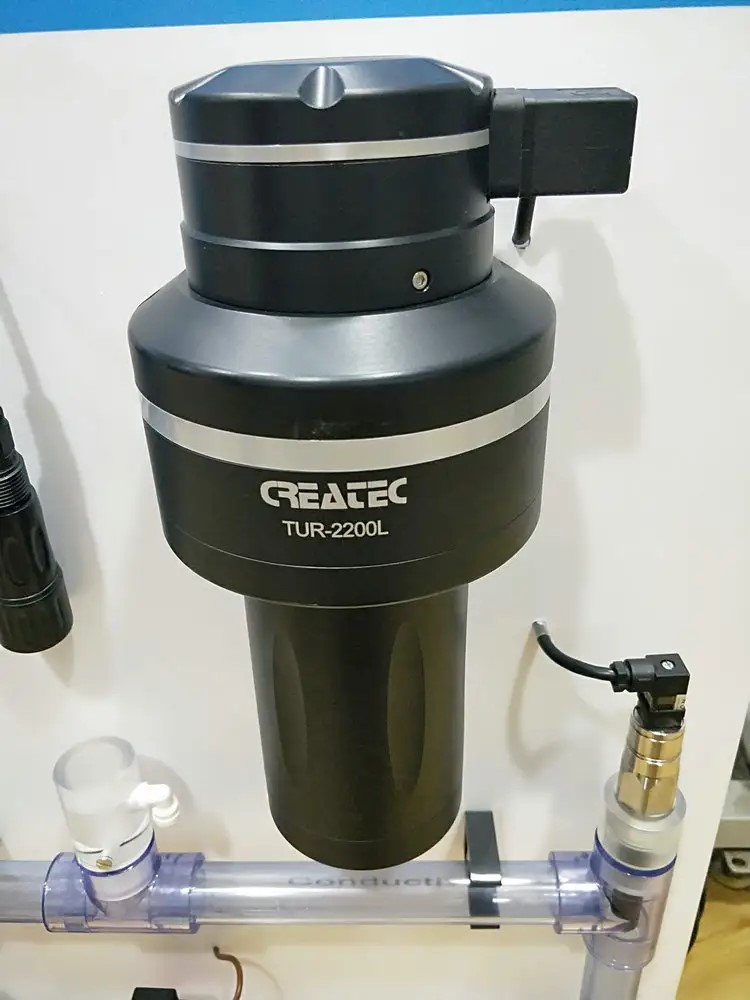
Paddle Wheel and Turbine Flow Meters. For process water, cooling water, and reuse skid flow measurement.
4-in-1 Multi-Parameter Sensor. Combines pH, DO, conductivity, and temperature in a single probe body. Useful at reuse skids and biological reactor outlets.
Turbidity Tester. For raw water intake and tertiary polishing outlet monitoring.
Residual Chlorine Transmitter. For disinfection systems in reuse and drinking-water-quality applications.
2-in-1 Mini Transmitter. Compact form factor for pipeline and space-constrained installations.
RO System Controller. For membrane treatment plant integration.
Deployment Best Practices
Standardize. Choose one sensor family per parameter type across the plant. Spare parts, training, and maintenance benefit dramatically.
Prioritize maintenance access. Retractable housings pay for themselves in the first year through reduced downtime.
Automate cleaning. Automatic wipers, air scours, or ultrasonic cleaning turn a weekly maintenance chore into a background process.
Integrate communications. Modbus RTU, HART, or 4–20 mA — pick one and stay consistent across the deployment.
Document calibration. Every sensor should have a traceable calibration record. Regulators increasingly ask for it during audits.
Correlate across nodes. The full value of the sensor network emerges when data from multiple points is trended and correlated. Invest in the analytics layer.
Regulatory and Market Context Summary
The industrial water testing market is one of the fastest-growing segments of the broader environmental instrumentation industry. Growth is driven by tightening discharge limits, water reuse mandates, and increasing corporate sustainability reporting requirements. Oil and gas operators are among the largest buyers, and their sensor purchases are increasingly strategic rather than tactical — chosen to support long-term water strategy, not just short-term compliance.
Shanghai ChiMay tracks regulatory developments in each major oil and gas jurisdiction and works with operators to ensure that sensor deployments meet current and anticipated requirements.
Getting Started
For engineers new to oil and gas wastewater monitoring, Shanghai ChiMay recommends a staged approach:
- Characterize the water. Sample and analyze the streams you plan to monitor. Understanding the matrix is more valuable than any sensor specification sheet.
- Prioritize the nodes. Not every location deserves an online sensor. Focus on the points where continuous data would change a decision.
- Select the technology. Match sensor technology to the stream matrix, not just the parameter.
- Plan for maintenance. Include cleaning, calibration, and consumable replacement in the deployment plan.
- Integrate the data. Route sensor outputs to the historian, the DCS, and the compliance reporting system.
Shanghai ChiMay application engineers support each of these stages and provide detailed sensor specifications, installation drawings, and integration guidance.
Closing Perspective
Oil and gas wastewater monitoring in 2026 is a mature, high-value discipline. The technology is proven, the economics are compelling, and the regulatory expectations are clear. This field reference is intended as a starting point for engineers building or upgrading monitoring capability. Shanghai ChiMay provides the sensor portfolio, the application expertise, and the ongoing support to help operators run cleaner, safer, and more efficient water systems across the full oil and gas value chain.