Table of Contents
Key Takeaways
Introduction
Water softening systems remove calcium and magnesium ions—the primary cause of scale formation and water hardness—through an ion exchange process. The effectiveness and efficiency of these systems depends critically on the control valve managing the softening process.
The control valve directs water flow through the softener vessel, initiating regeneration cycles at appropriate times, and managing the complex sequence of backwash, brine draw, slow rinse, and fast rinse steps. A poorly selected or malfunctioning valve undermines softening performance, wastes water and salt, and creates operational problems.
This guide examines water softener valve types, selection criteria, and implementation considerations to help facility managers make informed decisions.
Understanding Water Softening Basics
The Ion Exchange Process
Water softening operates through ion exchange where calcium and magnesium ions in the water are replaced with sodium ions from the exchange resin:
In the softening vessel:
During regeneration:
Understanding Water Hardness
Water hardness is measured in grains per gallon (gpg) or milligrams per liter (mg/L as CaCO₃):
| Hardness Range | Classification | Typical Impact |
|---|
| 0-3 gpg | Soft | Ideal for all uses |
|---|
| 7-10 gpg | Hard | Scale begins forming |
|---|
| >15 gpg | Extremely Hard | Severe scaling, soap inefficiency |
|---|
Regeneration Cycle Steps
Water softener regeneration involves multiple steps:
1. Backwash: Reverses flow to flush accumulated sediment from resin bed
2. Brine Draw: Introduces salt solution to regenerate resin
3. Slow Rinse: Removes excess brine from resin bed
4. Fast Rinse: Flushes remaining brine to drain
5. Brine Refill: Adds fresh water to brine tank for next cycle
Each step has specific flow rates, durations, and purposes that the control valve must manage precisely.
Types of Water Softener Valves
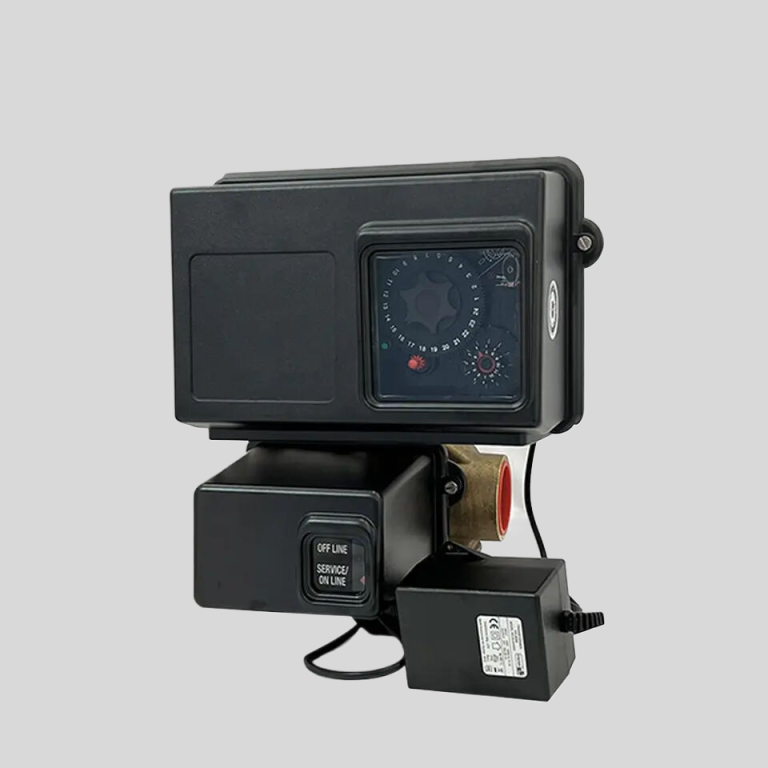
Time Clock Valves
Time clock valves initiate regeneration at predetermined times regardless of actual water use:
Operation: User sets regeneration day (e.g., every 3 days) and time (e.g., 2:00 AM)
Advantages:
Disadvantages:
Best applications:
Meter-Initiated Valves
Meter-initiated valves track water usage and regenerate only when capacity is exhausted:
Operation: Water meter in valve tracks cumulative flow; regeneration triggers when preset volume is reached
Advantages:
Disadvantages:
Best applications:
Demand-Initiated Valves
Advanced demand-initiated valves combine meter control with optimization algorithms:
Operation: Monitors water use patterns and predicts regeneration needs
Advantages:
Disadvantages:
Best applications:
Key Selection Criteria
Flow Rate Requirements
The valve must handle maximum expected flow rates:
Continuous flow: Maximum flow rate the system must support during normal operation
Peak flow: Short-term flow bursts that system must accommodate
| System Size | Typical Flow Rate | Valve Rating Required |
|---|
| Residential (1-2 bathrooms) | 5-8 GPM | 20 GPM minimum |
|---|
| Commercial | 30-60 GPM | 80 GPM minimum |
|---|
Regeneration Capacity
The valve must accommodate regeneration cycles for the resin volume:
| Resin Volume | Brine Required | Regeneration Time | Valve Size |
|---|
| 1 cubic foot | 10-15 lbs salt | 60-90 minutes | 1″ or 1.5″ |
|---|
| 3 cubic feet | 30-45 lbs salt | 120-150 minutes | 2″ |
|---|
Water Quality Considerations
Water quality affects valve selection:
High iron water:
High turbidity water:
Chlorinated water:
Installation Environment
Environmental factors affect valve selection:
Technical Specifications to Evaluate
Valve Body Materials
Valve construction materials affect durability and compatibility:
| Material | Advantages | Limitations |
|---|
| Brass | Durable, corrosion resistant | Higher cost |
|---|
| Polysulfone | Clear body for visual inspection | Limited size options |
|---|
Connection Types
Valve connections affect installation requirements:
Drain Line Requirements
Regeneration drain flow requires proper sizing:
Electrical Requirements
Control valve power requirements vary:
Commercial and Industrial Considerations
Multiple Tank Systems
Larger installations often use parallel softener systems:
Duplex systems: Two tanks alternately provide softened water
Triplex systems: Three tanks for high-demand applications
Layered Control Systems
Industrial applications may require coordinated control:
Salt Efficiency Requirements
Commercial users increasingly focus on salt efficiency:
| Efficiency Level | Salt per Regeneration | Water per Regeneration |
|---|
| Standard | 10-15 lbs/cubic foot | 40-80 gallons |
|---|
| Premium Efficiency | 2-3 lbs/cubic foot | 15-25 gallons |
|---|
Salt efficiency directly affects operating costs. A system using 50% less salt at premium efficiency can reduce annual salt costs by $1,000-$5,000 for commercial installations.
ChiMay Softening Valve Options
SV-100 Single Tank Valve
SV-200 Duplex Valve
SV-300 Industrial Valve
Installation and Startup
Pre-Installation Checklist
Before installing the valve:
Startup Procedure
Proper startup ensures optimal system performance:
1. Verify installation: Check all connections secure
2. Initiate manual regeneration: Cycle through all steps
3. Set regeneration parameters: Time, salt dose, flow rates
4. Program demand settings: Gallons between regenerations
5. Verify operation: Monitor first regeneration cycle
6. Document settings: Record all programming for reference
Operator Training
Ensure operators understand:
Maintenance Recommendations
Regular Maintenance Tasks
| Frequency | Task |
|---|
| Weekly | Check salt level, verify operation |
|---|
| Quarterly | Clean brine tank, check brine draw |
|---|
| As needed | Replace worn components |
|---|
Troubleshooting Common Issues
| Problem | Likely Cause | Solution |
|---|
| Hard water breakthrough | Capacity exhausted, valve malfunction | Verify regeneration cycle, check meter |
|---|
| Continuous drain flow | Valve leak, stuck piston | Inspect and repair valve |
|---|
Conclusion
Water softener valve selection significantly impacts system performance, efficiency, and operating costs. While time-clock valves offer simplicity and lower initial cost, meter-initiated valves provide efficiency advantages that generate ongoing savings.
For commercial and industrial applications, demand-initiated valves with optimization algorithms deliver the highest efficiency while maintaining reliable service. ChiMay’s softening valves provide options across the complexity spectrum, with models supporting everything from residential applications to demanding industrial environments.
Proper installation, programming, and maintenance ensure the selected valve delivers the performance, efficiency, and reliability that justified the investment.