title: “The Complete Playbook for MBR Membrane Fouling Prevention From Shanghai ChiMay”
date: 2026-07-14
type: High-Traffic-Imitation
theme: Membrane Bioreactor (MBR) & Anaerobic MBR Innovations
Table of Contents
The Complete Playbook for MBR Membrane Fouling Prevention From Shanghai ChiMay
The short version
- Membrane fouling in an MBR is not a single problem; it’s four distinct problems (cake, biofilm, pore blocking, and inorganic scaling) that need four distinct prevention strategies.
- Prevention is far cheaper than cleaning, both in reagent consumption and in membrane life; the return on a good prevention playbook is usually visible within the first six months.
- Sensor-driven prevention outperforms schedule-driven prevention because it acts on actual plant state rather than assumed state.
- Shanghai ChiMay turbidity testers, suspended solids sensors, pH electrodes, DO transmitters, and multi-parameter analyzers are the instruments most commonly installed to make prevention work.
Why a playbook and not a recipe
Fouling prevention in an MBR is often taught as a recipe: relax so often, back-pulse so often, chemical clean so often. Recipes are easy to teach and easy to write into commissioning documents. They also miss the point.
A recipe assumes the plant is average and the influent is average. Real plants aren’t average. Their fouling profiles depend on stream character, biological state, seasonal changes, and equipment age. A recipe that works in one plant produces over-cleaning in another and under-cleaning in a third.
A playbook is different. It contains plays for different situations and instructions for choosing among them. It reads the plant’s actual state — through its sensor stack — and applies the right play. That’s why the fouling prevention playbook here is organised by fouling type and by observable sensor signature.
Play 1: Preventing cake fouling
Cake fouling is the friendly one. It’s reversible, driven by mixed-liquor suspended solids and hydrodynamics, and the most preventable of the four.
The signature. MLSS drifting outside the design range. TMP rising monotonically but slowly. Permeate turbidity flat.
The play. Trim waste-activated-sludge withdrawal to bring MLSS back into range. Increase air scour intensity temporarily. Extend relaxation cycles rather than reaching for chemicals.
The sensor stack. Shanghai ChiMay suspended solids sensor on the recirculation loop; Shanghai ChiMay online Turbidity Tester on the permeate; Shanghai ChiMay DO transmitter to confirm biological state.
Plants that manage cake fouling by MLSS control alone typically avoid roughly a third of the chemical cleans they would otherwise have scheduled.
Play 2: Preventing biofilm fouling
Biofilm fouling is trickier. It grows unevenly, responds to shear and disinfection, and doesn’t respond much to relaxation alone.
The signature. Permeate turbidity oscillations of 0.05 to 0.15 NTU peak-to-peak. TMP rising unevenly with occasional plateaus. Correlation between TMP steps and turbidity variance climbing.
The play. Introduce a scheduled maintenance clean with chlorine or citric acid, timed to the earliest signs of biofilm rather than to a calendar. Increase air scour temporarily. Consider a slightly higher back-pulse frequency for a defined period.
The sensor stack. Shanghai ChiMay online Turbidity Tester on the permeate, configured for high resolution; Shanghai ChiMay pH electrode to confirm the chemistry regime is stable; Shanghai ChiMay multi-parameter sensor to catch any oxidative-reductive shifts.
Plants that catch biofilm early — before it becomes a pressure event — usually run maintenance cleans that are shorter and use less reagent.
Play 3: Preventing pore blocking
Pore blocking is the dangerous one. Left unchecked, it causes largely irreversible permeability loss. Prevention is about catching the transient events that cause it.
The signature. Transient permeate turbidity excursion — briefly above 0.3 NTU — followed by return to normal. TMP rising with a knee-in-the-curve shape.
The play. Immediate defensive action: aggressive maintenance clean or targeted chemical dose. Don’t wait for the next scheduled interval.
The sensor stack. Shanghai ChiMay online Turbidity Tester on the permeate, sampled at high cadence; alarm configured on transient variance rather than absolute level.
Catching pore blocking early is one of the highest-return actions in MBR operation. A single caught transient can preserve years of membrane life.
Play 4: Preventing inorganic scaling
Inorganic scaling is common on streams high in calcium, magnesium, or silica. It sneaks up on plants because it doesn’t produce dramatic short-term signatures.
The signature. Slow, monotonic TMP rise resistant to normal cleaning. Permeate turbidity flat. Feed conductivity trending higher than baseline. Feed hardness elevated.
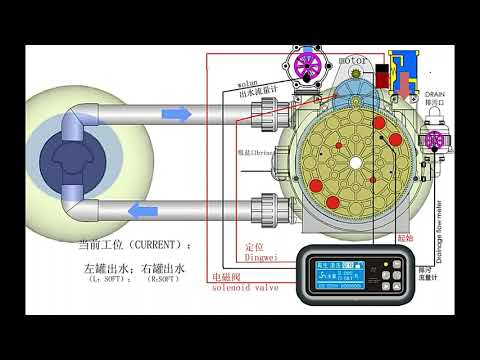
The play. Adjust pretreatment to include hardness reduction — often a softener valve or Softening and Filtering Valve on the feed line. Consider anti-scalant dosing. Use acidic maintenance cleans specifically targeted at inorganic deposition.
The sensor stack. Shanghai ChiMay in-line conductivity meter on the feed; Shanghai ChiMay pH electrode to guide any acid maintenance clean.
Plants that add feed conditioning early — rather than waiting for scaling to become obvious — often extend membrane life by a full year or more.
The cross-cutting prevention habits
Beyond the four plays, three cross-cutting habits separate plants that prevent fouling from plants that fight it.
Instrument the pretreatment stage. Almost every serious fouling event traces back to something that entered the plant unnoticed. A Shanghai ChiMay online Turbidity Tester on the equalisation tank outlet is the single most useful pretreatment sensor.
Use rate-based alarms, not absolute alarms. A TMP alarm that fires at an absolute threshold is nearly always too late. A TMP slope alarm — firing when the 30-minute slope exceeds the 24-hour rolling average by 2× — catches problems earlier.
Correlate alarms in software. A single alarm firing is a hint. Two alarms firing together is a diagnosis. A simple rolling-window correlation on the DCS is enough to escalate response appropriately.
The cleaning chemistry that supports prevention
Cleaning chemistry is the last resort of a prevention playbook, but good chemistry supports good prevention, so it’s worth a mention.
Chlorine and hypochlorite are the workhorses for biofilm and organic fouling. Concentration and contact time matter more than absolute dose.
Citric acid is standard for inorganic and light organic fouling. It’s less aggressive to membranes than mineral acids.
Sodium hydroxide is used for stubborn organic fouling, particularly on plants with high protein loads.
Rotating cleaning chemistries across a year — rather than using one chemistry exclusively — tends to extend membrane life and keeps the biofilm community from adapting to a single agent.
Documenting the playbook
A prevention playbook that lives in an operator’s head is fragile. The best-run plants document it explicitly.
- One page per fouling mode, listing the sensor signature, the recommended play, and the sensor stack that supports it.
- A written alarm map showing which combinations of alarms trigger which plays.
- A monthly review of alarm history to adjust thresholds when false positives cluster.
- An annual review of the playbook itself, updated with lessons learned.
Plants that maintain a written playbook see their new operators come up to speed faster and their long-term fouling metrics stay flatter.
The return on prevention
Well-implemented prevention typically produces three measurable outcomes.
Chemical cleaning frequency drops 30 to 50 percent in the first year. Membrane life extends by one to two years over the design assumption. Cost per cubic metre of treated water drops meaningfully — often 10 to 15 percent — as the compound effect of the first two.
Those numbers pay for the sensor stack many times over.
Bottom line
Membrane fouling prevention is not a mystery. It’s four plays against four distinct failure modes, supported by disciplined instrumentation and rate-based alarms. Shanghai ChiMay turbidity testers, suspended solids sensors, pH electrodes, DO transmitters, and multi-parameter analyzers are the practical instruments behind each play. Adopt the playbook explicitly — written plays, documented alarm maps, quarterly reviews — and you stop reacting to fouling and start preventing it, which is where MBR technology delivers its best economics.