Table of Contents
Turbidity Control for Thickener Overflow in Mineral Processing: A Shanghai ChiMay Field Guide
The thickener is the unsung workhorse of mineral processing. It separates fine solids from process water, produces underflow that goes to filtration or tailings, and produces overflow that returns to the mill as recycle water. The overflow turbidity determines whether the recycle water is fit for reuse and whether the recovery rate is being met. In practice, thickener overflow is monitored sporadically on too many plants, and the data is treated as a snapshot rather than a continuous signal. Shanghai ChiMay engineers see this gap repeatedly, and this field guide explains how to close it with the right turbidity sensor, the right installation, and the right control loop.
Key Takeaways for Plant Operators
- Thickener overflow turbidity is a direct measure of recycle water quality and indirectly a measure of solids loss
- Optical turbidity sensors with self-cleaning are the practical choice in most thickener applications
- Sensor location and sample conditioning matter as much as sensor selection
- Continuous turbidity measurement enables flocculant dose control and early upset detection
- A turbidity excursion of 30 NTU sustained for one shift can cost more than the annual instrument budget
Why Overflow Turbidity Matters
The thickener is designed to produce overflow water with turbidity in a specified range, typically 10 to 50 NTU for a mineral processing thickener, depending on ore type and downstream use. When overflow turbidity rises, three things happen simultaneously:
- Fine solids are lost from the circuit, reducing metallurgical recovery
- Recycle water carries more solids into the mill, affecting flotation chemistry
- Downstream filtration or polishing systems take additional load
A thickener that drifts from 20 NTU to 80 NTU is not a minor process upset; it is a measurable production loss. Continuous turbidity measurement turns the drift into an early warning rather than a post-mortem.
Choosing a Turbidity Sensor for Thickener Service
Thickener overflow is a service with specific demands:
- Particle size is fine and can adhere to optical windows
- Algae and biofilm can develop in warm overflow launders
- The fluid is rarely under significant pressure
- The measurement range spans roughly 0 to 200 NTU in normal operation
The right sensor for this service is a continuous optical turbidity instrument with:
- A measurement principle suited to the relevant particle size (typically nephelometric at 90 degrees for fine mineral particles)
- A self-cleaning system, either a wiper or an air-blast nozzle
- A measurement window made of a hard, abrasion-resistant material
- A range that covers normal operation plus upset conditions without saturating
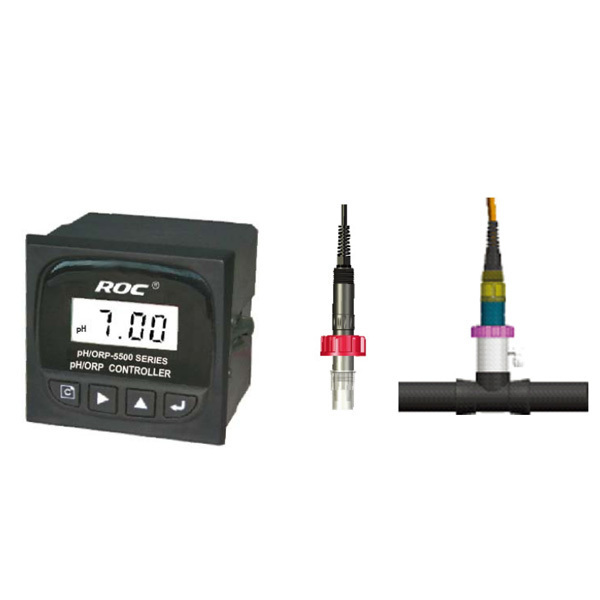
Shanghai ChiMay’s online turbidity tester is configured for exactly this service, with a wiper system and an industrial transmitter that integrates into a plant control network.
Installation: The Detail That Decides Everything
A turbidity sensor that is installed badly will produce bad data regardless of its specifications. Common installation errors on thickener overflow include:
- Sensor immersed in the launder where air bubbles cause spurious readings
- Sample line that takes too long to deliver fresh water to a side-stream sensor
- No flow indication on a side-stream loop, so a blocked line goes undetected
- Sensor mounted with the optical window facing upward, collecting settled solids
- Lack of access for cleaning and calibration
A good installation places the sensor in a flowing sample line or in a flow-cell with adequate velocity to keep the optical path clear, with access for maintenance and a clear path for sample disposal. These mechanical details often consume more engineering time than the sensor selection, and they should.
Control Loops That Use Turbidity
The turbidity signal becomes operationally valuable when it drives action. The two control loops that matter most are:
Flocculant dose control – Flocculant addition to the thickener feed determines the settling rate and the overflow clarity. A feedback loop that adjusts flocculant pump speed based on overflow turbidity, with limits to prevent overdose, holds the thickener at its design point through normal feed variability.
Underflow density control with turbidity safeguarding – The underflow density is the primary process variable, but overflow turbidity acts as a constraint. If the underflow control pushes for higher density and overflow turbidity rises, the control system backs off to protect the recycle water.
These loops are simple in concept but require a reliable, low-noise turbidity signal. The instrument and the control system are bought together, in effect.
Comparing Online and Grab Sample Approaches
Many plants still rely on grab sampling for thickener overflow turbidity. The data quality comparison is unflattering:
Grab sampling – One or two samples per shift, two-hour analytical turnaround, no visibility into transient events, dependent on operator discipline. Useful for trend confirmation but cannot drive control.
Online turbidity measurement – Continuous signal, sub-minute response to upsets, fully integrated with control system, calibration against grab samples on a monthly cadence. Drives control, drives reporting, and drives operational awareness.
The economics are similarly unflattering. A mining operation that loses one shift per month of recycle water quality due to an undetected thickener excursion typically loses far more value than the cost of the online instrument.
Calibration and Verification
Online turbidity sensors require a structured calibration regime to remain defensible:
- Initial calibration against formazin standards traceable to a recognized reference
- Monthly verification against a fresh formazin standard
- Quarterly comparison with grab samples analyzed in the laboratory
- Annual full service including window inspection and wiper replacement
Mines that follow this schedule report instrument accuracy of plus or minus 5 percent over years of service. Mines that skip steps end up with sensors that are dismissed as unreliable, when the real problem is missing process discipline.
Handling the Hard Cases
Some thickener applications are genuinely difficult:
- Iron ore tailings thickeners – High particle density and color can confuse optical sensors. A backscatter or absorption-based instrument may outperform a standard nephelometer.
- Lithium brine thickeners – High salinity affects refractive index. Calibration against site-specific standards is essential.
- Coal washery thickeners – Very fine carbonaceous particles absorb light strongly. Range selection matters more than usual.
In each case, Shanghai ChiMay engineers will recommend a specific instrument configuration rather than a generic turbidity sensor. The conversation should happen at procurement, not after commissioning.
Integration with the Wider Sensor Estate
Thickener overflow turbidity is most valuable when it is correlated with other measurements:
- Feed flow and feed solids content
- Flocculant dose
- Underflow density and pumping rate
- Pulp temperature
- Downstream recycle water conductivity and pH
A historian that captures all of these in time alignment allows the metallurgist to diagnose problems quickly. Shanghai ChiMay transmitters provide Modbus and HART communication that makes this integration straightforward.
Conclusion
The thickener is the quiet center of the water balance in most mineral processing plants, and overflow turbidity is the parameter that tells the operator whether it is performing. A correctly chosen, correctly installed, and correctly calibrated online turbidity sensor turns the thickener from a black box into a controllable asset. Shanghai ChiMay’s online turbidity testers and the engineering practices described in this field guide reflect what consistently works in operating plants, and the value of getting the measurement right is almost always larger than the cost of the instrument.