Table of Contents
Key Takeaways
- Water for Injection (WFI) market demand will exceed $1.2 billion globally by 2027
- Online monitoring reduces WFI production costs by 30% through real-time quality assurance
- Multi-effect stills and reverse osmosis dominate WFI production, accounting for 75% of new installations
- Continuous monitoring enables 60% faster detection of production issues compared to batch testing
Water for Injection (WFI) represents the highest purity water grade used in pharmaceutical manufacturing, serving as a critical ingredient in parenteral drug products that enter the bloodstream. The production of WFI requires sophisticated purification and monitoring systems that consistently deliver water meeting stringent pharmacopeial specifications. This guide examines current best practices for WFI production that pharmaceutical manufacturers should implement to ensure product quality and regulatory compliance.
Understanding WFI Requirements
Water for Injection must satisfy the most demanding water quality specifications in pharmaceutical manufacturing. The United States Pharmacopeia establishes WFI requirements including conductivity ≤1.3 μS/cm under USP <645>, TOC ≤500 μg/L under USP <643>, and endotoxin levels <0.25 EU/mL under USP <85>. These limits reflect the critical importance of water purity for parenteral product safety.
The European Pharmacopoeia historically required distillation as the sole acceptable WFI production method, but recent revisions now permit alternative technologies including reverse osmosis with appropriate ultrafiltration. This regulatory evolution reflects technological advances that have demonstrated equivalent purification performance for membrane-based systems.
WFI production systems typically operate at elevated temperatures—either hot (65-80°C) or ambient—depending on distribution system design and manufacturing requirements. Hot systems provide inherent microbial control but require more energy for maintenance and distribution. Ambient systems reduce energy consumption but require additional sanitization measures to control microbial proliferation.
WFI Production Technologies
Multi-Effect Distillation
Multi-effect stills remain the dominant WFI production technology, accounting for approximately 45% of installed capacity globally. These systems use mechanically vapor compression or multiple effect evaporation to produce high-purity water from feed water sources. The multiple effect configuration improves energy efficiency by reusing vapor from earlier effects to drive subsequent evaporation stages.
Modern multi-effect stills achieve energy consumption of approximately 1 kWh per liter of produced WFI, representing significant improvement over earlier designs. Still capacities range from 100 L/h for small laboratory units to 10,000 L/h for large production installations. Redundancy through multiple still installations ensures production continuity during maintenance periods.
The distillation process inherently removes endotoxins through the high-temperature destruction of lipopolysaccharide molecules, providing reliable endotoxin control that alternative technologies must achieve through additional treatment steps. This inherent endotoxin removal capability maintains distillation's position as a preferred WFI production method despite higher energy consumption.
Reverse Osmosis Systems
Reverse osmosis (RO) with appropriate post-treatment increasingly serves as an alternative to distillation for WFI production. RO systems remove 95-99% of dissolved ionic species and 99% of organic molecules larger than the membrane molecular weight cutoff. Combined with electrodeionization for final polishing, RO-based systems can achieve water quality equivalent to distillation at significantly lower energy consumption.
RO-based WFI systems typically include pretreatment stages (media filtration, softening, anti-scalant dosing) to protect membrane elements from fouling and scaling. The RO membrane stage operates at pressures of 10-20 bar, with energy consumption approximately 0.5-1 kWh/m³—significantly lower than distillation energy requirements.
For endotoxin control, RO systems require ultrafiltration (UF) membranes with molecular weight cutoffs below 10,000 Daltons to achieve the required <0.25 EU/mL endotoxin limits. Membrane integrity testing through periodic bubble point or pressure decay measurements verifies UF membrane performance throughout operational life.
Real-Time Monitoring for WFI Production
Effective WFI production requires comprehensive monitoring systems that provide real-time assurance of water quality throughout the production process. Key monitoring parameters include conductivity, TOC, temperature, pressure, flow, and endotoxin levels. Online sensors enable immediate detection of quality deviations, enabling rapid response before water quality deteriorates to unacceptable levels.
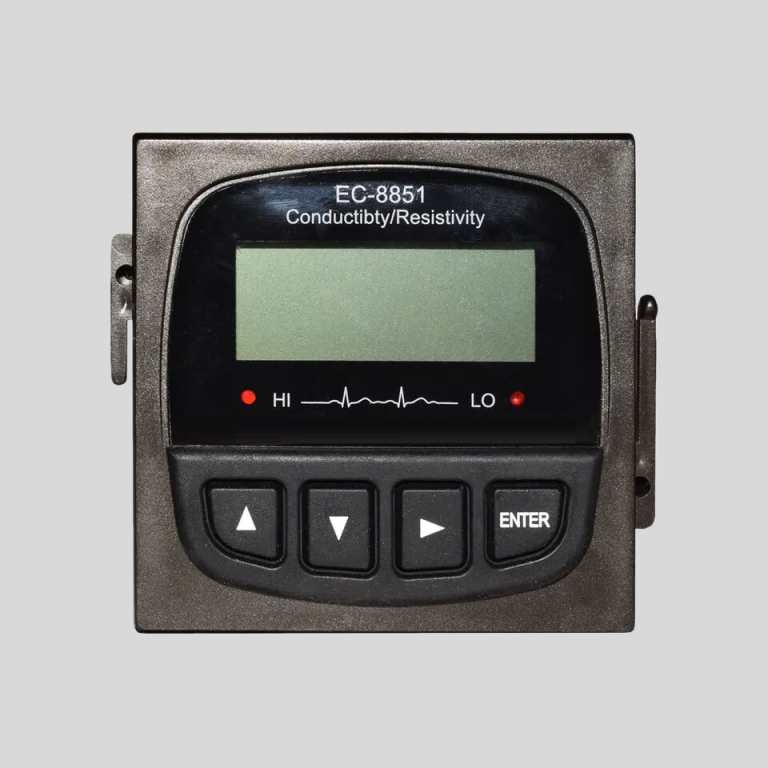
Conductivity monitoring serves as the primary screening parameter for WFI quality, with inline sensors continuously evaluating USP <645> compliance. Modern digital conductivity sensors achieve accuracy of ±0.1 μS/cm, providing measurement confidence that satisfies pharmaceutical requirements. Temperature-compensated measurements automatically adjust to the USP reference temperature of 25°C.
TOC monitoring complements conductivity measurement by detecting organic contamination that may not significantly affect ionic purity. Online TOC analyzers employing UV oxidation technology achieve detection limits of 0.5 μg/L, meeting USP <643> requirements while providing continuous real-time data. Response times under 2 minutes enable rapid identification of organic contamination events.
ChiMay's inline conductivity sensors and TOC analyzers provide the measurement performance and reliability that WFI production requires. Four-electrode conductivity technology eliminates polarization effects that compromise measurement accuracy in low-conductivity WFI applications. Digital communication protocols enable seamless integration with pharmaceutical control systems and data historians.
Distribution System Design
WFI distribution systems must maintain water quality throughout the storage and delivery infrastructure while enabling effective sanitization and microbial control. Storage vessels typically hold 4-24 hours of production capacity, with 316L stainless steel construction and surface finishes of ≤0.8 μm Ra to minimize biofilm adhesion and facilitate cleaning.
Distribution loops maintain continuous circulation at velocities above 1 m/s to minimize particle deposition and biofilm formation. Loop return temperatures are typically maintained above 65°C for hot systems or below 5°C for cold systems, with appropriate sanitization measures for ambient temperature systems. Ozone sanitization provides effective microbial control for ambient systems without chemical residue concerns.
Online monitoring points throughout the distribution system provide comprehensive quality assurance coverage. Critical monitoring locations include tank discharge, loop supply, loop return, and point-of-use positions. This monitoring strategy enables detection of issues at any location within the distribution system while supporting diagnostic investigation when quality concerns arise.
Sanitization and Microbial Control
Microbial control in WFI systems requires multiple strategies addressing source control, distribution control, and sanitization. Feed water pretreatment reduces incoming bioburden, while continuous hot or cold temperatures limit microbial proliferation in the distribution system. Regular sanitization cycles provide additional microbial control assurance.
Hot water sanitization at temperatures above 80°C for minimum 30 minutes provides effective microbial control without chemical residue concerns. This approach is well-suited for hot WFI systems where sanitization temperatures match operating temperatures. Automated sanitization cycles ensure consistent execution without reliance on operator intervention.
Chemical sanitization using ozone, peracetic acid, or hydrogen peroxide provides effective microbial control for ambient temperature systems. Ozone sanitization at concentrations of 0.1-0.5 mg/L provides rapid microbial inactivation with automatic degradation to oxygen, eliminating chemical residue concerns. Implementation requires appropriate materials compatibility verification and safety measures.
Quality Assurance Documentation
Comprehensive documentation supports regulatory compliance and enables traceability throughout WFI production and distribution. Required documentation includes equipment specifications, installation verification, calibration records, operational logs, sanitization records, microbial monitoring results, and deviation investigations.
Electronic documentation systems must satisfy FDA 21 CFR Part 11 and equivalent data integrity requirements. User authentication ensures appropriate access controls, while complete audit trails document all system activities. Automatic data backup ensures record preservation throughout required retention periods—typically 5 years or the product shelf life plus one year, whichever is longer.
Regulatory inspections frequently examine water system documentation in detail, making robust record-keeping practices essential for maintaining manufacturing authorizations. Common inspection findings include incomplete calibration documentation, insufficient sanitization records, and failure to investigate trends or address system deficiencies. Preventive measures include automated monitoring, standardized documentation procedures, and regular compliance audits.
Energy Efficiency Considerations
WFI production is energy-intensive, with distillation systems consuming approximately 1 kWh/L and RO-based systems consuming approximately 0.5-1 kWh/m³. Energy costs represent 40-60% of total WFI production costs, making energy efficiency improvements attractive for reducing operational expenses.
Heat recovery systems capture energy from still condensate and vapor streams for preheating feed water, improving overall system efficiency by 20-30%. Variable frequency drives on distribution pumps reduce energy consumption during periods of reduced demand. Heat exchanger optimization minimizes temperature losses throughout the distribution system.
Multi-effect still configurations with increased effect counts improve energy efficiency by recovering more energy from the evaporation process. Mechanical vapor compression (MVC) stills achieve the lowest energy consumption by using compressor-driven vapor compression rather than steam as the energy source. These advanced configurations typically achieve 30-40% energy savings compared to conventional designs.
Future Trends in WFI Production
WFI production continues evolving toward greater efficiency, automation, and sustainability. Energy recovery technologies, advanced membrane materials, and intelligent control systems will further improve production economics while maintaining required quality standards.
Real-time release testing (RTRT) approaches increasingly rely on continuous monitoring data to provide water quality assurance without end-product testing delays. This evolution reflects regulatory support for process analytical technology (PAT) approaches that enable more efficient manufacturing while maintaining equivalent quality assurance.
ChiMay continues developing monitoring technologies that support WFI production efficiency and compliance, including enhanced sensors, improved connectivity, and advanced analytics capabilities. These advances will help pharmaceutical manufacturers meet growing WFI demand while reducing production costs and environmental impact.