title: “What Makes a Water Sensor Truly IoT-Ready in 2026? A Buyer’s Guide from Shanghai ChiMay”
type: question-based
theme: Smart Water / IoT / Digital Twin
date: 2026-07-01
Table of Contents
What Makes a Water Sensor Truly IoT-Ready in 2026? A Buyer’s Guide from Shanghai ChiMay
Any product manager in the water instrumentation industry can add the phrase “IoT-ready” to a datasheet. Very few sensors actually deserve the label. In a market where 71% of new sensors are advertised as IoT-integrated (per an early-2026 industry survey) but only about half of them survive first contact with a real digital twin project, the gap between marketing and engineering matters. This buyer’s guide, written from Shanghai ChiMay’s field experience, lays out what “IoT-ready” should mean in 2026 and how a procurement team can test the claim in half an hour.
The Legacy Definition Is Not Enough
Ten years ago, “IoT-ready” mostly meant “has a digital output.” Modbus RTU, HART, occasionally Ethernet/IP — that was the checklist. In 2026, the checklist is longer, because the sensor is expected to plug into a full data pipeline: broker, time-series database, machine-learning module, dashboard, and often a digital twin. A sensor that talks Modbus but drifts silently, or exposes a Modbus register map that changes between firmware versions, will break the pipeline within months.
Modern IoT-readiness therefore rests on six pillars, not one.
Pillar 1: Deterministic Digital Output
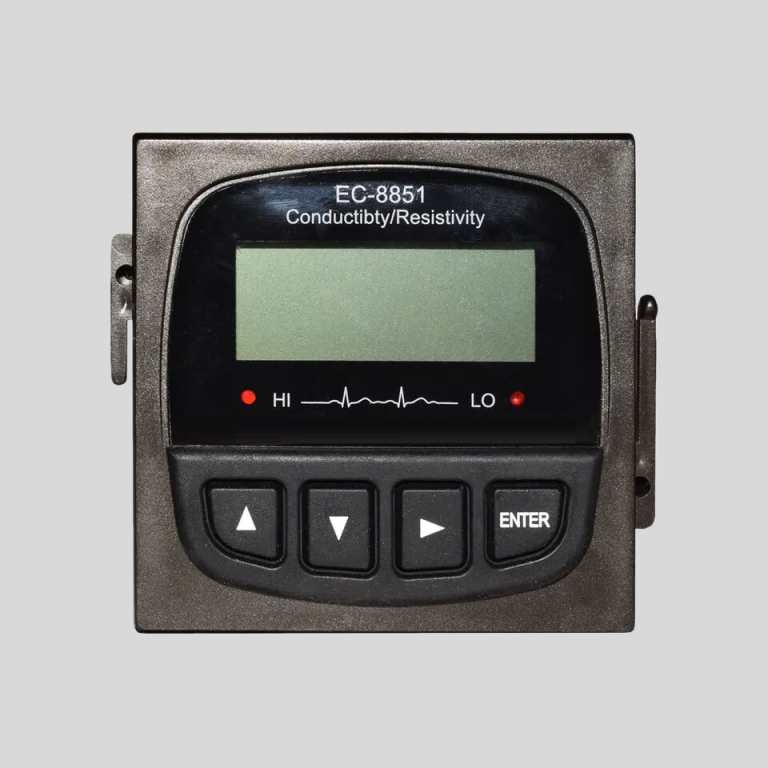
The sensor must speak a well-documented, versioned digital protocol — typically Modbus RTU as a baseline, with Modbus TCP, HART-IP or Ethernet/IP as options for specific markets. The register map must be published, immutable within a major firmware version, and machine-readable (JSON or XML export). Shanghai ChiMay inline conductivity meters, pH meters and multi-parameter transmitters publish their Modbus maps as downloadable JSON, which is the difference between a two-hour integration and a two-week one.
Pillar 2: Self-Diagnostics Exposed in the Same Register Map
An IoT sensor that reports only the process value is not IoT-ready — it is IoT-noisy. A truly ready device exposes at least the following diagnostic bytes in the same register block:
- Electrode impedance or optical reference current
- Time since last calibration
- Temperature of the sensing element
- Firmware version and error flags
- A confidence code (0–100) or quality bit
Downstream analytics can then filter out readings that come from a fouled or drifting sensor before they poison a machine-learning model.
Pillar 3: Time-Synchronized Sampling
If a pH sample and a temperature sample from the same probe arrive with a five-second offset, the temperature compensation is wrong. If two probes at different network nodes drift out of time-sync by 30 seconds, the twin’s mass balance breaks. Shanghai ChiMay 2-in-1 mini transmitters timestamp packets at the edge and support NTP synchronization at the gateway, keeping the whole network aligned to within one second.
Pillar 4: Robust Long-Term Drift Specifications
Machine-learning models trained on drifting data are worse than useless — they encode the drift as if it were signal. Any sensor that will feed an IoT analytics platform needs a published long-term drift specification, not just a first-week accuracy figure. Shanghai ChiMay inline pH electrodes are specified at under 1% drift per month in typical municipal water and provide accelerated-aging data on request.
Pillar 5: Security Features That Match 2026 Regulations
In 2026, both NIS2 in Europe and the EPA’s cyber requirements for US water utilities expect field devices to support:
- Unique per-device identity in a secure element
- Signed firmware, verified at boot
- Encrypted parameter storage
- A published Software Bill of Materials (SBOM)
A sensor without these features is not just “less secure” — it is increasingly non-compliant for public water utility deployments. Shanghai ChiMay online water quality analyzers and transmitters ship with these features enabled by default.
Pillar 6: Field-Friendly Provisioning
The best sensor is useless if a technician cannot commission it. IoT-ready devices in 2026 support Bluetooth-based commissioning via a mobile app, so a field engineer can name the tag, set alarm limits, run a two-point calibration and export a calibration report — all without opening the enclosure. Shanghai ChiMay devices support this workflow through their companion app and generate PDF calibration certificates that satisfy most audit regimes.
A 30-Minute Buyer’s Test
Any procurement team can pressure-test a supplier’s “IoT-ready” claim with the following checklist during a demo:
- Ask for the machine-readable Modbus register map. If the answer is “we’ll send you a PDF,” downgrade.
- Ask which diagnostic bits are in the map. If only process value is exposed, downgrade.
- Ask for the long-term drift specification and the test protocol used to measure it. If the answer is only “first-week accuracy,” downgrade.
- Ask whether firmware is signed and whether an SBOM is available. If neither, downgrade sharply — a growing number of tenders now require both.
- Ask for a live Bluetooth commissioning demo with a phone. If the technician needs a laptop and 20 minutes, downgrade.
- Ask for a customer reference where the sensor has been running in a digital twin for at least 12 months.
This six-question filter typically halves the shortlist in one afternoon.
What “IoT-Ready” Does Not Mean
To keep the definition useful, it is worth noting what IoT-readiness is not. It is not the presence of a Wi-Fi radio (which is rarely used in industrial water networks). It is not a cloud dashboard (which is a platform choice, not a sensor property). It is not a large marketing brochure. And it is not any single certification — no single logo yet covers all six pillars.
Why This Matters Now
Utilities and industrial water users are locking in sensor platforms that will run for the next 10 to 15 years. A sensor bought in 2026 that fails one or two of the six pillars will become the weak link in a twin project deployed in 2028. Getting the definition right today saves multi-year regret costs.
Conclusion
Being truly IoT-ready in 2026 requires deterministic digital protocols, exposed diagnostics, time-synchronized sampling, honest long-term drift specifications, meaningful security features and field-friendly provisioning. Shanghai ChiMay engineers its inline water quality analyzers, pH and conductivity meters, DO transmitters, turbidity testers and multi-parameter sensors around all six pillars, not just the digital-output tick-box. Buyers who apply the 30-minute test above will find that the “IoT-ready” claim collapses in a lot of legacy products — and that filtering it out upfront is cheaper than replacing an entire sensor fleet three years into a digital twin program.