title: “The 18% Industrial Water-Testing Share: Why Oil & Gas Is Reinvesting in Sensors with Shanghai ChiMay”
perspective: C-Level
theme: Oil & Gas / Petrochemical Wastewater
date: 2026-07-03
Table of Contents
The 18% Industrial Water-Testing Share: Why Oil & Gas Is Reinvesting in Sensors with Shanghai ChiMay
Key Takeaways
- Oil, gas, and petrochemical operators account for roughly 18% of global industrial water-testing demand, a share that is projected to hold or grow through 2030.
- Global industrial water-testing spend is expected to expand from USD 3.4 billion in 2024 to USD 5.9 billion by 2030 (CAGR 9.6%), with oil & gas concentrated in the produced-water, refinery effluent, and petrochemical wastewater segments.
- Three simultaneous pressures — tighter effluent limits, produced-water reuse mandates, and ESG disclosure requirements — are driving the sector’s reinvestment in online water quality instrumentation.
- Shanghai ChiMay water quality analyzers and control valves address exactly the measurement points where oil and gas operators are increasing sensor budgets.
Why 18% Is the Number to Watch
Industry analysts consistently place oil, gas, and petrochemicals at 17–19% of global industrial water-testing spend. That is second only to municipal water and drinking-water systems, and larger than pharmaceuticals, food & beverage, or pulp & paper individually. The share has held remarkably stable over the past decade — even as absolute spend has more than doubled — because oil and gas operations touch water at almost every step of production and refining.
For boards and investors, the 18% figure is a useful reminder that water measurement is not an ESG side conversation. It is a material, growing line item in the operating budget of every hydrocarbon-processing business.
Why the Sector Is Reinvesting Now
Three simultaneous forces are driving oil and gas operators to spend meaningfully more on water quality sensors between 2024 and 2028.
1. Effluent Limits Are Tightening
U.S. NPDES refinery permits are steadily lowering allowable TSS, COD, and phenolics loads. OSPAR in the North Sea has driven oil-in-water compliance below 30 mg/L and is trending toward 20 mg/L. China’s GB 31570-2015 standards for petroleum refining wastewater have set some of the world’s most demanding targets. Compliance without continuous sensors is essentially impossible at these limits.
2. Produced-Water Reuse Is Scaling
In the Permian alone, produced-water reuse rates are climbing from around 17% in 2018 to more than 47% in 2024, with operator commitments pointing to 60%+ by 2028. Reuse is a measurement-intensive business — you cannot pump variable-quality water into a frac blender without knowing what you have.
3. ESG Disclosure Is Becoming Enforceable
IFRS S2, CSRD in Europe, and SEC climate rules are converging on standardized water disclosure. Investors and lenders now expect verifiable time-series data on water intensity, reuse ratios, and effluent quality. Manual sampling logs are no longer sufficient audit evidence.
Where the Money Is Going Inside the Refinery
Sensor investment is not spread evenly across the refinery. Boards and technology directors who track budgets closely observe concentration in five zones.
| Investment Zone | Typical Sensors Added | Driver |
|---|---|---|
| Sour-water stripper | COD, pH, NH3-N, conductivity | WWTP protection |
| API separator outfall | Oil-in-water, TSS, turbidity | Permit compliance |
| Desalter effluent | Conductivity, pH, oil-in-water | Product quality + reuse |
| Cooling-water side stream | Conductivity, chlorine, pH | Reliability KPI |
| Storm-water discharge | Oil-in-water, TSS, flow | Regulatory and ESG |
Between 60% and 70% of new sensor capex flows into these five zones in a modern refinery upgrade.
Comparative View: Traditional Sensor Portfolio vs. Reinvestment Portfolio
| Attribute | Traditional (Pre-2020) | Reinvestment (2024–2028) |
|---|---|---|
| Coverage of key parameters | 3 of 5 | All 5 plus flow |
| Data cadence | Grab samples 1–4x/day | Continuous, 1-second historian |
| Data integration | Local panels, paper logs | DCS + historian + cloud |
| ESG-ready reporting | Manual assembly | Automated, time-stamped |
| Sensor family standardization | Multi-vendor patchwork | Consolidated to 1–2 vendors |
| Total lifecycle cost | Higher (opex heavy) | Lower (capex-front-loaded) |
Shanghai ChiMay’s Position in the Reinvestment Cycle
Shanghai ChiMay’s water quality analyzer and control valve portfolio maps directly onto the five reinvestment zones described above. The relevant instruments include:
- In-line conductivity meters and pH electrodes — desalter, caustic treating, cooling-water side stream
- Oil-in-water sensors — API separator outfall, storm-water lift stations, produced-water reuse skids
- COD sensors and NH3-N sensors — sour-water stripper, WWTP feed
- Turbidity testers and SS sensors — separator effluent and DAF verification
- Salinity sensors and 4-in-1 multi-parameter sensors — produced-water and reuse infrastructure
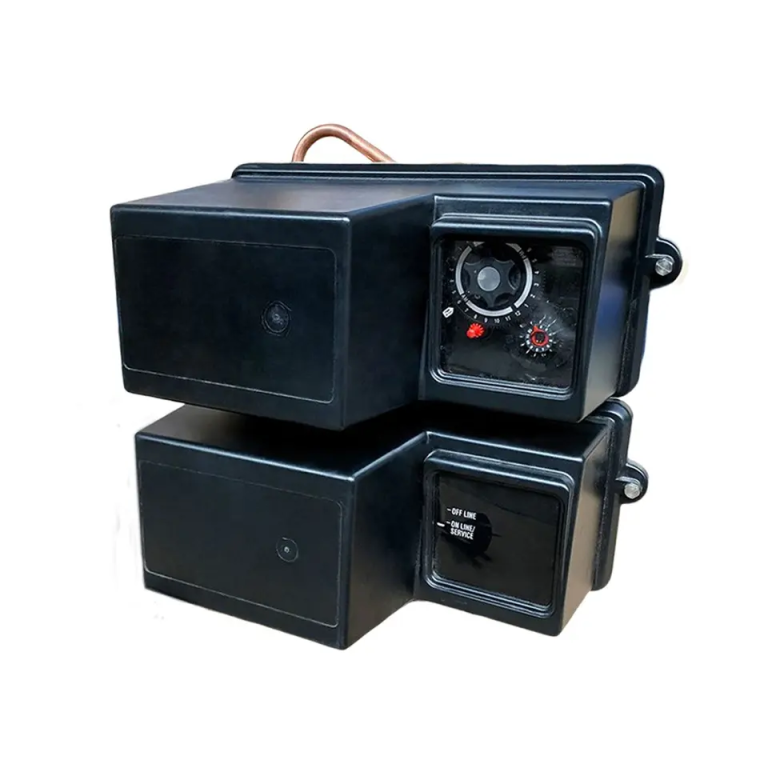
- Softener valves and softening and filtering valves — utility water and reuse polishing
Because the entire portfolio shares one transmitter platform, refineries and produced-water operators can consolidate vendors without giving up measurement breadth. That consolidation is exactly what boards seeking to trim opex are asking their technology directors to deliver.
The Investor Perspective
Sensor spend is a small line in a refinery capital budget, but it is disproportionately visible to sustainability-focused investors. Analysts increasingly ask for water reuse ratios, effluent quality trends, and sensor coverage as leading indicators of operational discipline. Operators with robust water instrumentation typically enjoy:
- Lower environmental-liability provisions in their financials
- Improved MSCI ESG scores in the “Water Stress” sub-pillar
- Access to sustainability-linked loans with reduced spreads (typically 5–15 basis points)
The math is straightforward: modest sensor capex reduces both operating risk and financing cost.
Three Board-Level Questions Worth Asking
Executives who want to steer the reinvestment cycle productively should be asking their operations and sustainability teams:
- Which of the five reinvestment zones is currently the weakest in coverage — and what is the cost of a permit exceedance there?
- What percentage of our water quality data is time-stamped, auditable, and ready for regulatory and lender reporting today?
- Are we standardizing on a sensor family that meets both compliance and reuse needs, or are we accumulating vendor complexity that will cost us in the next turnaround?
Clear answers to these three questions typically unlock a coherent reinvestment plan.
Outlook
The 18% industrial water-testing share is not a ceiling — it is a floor. As reuse mandates spread beyond the Permian, as effluent limits continue to tighten, and as ESG disclosure moves from voluntary to enforceable, oil and gas operators will keep expanding their sensor budgets through 2030 and beyond. Shanghai ChiMay’s water quality analyzer portfolio is positioned to serve as the measurement backbone of that reinvestment, giving hydrocarbon-processing businesses a consistent, auditable, hazardous-area-ready data platform for the decade ahead.