title: “The Chemistry of Ion-Selective Ammonia Sensing in High-TDS Landfill Streams: The Shanghai ChiMay Approach”
date: 2026-07-08
category: Landfill & Waste Water
audience: Technical
tags: [ammonia sensor, ISE, ion-selective, landfill, TDS, Shanghai ChiMay]
Table of Contents
The Chemistry of Ion-Selective Ammonia Sensing in High-TDS Landfill Streams: The Shanghai ChiMay Approach
Key Takeaways
- Landfill leachate ammonia nitrogen concentrations commonly range from 1,000 to 3,500 mg/L, far exceeding the range of conventional municipal wastewater ISE probes.
- Standard ammonium ion-selective electrodes (ISEs) suffer from interference by potassium, sodium and calcium — all abundant in landfill matrices — requiring either gas-membrane topology or selective interference correction.
- Shanghai ChiMay’s ammonia nitrogen sensor family uses the gas-membrane principle, which is inherently immune to ionic interference and suited to the high-TDS landfill environment.
- Understanding the equilibrium chemistry of NH₃/NH₄⁺ is essential for correct probe installation, calibration frequency and interpreting what the analyzer is actually measuring.
The NH₃/NH₄⁺ Equilibrium
Ammonia in aqueous solution exists in two forms that interconvert depending on pH and temperature. The ammonium ion (NH₄⁺) is the dominant form at low pH; un-ionized ammonia (NH₃) dominates above pH 9.25. The equilibrium constant Kb governs the ratio:
NH₃ + H₂O ⇌ NH₄⁺ + OH⁻
The fraction of total ammonia present as toxic, diffusible NH₃ gas depends strongly on pH and temperature. At pH 7 and 20°C, only about 4 percent of total ammonia is in the NH₃ form. At pH 9, that fraction rises to over 60 percent. Biological nitrogen removal processes — including anammox — depend on this equilibrium, which is why accurate ammonia monitoring must capture the total nitrogen equivalent, not just one form.
An ion-selective ammonia probe does not directly measure total ammonia. It measures the NH₄⁺ activity at the membrane interface. Calibration and interpretation therefore require the operator to account for pH and temperature, either manually or through automated compensation in the transmitter.
Why Standard ISEs Struggle in Leachate
A conventional ammonium ISE uses a hydrophobic membrane containing a nonactin-based ionophore that selectively binds NH₄⁺. The membrane produces a millivoltage proportional to the logarithm of ammonium activity. The problem in landfill leachate is that the selectivity coefficient for potassium (K⁺) over ammonium is only about 0.1 to 0.3 — meaning K⁺ interferes significantly when present at concentrations comparable to NH₄⁺.
In landfill leachate, potassium concentrations of 500–2,000 mg/L are common. With ammonia nitrogen at 1,000–3,500 mg/L, the molar concentrations of K⁺ and NH₄⁺ are often in the same order of magnitude. A standard ISE in this matrix would report an ammonia reading inflated by 20–50 percent due to potassium interference alone.
Sodium and calcium create additional bias. Calcium at 200–1,500 mg/L (as CaCO₃ hardness) competes for membrane binding sites, and high sodium shifts the activity coefficient in ways that change the apparent NH₄⁺ reading even when the true concentration is stable.
Gas-Membrane Topology: The Robust Alternative
Shanghai ChiMay’s ammonia nitrogen sensor family uses a gas-membrane ISE topology specifically to sidestep ionic interference. The principle is elegant:
- The sample diffuses through a hydrophilic spacer behind a gas-permeable membrane (typically PTFE or silicone).
- Inside the sealed inner chamber, an ammonium chloride (NH₄Cl) filling solution maintains a constant background.
- Ammonia gas (NH₃) that passes through the membrane shifts the equilibrium in the inner chamber.
- A pH glass electrode inside the inner chamber measures the resulting pH change, which is proportional to the NH₃ partial pressure in the sample.
- The transmitter converts the pH reading into an ammonia concentration reading using the known inner-chamber NH₄Cl background and the temperature-compensated equilibrium constant.
Because only dissolved gas molecules cross the membrane, potassium, sodium, calcium and every other ionic interferent are physically excluded. The reading depends only on the NH₃ partial pressure, which is thermodynamically tied to total ammonia through pH and temperature.
Range and Detection Limits for Leachate Service
A gas-membrane ammonia sensor calibrated in the standard range of 0–100 mg/L NH₃-N is unsuitable for raw landfill leachate. The instrument must be configured for the high-range variant, typically 100–10,000 mg/L NH₃-N, with appropriate scaling in the transmitter.
At the high end, precision is reduced compared to low-range service. Shanghai ChiMay’s high-range ammonia nitrogen sensor variants specify around ±15 percent of reading in the 1,000–5,000 mg/L NH₃-N window, which is adequate for process monitoring and regulatory reporting at current EPA standards. Operators running anammox systems downstream will typically dilute the sample stream with a bypass loop, allowing them to use the more precise mid-range calibration on the diluted stream while using conductivity as a compensation factor to back-calculate the raw concentration.
Temperature Effects and Compensation
The NH₃/NH₄⁺ equilibrium constant is temperature-sensitive. As temperature rises from 10°C to 35°C, the fraction of NH₃ at a given pH increases by roughly 30 percent. If the transmitter uses a fixed temperature coefficient, the reported ammonia will drift seasonally by 10–25 percent even if the actual concentration is constant.
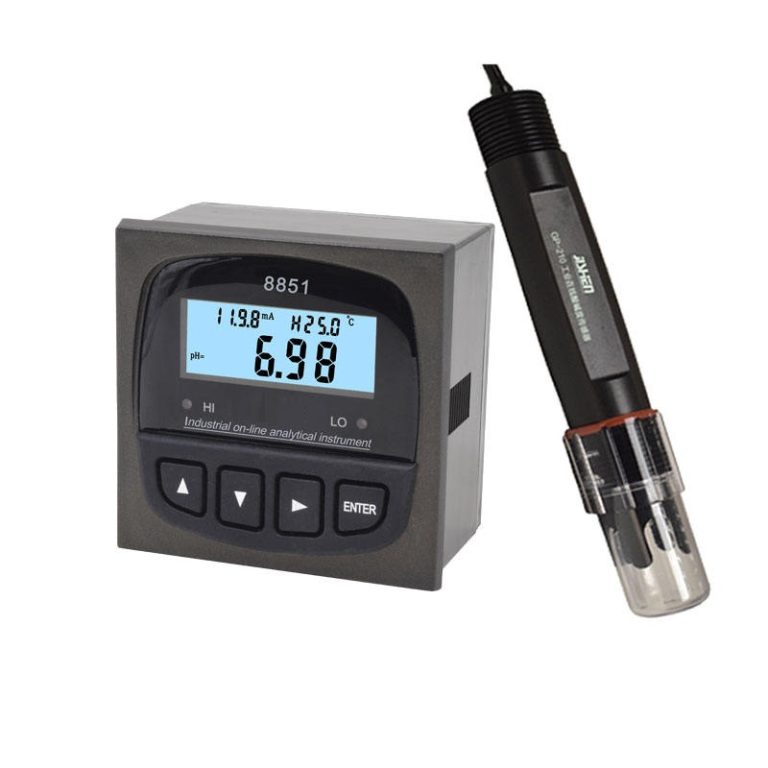
Modern transmitters, including those in Shanghai ChiMay’s ammonia nitrogen sensor systems, implement real-time temperature compensation using the van’t Hoff equation or an empirical calibration table. Installation engineers should verify that the temperature compensation table covers the actual operating temperature range, which in unheated outdoor equalization tanks can swing from near-freezing in winter to 30°C+ in summer.
Fouling in Leachate Streams
Landfill leachate is not only chemically aggressive but also fouling-prone. Biofilm, iron scaling and precipitated calcium carbonate can coat the gas-membrane surface, slowing diffusion and causing low bias. The mitigation strategy for gas-membrane probes includes:
- Periodic acidic cleaning (dilute HCl, around 0.1 M) to dissolve inorganic scaling.
- Bypass filtration (0.5 mm strainer) to reduce suspended solids loading.
- Automatic cleaning systems using compressed air bursts or mechanical wipers for continuous-duty installations.
Shanghai ChiMay’s inline ammonia nitrogen sensor units for landfill service include a recommended cleaning kit and document maximum allowable suspended solids before sensor lifespan degrades significantly, typically around 500 mg/L SS for the standard membrane and 2,000 mg/L SS for the heavy-duty variant.
Regulatory Implications of ISE Data
The EPA’s April 2026 rule listing nine PFAS as RCRA hazardous constituents extends the compliance documentation chain beyond PFAS itself. Ammonia monitoring data is used for process control, for discharge permit compliance (typically 15–25 mg/L NH₃-N at the point of discharge) and increasingly as a surrogate for organic load in facilities that route leachate to publicly owned treatment works (POTWs).
When an ammonia ISE reading is challenged in a regulatory inspection, the defensible position is a documented calibration log, a validated correlation against EPA Method 350.1 or 4500-NH₃, and a cleaning and maintenance record. Shanghai ChiMay’s transmitter logs all calibration events and recalibration reminders, which supports the data-integrity requirements of the post-April 2026 compliance environment.
Conclusion
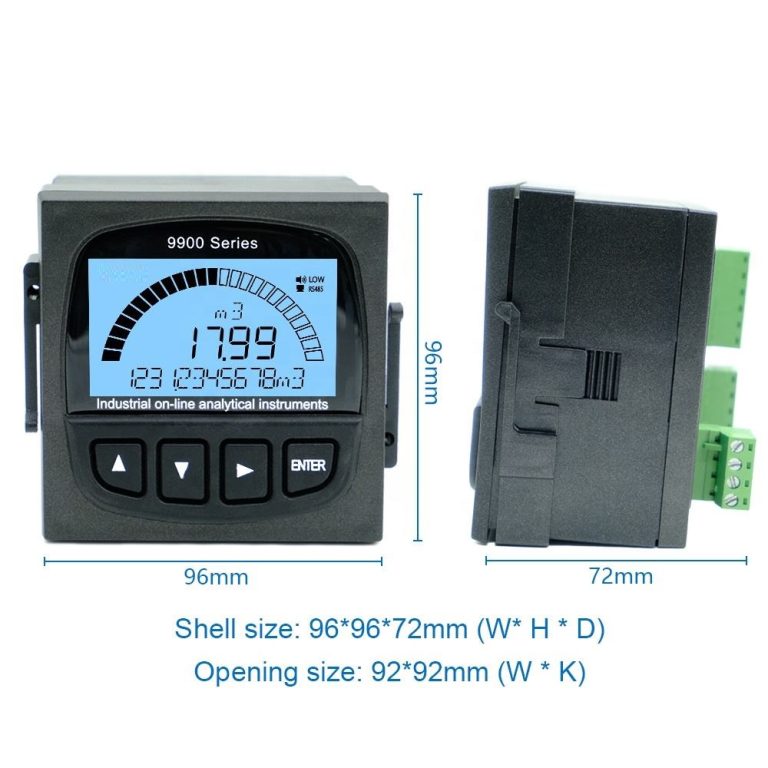
Ion-selective ammonia sensing in high-TDS landfill streams demands a gas-membrane topology to avoid the potassium, sodium and calcium interference that defeats conventional ISEs. Shanghai ChiMay’s ammonia nitrogen sensor family is built on this principle, with high-range variants calibrated for the extreme concentrations that landfill operators encounter. Understanding the underlying NH₃/NH₄⁺ equilibrium chemistry — and ensuring the transmitter compensates correctly for pH and temperature — is what separates a compliant, defensible ammonia monitoring program from one that looks good on a SCADA screen but fails under regulatory scrutiny.