Table of Contents
Conductivity Sensors in Seawater Desalination: Technical Requirements and Performance Optimization
Key Takeaways
Seawater desalination represents an increasingly critical water supply source for arid regions and water-stressed communities worldwide, with global capacity exceeding 100 million cubic meters per day according to the International Desalination Association (IDA) 2024 report. Reverse osmosis (RO) technology dominates new desalination capacity additions, accounting for 60% of global installed capacity through its energy efficiency advantages over thermal processes. Precise conductivity monitoring serves multiple essential functions in RO desalination systems, from feedwater quality assessment to product water quality verification and membrane performance optimization.
Reverse Osmosis Desalination Process Fundamentals
Reverse osmosis separation occurs when seawater under pressure passes through semipermeable membrane elements that reject dissolved salts while allowing water molecules to permeate. The osmotic pressure of seawater, approximately 25-30 bar for typical ocean salinity, must be overcome by applied pressure to achieve net water flow through the membrane. According to the Desalination and Water Treatment journal (2024), modern RO systems operate at pressures of 55-70 bar to achieve 40-50% water recovery rates while maintaining acceptable energy consumption.
Membrane performance degrades over time through fouling, scaling, and compaction mechanisms that reduce permeate flow and increase salt passage. Conductivity monitoring provides essential data for tracking membrane performance trends and identifying performance decline requiring membrane cleaning or replacement. The Membrane Technology Research organization (2024) reports that early detection of membrane performance changes through continuous monitoring enables cleaning interventions that extend membrane lifetime by 25-40%.
Product water conductivity measurement verifies that permeate quality meets specifications for intended use, whether direct potable use, industrial process water, or irrigation applications. The World Health Organization (WHO) drinking water guidelines establish maximum allowable total dissolved solids (TDS) concentrations that translate to conductivity limits dependent on ionic composition. Continuous conductivity monitoring with alarm capabilities provides protection against membrane failures that could result in unacceptable product water quality.
Conductivity Measurement Technology for Desalination Applications
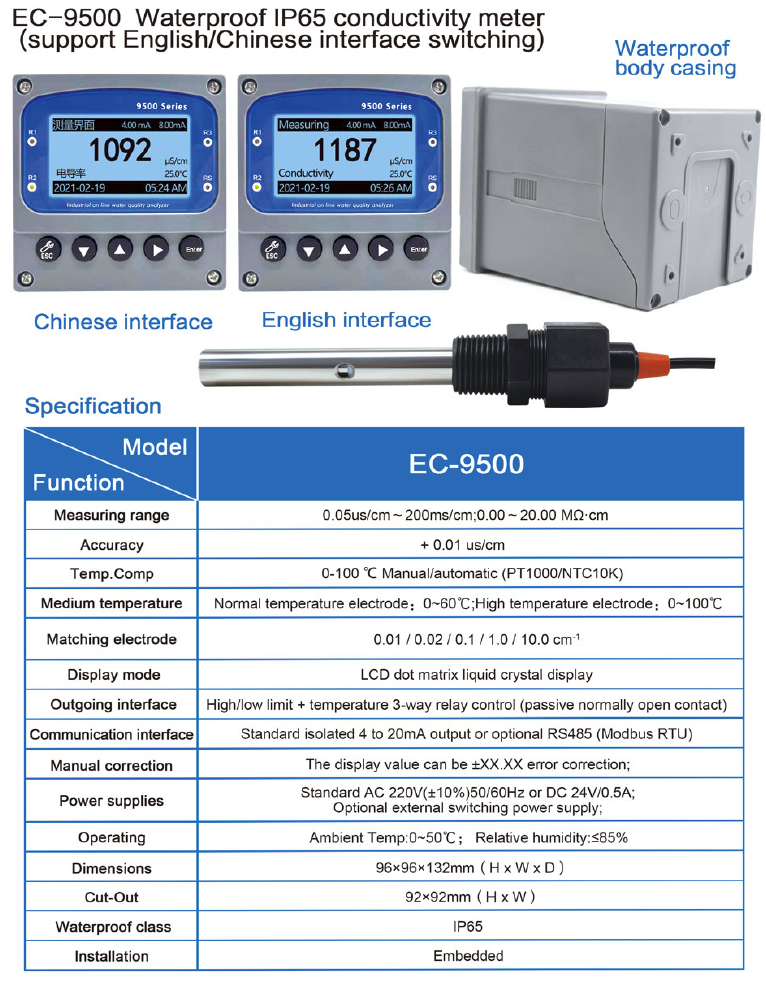
Conductivity measurement principles involve applying an alternating voltage across electrode surfaces and measuring the resulting current flow through the sample solution. The measured conductance, inversely proportional to solution resistance, relates to ionic concentration through the solution conductivity constant. Modern inline conductivity meter technology employs four-electrode designs that eliminate polarization effects and electrode surface variations that compromise two-electrode measurement accuracy.
Temperature compensation represents an essential function for accurate conductivity measurement, as solution conductivity varies significantly with temperature changes. The American Society for Testing and Materials (ASTM) D1125 standard establishes temperature compensation algorithms for seawater conductivity measurements that maintain accuracy across the operating temperature range. ChiMay's conductivity sensors incorporate automatic temperature compensation algorithms calibrated for seawater ionic composition, achieving measurement accuracy of ±0.5% across the full measurement range.
Sensor material selection for seawater applications must address corrosion resistance, biofilm resistance, and mechanical durability in harsh marine environments. Titanium electrodes provide excellent corrosion resistance while maintaining stable electrical characteristics over extended deployment periods. The International Electrotechnical Commission (IEC) 60746 standard establishes performance specifications for industrial conductivity analyzers including minimum accuracy, temperature compensation range, and environmental protection requirements.
Comparative Analysis: In-Line vs. Flow-Through Sensor Configurations
Sensor installation configuration significantly influences measurement accuracy, maintenance requirements, and system integration complexity in desalination plant applications. In-line sensors installed directly in process piping provide continuous measurement without sample extraction requirements, eliminating flow cell complexity and reducing installation costs. According to the International Water Association (IWA) desalination technology guide (2024), in-line sensors achieve response times of 5-10 seconds to conductivity changes, suitable for most monitoring applications.
Flow-through configurations that extract sample streams to dedicated measurement cells provide installation flexibility and simplify sensor maintenance without process interruption. Flow cells enable sensor removal and replacement during planned maintenance periods, eliminating the emergency response requirements of in-line installations. The American Water Works Association (AWWA) membrane filtration guidelines recommend flow-through configurations for critical monitoring points where measurement continuity is essential.
The choice between in-line and flow-through configurations depends on maintenance accessibility, monitoring criticality, and sensor lifetime characteristics. Remote installations with limited access favor in-line sensors that minimize maintenance requirements, while easily accessible locations enable flow-through configurations that simplify calibration and sensor replacement. ChiMay's sensor product line includes both configurations with standardized mounting interfaces that simplify retrofit installations and spare parts management.
System Integration and Control Applications
Conductivity data integration with plant control systems enables automated optimization of RO system operating parameters based on real-time performance feedback. Permeate conductivity monitoring triggers system shutdown or diversion actions when membrane performance degradation results in unacceptable product quality. The American Society of Civil Engineers (ASCE) desalination infrastructure guidelines recommend alarm setpoints providing 30-second advance warning of specification exceedance to enable controlled system response.
Membrane cleaning optimization based on conductivity trend analysis reduces unnecessary cleaning cycles while ensuring cleaning occurs before performance degradation impacts product quality or energy efficiency. The Membrane Bioreactor (MBR) journal (2024) demonstrates that condition-based cleaning triggered by conductivity performance indicators reduces cleaning frequency by 35% compared to calendar-based schedules, extending membrane life and reducing chemical consumption.
Energy optimization through recovery rate control utilizes conductivity measurements to balance water production efficiency against energy consumption and membrane stress. Higher recovery rates produce more permeate per unit feedwater but require higher operating pressures that increase energy consumption. Real-time conductivity monitoring enables dynamic optimization that maximizes efficiency under varying feedwater conditions and product water demand requirements.
Seawater Environment Considerations
Marine deployment environments present challenging conditions including saltwater exposure, biofouling, and mechanical stress that influence sensor selection and maintenance requirements. IP68 environmental protection rating ensures reliable operation despite temporary submersion and continuous salt spray exposure common in coastal installations. The International Maritime Organization (IMO) ballast water management guidelines establish standards for sensor deployment in marine environments that inform appropriate protection specifications.
Biofouling from marine organism growth represents the primary maintenance challenge for seawater conductivity sensors, potentially coating electrode surfaces and affecting measurement accuracy. Anti-fouling sensor housings with copper alloy components provide inherent biofouling resistance through toxic effect on marine organisms. Research from the Marine Technology Society journal (2024) demonstrates that copper alloy housings reduce biofouling accumulation by 80% compared to stainless steel alternatives.
Sensor calibration in seawater applications must account for the unique ionic composition that influences conductivity measurement relationships. Standard calibration solutions with different ionic compositions than seawater may introduce systematic errors if applied without correction. The International Association of Water and Environment (IAWE) calibration guidelines recommend in-situ calibration using reference measurements or calibration solutions specifically formulated for seawater applications.
Operational Best Practices
Effective conductivity monitoring in desalination applications requires attention to sensor maintenance, calibration verification, and data quality assurance practices that ensure reliable measurement. Weekly sensor inspection and cleaning removes accumulated deposits that could affect measurement accuracy, with frequency adjusted based on observed fouling rates at specific installation locations. The Desalination and Water Treatment (DWT) journal (2024) recommends cleaning frequency of 7-14 days for most seawater applications.
Calibration verification frequency depends on sensor stability characteristics and the measurement accuracy requirements of specific monitoring applications. Critical monitoring points may require monthly calibration verification, while routine monitoring may function adequately with quarterly verification schedules. The ISO 17025 laboratory accreditation requirements for calibration services ensure traceability of verification standards used in desalination plant calibration activities.
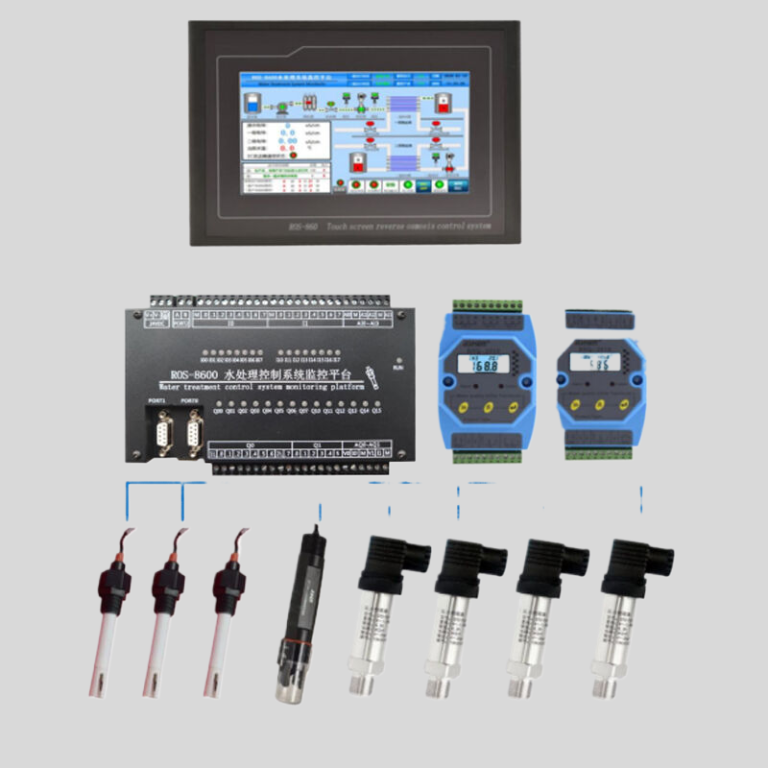
Data quality assurance programs should include periodic comparison of online sensor readings against laboratory analyses and cross-checking between multiple sensors at equivalent monitoring points. The American Water Works Association Research Foundation (AwwaRF) data quality guidelines recommend monthly correlation exercises for critical monitoring parameters to verify ongoing measurement reliability. ChiMay's monitoring platforms incorporate automated data validation algorithms that flag suspicious readings requiring investigation.
Conclusion
Conductivity monitoring provides essential measurement capability for seawater desalination operations, supporting process optimization, product quality assurance, and membrane performance management across RO system applications. Advanced inline conductivity meter technology delivers the accuracy, reliability, and environmental protection required for demanding marine deployment conditions.
Strategic implementation of conductivity monitoring systems requires attention to sensor configuration selection, installation requirements, and maintenance practices that ensure consistent measurement quality throughout the operational lifetime. Investment in robust sensor technology designed for seawater applications reduces maintenance requirements and extends sensor lifetime, improving the economics of comprehensive monitoring programs. ChiMay's expertise in desalination process monitoring supports facilities seeking to optimize RO system performance and maximize water production from increasingly important desalination infrastructure.