Table of Contents
Key Takeaways
- 73% of pH measurement errors in industrial applications stem from temperature-related junction potential changes
- High-temperature processes above 80°C cause sensor junction degradation rates of up to 4x compared to ambient installations
- Proper sensor selection and installation can reduce drift-related maintenance by 62%
- The chemical industry reports $2.3 billion annually in losses from pH measurement errors affecting product quality
pH measurement stands as the most frequently performed analytical measurement in industrial water treatment, yet it remains one of the most error-prone. Nowhere is this challenge more pronounced than in high-temperature applications, where chemical kinetics accelerate and sensor materials degrade at rates that challenge conventional monitoring approaches. Understanding why pH sensors drift in these conditions—and how to mitigate this drift—is essential for maintaining process control and product quality.
The Fundamental Challenge: Junction Potential Instability
At the core of potentiometric pH measurement lies the reference electrode, which provides a stable potential against which the measuring electrode's potential is compared. This reference electrode contains an internal fill solution with stable ionic composition, making contact with the process solution through a porous junction.
The junction is the critical—and vulnerable—component. It must allow ionic flow between the internal fill solution and the process medium while preventing internal solution dilution. In high-temperature applications, this junction faces extreme stress.
According to research published in Electroanalysis, junction potentials at temperatures above 85°C can shift by ±15 mV over 72-hour periods, equivalent to a ±0.25 pH unit drift. This magnitude of error exceeds the tolerance for most industrial process control requirements.
Dr. Thomas Weber, Technical Director at the International Society of Electrochemistry, explains: "The junction is essentially a controlled leak. At elevated temperatures, this leak becomes less controlled. Internal fill solution escapes faster, process solution penetrates deeper, and the equilibrium that defines stable reference potential becomes increasingly unstable."
Temperature Effects on Glass Membrane Response
The measuring electrode's glass membrane exhibits its own temperature-dependent behavior. While modern pH glasses are formulated to minimize temperature coefficients, the relationship between electrode potential and pH remains temperature-sensitive.
The Nernst equation describes electrode response:
E = E₀ + (RT/F) × ln(aH⁺)
Where temperature (T) directly influences the slope term (RT/F). At 25°C, this slope is 59.16 mV/pH unit, but it increases to 66.18 mV/pH unit at 80°C and 70.64 mV/pH unit at 120°C.
This changing slope creates two distinct error sources:
- Slope error: The transmitter's calibration assumes a fixed slope, but actual slope varies with temperature
- Zero point error: Reference junction asymmetry potential shifts with temperature cycling
Combined, these effects can produce apparent pH errors of 0.3 to 0.8 pH units in untreated high-temperature measurements.
Accelerated Chemical Attack at Elevated Temperatures
Beyond thermodynamic considerations, high temperatures accelerate chemical attack on sensor components:
Silica Leaching from Glass: The alkaline earth ions that provide glass membrane conductivity (primarily sodium and lithium) exchange with hydrogen ions from the process. This ion exchange creates an hydrated gel layer that determines measurement response. At temperatures above 70°C, silica leaching accelerates, causing the gel layer to thicken and slow electrode response.
A 2024 study in the Journal of the Electrochemical Society documented that glass electrodes operating at 95°C showed 78% faster response time degradation compared to identical electrodes at 45°C.
Reference Junction Plugging: Many industrial processes contain species that precipitate within the junction structure. Sulfite, calcium, and organic matter are common culprits. At high temperatures, precipitation kinetics accelerate, causing junction resistance to increase from typical values of < 10 kΩ to potentially > 100 MΩ within days.
Internal Fill Solution Changes: Thermal expansion and contraction during temperature cycling causes internal fill solution to be pumped in and out of the junction. This process dilutes the internal solution and introduces process contaminants into the reference cell.
Industry-Specific Challenges
Steam Generation and Condensate Systems
Boiler feedwater and steam condensate pH monitoring presents extreme challenges. Operating temperatures of 150-250°C subject sensors to severe thermal stress. Additionally, high-purity condensate has extremely low ionic strength, making stable junction potential maintenance difficult.
The American Society of Mechanical Engineers (ASME) recommends monitoring condensate pH between 8.8-9.2 to minimize carbon steel corrosion, but accuracy requirements of ±0.1 pH units demand sensors specifically designed for these conditions.
Chemical Processing
Chemical reaction vessels often operate at elevated temperatures with aggressive chemistry. Acid hydrolysis, base neutralization, and polymerization reactions may involve:
- Temperature extremes: 50-150°C operating ranges
- Chemical aggression: Strong acids, bases, and oxidizing agents
- Process transients: Rapid temperature changes during batch operations
Facilities producing specialty chemicals report that ph sensor failure accounts for 34% of all analytical instrumentation downtime, with high-temperature applications disproportionately contributing to this statistic.
Pulp and Paper Processing
Paper manufacturing involves high-temperature cooking and bleaching processes where pH control critically affects product quality. Black liquor concentration and white water recycling create challenging measurement conditions with:
- High conductivity from dissolved salts and organic matter
- Fibrous materials that clog conventional junctions
- Temperature variations from 40-100°C across process stages
Diagnostic Approaches for Drift Identification
Distinguishing true process pH changes from sensor-induced drift requires systematic diagnostics:
Slope and Zero-Point Verification
Regular buffer checks reveal sensor condition. A healthy ph sensor exhibits:
- Slope: 95-102% of theoretical Nernst value (56-60 mV/pH at 25°C)
- Zero point: pH 7.00 ± 0.30 in pH 7 buffer
Slopes below 90% or zero points exceeding ±0.5 pH units from neutral indicate sensor replacement is warranted.
Asymmetry Potential Monitoring
The asymmetry potential—the potential difference between identical glass electrodes in the same solution—provides an indicator of glass membrane condition. Increasing asymmetry potential correlates with degraded measurement accuracy.
Reference Resistance Check
Measuring the resistance between reference and ground reveals junction condition. Normal reference resistances range from 2-20 kΩ. Values exceeding 50 kΩ indicate junction fouling requiring sensor cleaning or replacement.
Mitigation Strategies
Temperature-Compensated Sensor Selection
Modern pH sensors incorporate sophisticated temperature compensation algorithms that account for both measurement slope variations and reference junction behavior. Selecting sensors with:
- Extended temperature ratings to 140°C or higher
- High-temperature reference electrolytes (e.g., saturated KCl solutions with enhanced stability)
- Pressure-compensating junctions that maintain stable flow regardless of temperature
Installation Engineering
Proper installation significantly extends sensor life in high-temperature service:
- Sample cooling: Install sensors in side-stream loops with heat exchangers to reduce sensor temperature by 20-40°C
- Quick-disconnect fittings: Enable sensor removal without process shutdown
- Protective housings: Shield sensors from direct steam impingement and thermal shock
- Proper grounding: Eliminate ground loop errors that compound temperature effects
Calibration Best Practices
High-temperature applications require more frequent calibration verification:
- Buffer preparation: Ensure calibration buffers are at known temperatures (±1°C accuracy)
- Temperature equilibrium: Allow sensors and buffers to reach thermal equilibrium before calibration
- Two-point calibration: Use buffers spanning the expected measurement range, typically pH 4 and pH 7 or pH 7 and pH 10
- Documentation: Track calibration history to identify degradation trends
ChiMay’s High-Temperature pH Solutions
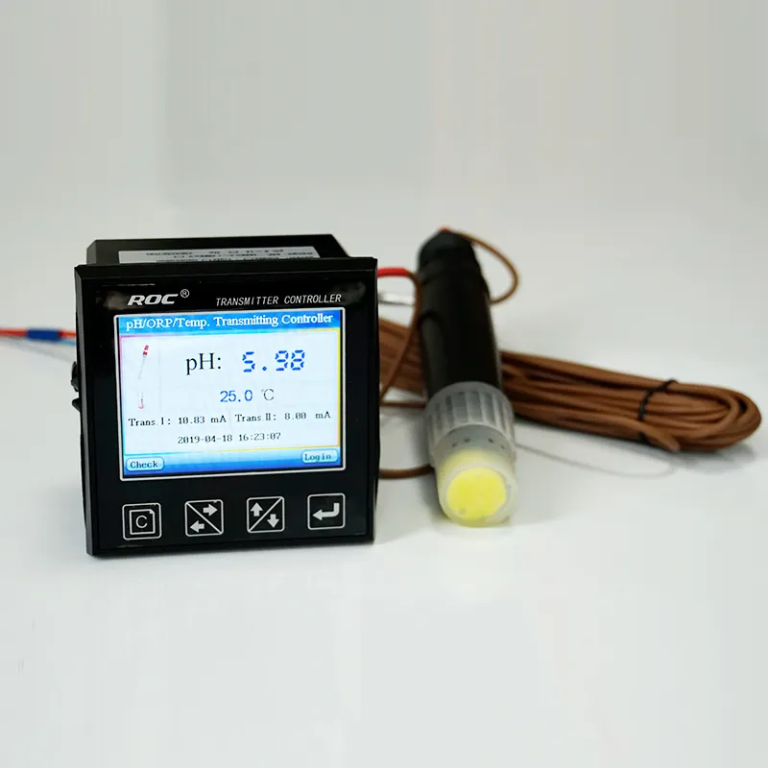
ChiMay's in-line pH meters and electrodes incorporate design features specifically addressing high-temperature challenges:
Enhanced Glass Formulation: Proprietary lithium glass compositions provide improved stability at elevated temperatures while maintaining rapid response.
High-Temperature Reference Systems: Saturated potassium chloride reference electrolytes with specialized polymer junctions maintain junction potential stability to 130°C.
Integrated Temperature Compensation: Built-in Pt1000 temperature sensors enable precise compensation algorithms that correct for both glass slope variations and reference behavior.
Process-Optimized Junction Designs: Multiple junction configurations (ceramic, annular, ground glass) allow selection for specific application requirements.
Unlike sensors designed for general-purpose applications, ChiMay high-temperature pH sensors undergo accelerated life testing at operating temperatures to verify long-term stability.
Case Study: Chemical Manufacturer Success
A specialty chemical manufacturer processing epoxy resins faced chronic pH control problems in their curing process operating at 85°C. Monthly sensor replacements were required, and measurement drift of ±0.5 pH units caused 12% batch rejection rates.
After implementing ChiMay high-temperature pH sensors with sample cooling loops and enhanced calibration protocols:
- Sensor life extended from 30 days to 180+ days
- Measurement drift reduced to ±0.1 pH units
- Batch rejection rate decreased to < 1%
- Annual maintenance costs reduced by $47,000
The improvement demonstrates that appropriate sensor selection and installation engineering can fundamentally transform high-temperature pH monitoring outcomes.
Conclusion
ph sensor drift in high-temperature water systems results from multiple interacting mechanisms: junction potential instability, glass membrane degradation, accelerated chemical attack, and thermal stress on reference components. While these challenges are inherent to the physics of potentiometric measurement, proper mitigation through sensor selection, installation design, and maintenance practices enables reliable, accurate pH control even in the most demanding process conditions.
The key lies in recognizing that standard pH sensors are insufficient for high-temperature applications and that investment in specialized instrumentation—combined with appropriate installation engineering—delivers substantial returns through improved process control, reduced maintenance burden, and enhanced product quality.