Table of Contents
5 Proven Strategies for Cutting Mining Water Costs Without Compromising Compliance
Key Takeaways:
– Leading mining operations achieve water costs of USD 0.15-0.35 per tonne processed through strategic water management
– Water recycling initiatives typically achieve 60-85% recycle rates with 18-36 month payback periods
– The International Water Resources Association estimates that optimized water management can reduce mining operating costs by 8-12%
Water represents one of the largest operating costs for mining operations, with typical consumption of 500-2,000 liters per tonne of ore processed. As freshwater scarcity increases and discharge regulations tighten, strategic water management becomes both an environmental imperative and competitive advantage.
This guide presents five proven strategies for reducing water costs while maintaining or improving environmental compliance.
Strategy 1: Optimize Recycle Rates Through Advanced Monitoring
Water recycling represents the most significant opportunity for cost reduction, with typical savings of USD 0.50-1.50 per cubic meter of freshwater displaced.
Technology Implementation
Effective recycling requires sophisticated water quality monitoring to ensure recycled water meets process specifications:
- Conductivity monitoring tracks dissolved solids accumulation, triggering blowdown when concentrations exceed 8,000-12,000 μS/cm
- pH measurement maintains reagent efficiency in leaching circuits
- Turbidity monitoring optimizes clarification and filtration performance
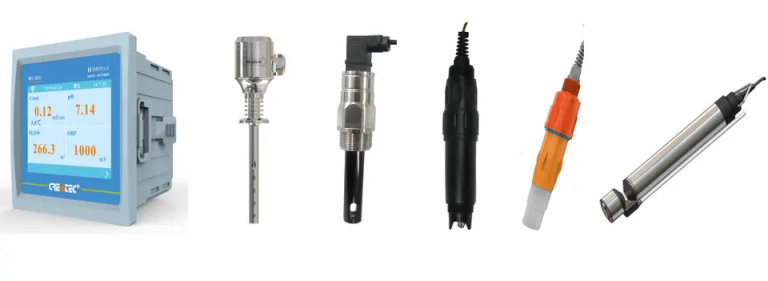
In-line conductivity sensors with automatic temperature compensation provide continuous data for recycle system control. Shanghai ChiMay’s sensors achieve accuracy of ±0.5% of reading across ranges from 0.1 μS/cm to 200 mS/cm.
Case Study Results
A Chilean copper mine implementing comprehensive recycle monitoring achieved:
- Recycle rate increase: From 45% to 78% over 18 months
- Freshwater reduction: 1.2 million cubic meters annually
- Cost savings: USD 2.8 million per year
- Simple payback: 14 months on monitoring system investment
The Society of Mining, Metallurgy & Exploration (SME) reports similar results across multiple commodity types, with average recycle rate improvements of 25-35 percentage points.
Process Optimization
Advanced monitoring enables process optimization beyond simple recycling:
- Real-time turbidity control optimizes coagulant dosing, reducing chemical costs by 20-30%
- Multi-parameter correlation identifies water quality impacts on metallurgical recovery
- Predictive modeling anticipates water quality changes, enabling proactive management
Strategy 2: Implement Predictive Maintenance for Water Systems
Unplanned water system downtime costs mining operations an average of USD 15,000-50,000 per hour. Predictive maintenance approaches using water quality monitoring reduce downtime while extending equipment life.
Sensor-Based Condition Monitoring
Continuous water quality monitoring provides early warning of equipment issues:
- Increasing turbidity indicates pump seal wear or pipe erosion
- pH drift may signal chemical injection system problems
- Conductivity anomalies reveal membrane or exchanger fouling
SCADA integration enables automated alerts when parameters deviate from normal operating ranges, triggering maintenance before failure occurs.
Maintenance Scheduling
Water quality trends inform maintenance scheduling:
- Filter life prediction based on turbidity headloss curves
- Membrane replacement timing based on conductivity trends
- Chemical injection optimization based on pH control stability
The International Water Association (IWA) estimates that predictive maintenance reduces water system maintenance costs by 25-40% while increasing equipment availability by 10-15%.
Cost Analysis
Predictive maintenance implementation:
- Investment: USD 50,000-150,000 for additional monitoring instrumentation
- Annual savings: USD 200,000-600,000 for medium-sized operations
- Payback period: 3-8 months
Strategy 3: Deploy Real-Time Compliance Monitoring
Traditional compliance monitoring through periodic sampling creates blind spots that risk violations and penalties. Real-time monitoring transforms compliance from a statistical gamble to a managed process.
Continuous Monitoring Benefits
Continuous turbidity monitoring provides the data density necessary for meaningful compliance demonstration:
- U.S. EPA data shows 94% compliance rates for operations with continuous monitoring versus 67% with manual sampling
- Real-time alerts enable immediate response to developing exceedances
- Historical records demonstrate due diligence for regulatory reviews
Automated Response Systems
Integration between monitoring and process control enables automated responses:
- High turbidity events trigger diversion to settling ponds
- pH excursions activate chemical dosing systems
- Flow anomalies close diversion valves
Penalty Avoidance
Real-time monitoring investment typically pays for itself through avoided penalties:
- Average avoided penalties: USD 100,000-500,000 annually
- Enforcement action reduction: 60-80% based on EPA data
- Permit modification support: Comprehensive monitoring data facilitates permit flexibility
The British Columbia Ministry of Environment notes that operations with continuous monitoring receive 50% fewer enforcement actions than comparable facilities with only periodic sampling.
Strategy 4: Integrate Water Management with Energy Optimization
Water pumping and treatment represent significant energy costs, typically 20-35% of total mining energy consumption. Integrated water-energy management unlocks additional savings.
Pumping Optimization
Variable frequency drives (VFDs) controlled by flow and pressure monitoring reduce pumping energy by 15-30%:
- Flow meters provide feedback for demand-based pumping control
- Pressure sensors optimize distribution system pressure
- Conductivity monitoring identifies opportunities for reduced pumping through water quality optimization
Turbine flow meters and paddle wheel flow meters provide accurate measurement for these applications. Shanghai ChiMay’s flow measurement products achieve accuracy of ±1% of reading across flow ranges appropriate for mining distribution systems.
Treatment Energy Management
Aeration systems for water treatment consume substantial energy:
- Dissolved oxygen monitoring enables demand-controlled aeration, reducing blower energy by 20-40%
- Real-time control matches oxygen supply to actual demand rather than worst-case design
- Process integration coordinates aeration with upstream water quality conditions
The U.S. Department of Energy estimates that water treatment optimization can reduce mining energy costs by 8-15%.
Combined Savings
Integrated water-energy management achieves:
- Water cost reduction: 15-25%
- Energy cost reduction: 10-20%
- Combined savings: USD 500,000-2,000,000 annually for medium operations
Strategy 5: Leverage Data Analytics for Continuous Improvement
Modern water management generates substantial data that, properly analyzed, reveals optimization opportunities invisible through traditional approaches.
Advanced Analytics Applications
Machine learning algorithms applied to water quality data identify:
- Anomaly detection: Early warning of equipment degradation or process upsets
- Pattern recognition: Relationships between operational parameters and water quality
- Predictive models: Forecasting water demand and quality trends
Benchmarking and Performance Tracking
Analytics platforms enable meaningful performance comparison:
- Normalized metrics: Water consumption per tonne of production
- Trend analysis: Continuous improvement tracking
- Peer comparison: Performance relative to similar operations
The International Mining and Metals Council (ICMM) water accounting framework provides standardized metrics enabling industry-wide benchmarking.
Implementation Approach
Effective analytics implementation requires:
- Comprehensive data collection: All water flows and quality parameters
- Data quality assurance: Automated validation and error detection
- Analytical capability: Statistical and machine learning tools
- Integration with operations: Dashboard displays and alert systems
Cloud-based monitoring platforms provide these capabilities as integrated services, reducing implementation complexity and cost.
Implementation Roadmap
Successful water cost optimization follows a structured approach:
Phase 1: Foundation (Months 1-3)
- Comprehensive water balance development
- Baseline monitoring system installation
- Data collection and validation
- Quick-win identification
Phase 2: Optimization (Months 4-9)
- Recycle rate optimization
- Predictive maintenance implementation
- Real-time compliance monitoring
- Energy integration pilot
Phase 3: Advanced Control (Months 10-18)
- Full SCADA integration
- Advanced analytics deployment
- Continuous improvement program establishment
- Industry benchmarking
Investment and Returns
Typical implementation economics:
| Phase | Investment | Annual Savings | Payback |
|---|---|---|---|
| Foundation | USD 100-200K | USD 200-400K | 6-12 months |
| Optimization | USD 200-400K | USD 500-1,000K | 4-8 months |
| Advanced | USD 150-300K | USD 300-600K | 6-12 months |
| Total | USD 450-900K | USD 1,000-2,000K | 6-9 months average |
Conclusion
Water cost optimization in mining represents substantial opportunity with proven technology and approaches. The five strategies outlined—recycle optimization, predictive maintenance, real-time compliance monitoring, energy integration, and advanced analytics—collectively can reduce water-related costs by 20-35% while improving environmental performance.
Success requires commitment to comprehensive monitoring, data-driven decision making, and integration across operational functions. Operations achieving best-in-class water costs share common characteristics: executive sponsorship, dedicated water management resources, and continuous investment in monitoring and control capabilities.
Shanghai ChiMay’s comprehensive water quality monitoring product line—including in-line sensors, multi-parameter systems, and cloud-based data platforms—provides the foundation for effective water cost optimization.