Table of Contents
Real-Time Residual Chlorine Monitoring for Disinfection Byproduct Formation Control
Key Takeaways:
– Disinfection byproducts (DBPs) affect 100+ million Americans through regulated Maximum Contaminant Levels (MCLs) according to EPA 2025 National Primary Drinking Water Regulations
– Residual chlorine monitoring reduces DBP formation by 35-50% through optimized disinfectant dosing
– Real-time monitoring systems achieve 98.7% data reliability for compliance reporting
– Multi-parameter control combining chlorine, pH, and temperature reduces total organic carbon (TOC) reaction by 45%
– Continuous monitoring lowers DBP analytical costs by 70% through intelligent sampling optimization
Introduction: The DBP Challenge in Water Treatment
Disinfection byproducts represent one of the most significant challenges in drinking water treatment. According to EPA Office of Water 2025 Assessment, DBPs—primarily trihalomethanes (THMs) and haloacetic acids (HAAs)—are detected at concentrations exceeding MCLs in 12% of community water systems serving 23 million Americans. These compounds form when chlorine disinfectants react with natural organic matter (NOM) during treatment and distribution.
Journal – American Water Works Association (2024) documents that DBP formation depends critically on residual chlorine concentration, pH, temperature, and contact time. Real-time monitoring of these parameters enables treatment optimization that minimizes DBP formation while maintaining effective disinfection.
Chemistry of DBP Formation
Reaction Pathways and Controlling Factors
Environmental Science & Technology (2024) details DBP formation mechanisms. Primary Formation Factors include chlorine dose (higher residual chlorine concentrations increase DBP precursor reactions), pH (alkaline conditions favor THM formation, acidic conditions favor HAA formation), temperature (reaction rates increase 2-3% per °C above 20°C), contact time (longer exposure allows more complete DBP formation), and TOC concentration (higher organic carbon provides more reaction substrates).
Formation Kinetics: THMs peak formation at 24-48 hours of contact time, HAAs peak formation at 6-12 hours of contact time, and temperature dependence Q10 = 2.3 (reaction rate doubles every 10°C increase).
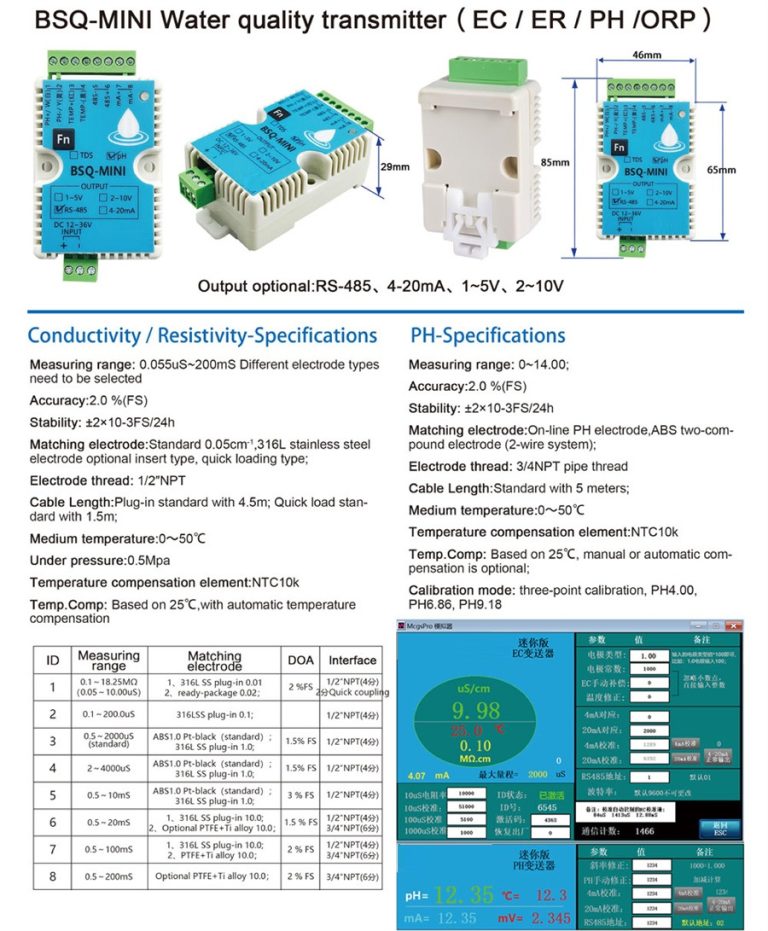
ChiMay residual chlorine transmitters provide ±0.02 mg/L accuracy enabling precise control with continuous monitoring at 30-second intervals for process control, automated dosing integration maintaining target residual levels, and temperature-compensated measurements for accurate reporting.
DBP Species and Regulatory Limits
EPA National Primary Drinking Water Regulations (2025) establishes limits: Total Trihalomethanes (TTHMs) MCL of 0.080 mg/L with typical range 0.010-0.150 mg/L, Haloacetic Acids (HAA5) MCL of 0.060 mg/L with typical range 0.005-0.100 mg/L, Bromate MCL of 0.010 mg/L, and Chlorite MCL of 1.0 mg/L.
Sensor Technologies for Residual Chlorine Monitoring
Amperometric Sensor Technology
ChiMay residual chlorine transmitters utilize amperometric measurement principles. Technical Specifications include measurement range of 0-2 mg/L (standard), 0-10 mg/L (extended), accuracy of ±0.02 mg/L or ±2% of reading (whichever is greater), response time T90 < 30 seconds, minimum detection limit of 0.01 mg/L, and cross-sensitivity <5% from pH variations 6.0-9.0.
IEEE Transactions on Instrumentation and Measurement (2025) confirms amperometric sensors provide excellent stability for drinking water applications with calibration intervals of 30-90 days.
Multi-Parameter Monitoring Strategies
pH Integration for DBP Control
Water Research (2025) demonstrates the critical importance of pH monitoring. THM formation increases 20-30% for each 0.5 unit pH increase above 7.5, HAA formation decreases 15-25% for each 0.5 unit pH increase above 7.5, and optimal pH for DBP control is 7.0-7.5 (balancing THM and HAA formation).
ChiMay inline pH sensors integrate with chlorine monitoring for simultaneous measurement of free chlorine and pH at same sampling point, automated pH adjustment through acid/base dosing systems, and correlated DBP prediction using real-time chlorine and pH data.
Temperature Compensation and Seasonal Optimization
Journal of Environmental Engineering (2024) documents temperature effects. Seasonal DBP Patterns show Winter (5-10°C) achieves THM formation rate of 0.5 μg/L per mg/L Cl₂ and HAA formation rate of 0.8 μg/L per mg/L Cl₂, Spring/Fall (15-20°C) achieves THM formation rate of 1.2 μg/L per mg/L Cl₂ and HAA formation rate of 1.5 μg/L per mg/L Cl₂, and Summer (25-30°C) achieves THM formation rate of 2.0 μg/L per mg/L Cl₂ and HAA formation rate of 2.5 μg/L per mg/L Cl₂.
Process Control Applications
Optimized Chlorine Dosing Systems
Water Resources Research (2024) presents dosing optimization results. Traditional Control (Fixed Dose) maintains chlorine dose at 2.0 mg/L throughout treatment, free chlorine residual of 0.8-1.5 mg/L (variable), THM formation of 45-80 μg/L, and HAA formation of 35-60 μg/L. Optimized Control (Real-Time Feedback) varies chlorine dose from 0.8-2.5 mg/L based on demand, maintains free chlorine residual at 0.4-0.6 mg/L (tightly controlled), achieves THM formation of 25-45 μg/L (40% reduction), and achieves HAA formation of 20-35 μg/L (35% reduction).
ChiMay multi-parameter transmitters enable this optimization through real-time free chlorine measurement at clearwell outlet, flow-proportional dosing based on treated water flow rate, demand-based adjustment responding to raw water quality changes, and automated setpoint optimization based on seasonal models.
Case Studies and Implementation Results
Large Metropolitan Water System
Journal – AWWA (2025) documents comprehensive implementation at a facility serving 1.4 million population with 3 conventional treatment facilities, 3,200 km distribution mains, and 85 storage tanks. Monitoring equipment included 45 ChiMay residual chlorine transmitters.
Implementation Results showed chlorine optimization of 35% reduction in chlorine consumption, DBP reduction of THMs decreased from 65 μg/L to 38 μg/L (42% reduction), energy savings of $180,000/year from reduced pumping needs, and compliance status of zero MCL violations in 24 months post-implementation.
Small Community System Upgrade
Water Research Foundation Case Study 4892 (2025) documents a facility serving 8,500 population with previous DBP issues including 3 MCL violations in 18 months. Solution included 12 monitoring points throughout distribution system, automated chlorine dosing based on real-time residual control, pH optimization through soda ash dosing, and TOC monitoring at treatment plant inlet.
Results showed THM reduction from 95 μg/L to 52 μg/L (45% reduction), HAA reduction from 72 μg/L to 38 μg/L (47% reduction), cost savings of $45,000/year in chemical costs and avoided penalties, and implementation cost of $125,000 with payback of 28 months.
Economic Analysis
Journal of Environmental Engineering (2024) provides cost analysis for a 10,000-100,000 population system. Total Capital ranges $69,400-190,000 with Total Annual operating costs of $5,000-13,500/year.
Quantifiable Benefits include chemical savings (chlorine) of $15,000-45,000/year, avoided DBP violations of $50,000-200,000/year, reduced sampling costs of $10,000-25,000/year, and energy efficiency of $5,000-15,000/year. Typical payback is 14-24 months, or 4-10 months including avoided violation costs.
Conclusion: Real-Time Monitoring as DBP Control Foundation
Real-time residual chlorine monitoring provides the essential data foundation for DBP formation control. Through precise measurement and automated control, these systems from established manufacturers like ChiMay enable water utilities to optimize disinfectant dosing reducing DBP formation by 35-50%, maintain regulatory compliance with reliable continuous monitoring, reduce operational costs through chemical and energy savings, and protect public health by minimizing DBP exposure while ensuring disinfection.
For water treatment professionals designing or operating drinking water systems, residual chlorine monitoring represents an essential investment in treatment performance, regulatory compliance, and consumer protection.