Table of Contents
Key Takeaways
Introduction
Turbidity—the optical property of water that causes light scattering due to suspended particles—serves as a fundamental indicator of water quality across virtually every application where water is treated, monitored, or processed. While simple to understand conceptually, turbidity measurement requirements vary dramatically depending on the specific application, ranging from ultra-low level detection in drinking water to high-range monitoring in industrial wastewater.
Traditional turbidity assessment relied on periodic grab sampling and laboratory analysis, an approach that introduces delays between sample collection and result availability. This delay creates blind spots where contamination events may affect processes or products before anyone becomes aware. Online turbidity analyzers address this gap by providing continuous, real-time measurement that immediately detects changes in water quality.
Determining when to invest in online turbidity monitoring requires understanding the specific drivers for different industries and applications. This guide examines the key factors that indicate online turbidity monitoring investment makes sense for your facility.
Understanding Turbidity Measurement Technology
Nephelometric Measurement Principle
Modern turbidity measurement employs the nephelometric principle, where a light detector positioned at 90 degrees to the incident light source measures scattered light intensity. This geometry provides optimal sensitivity to particle concentrations within the measurement range while minimizing interference from the light source itself.
The ratio of scattered light to transmitted light correlates with particle concentration, enabling quantitative measurement. International standards, including ISO 7027 and EPA Method 180.1, specify the nephelometric approach as the reference methodology for turbidity measurement.
Measurement Units and Ranges
Turbidity is expressed in Nephelometric Turbidity Units (NTU), with specialized applications using alternative units:
| Unit | Definition | Typical Application |
|---|
| NTU | Nephelometric Turbidity Unit | General water monitoring |
|---|
| FTU | Formazin Turbidity Unit | Historical reference unit |
|---|
Different applications require different measurement ranges:
Low Range (0-100 NTU): Drinking water treatment, pharmaceutical water, semiconductor rinse water. These applications require sensitivity below 0.1 NTU to detect subtle quality changes.
Medium Range (0-1,000 NTU): Municipal wastewater, industrial process water, surface water monitoring. This range covers most municipal and industrial monitoring applications.
High Range (0-10,000 NTU): Industrial wastewater, sludge processing, mining applications. High-range sensors tolerate significant fouling while maintaining measurement capability.
Key Indicators Your Facility Needs Online Turbidity Monitoring
1. Regulatory Compliance Requirements
Drinking Water Systems: EPA regulations under the Surface Water Treatment Rule require turbidity monitoring at treatment plant outlets, with limits below 0.3 NTU in 95% of samples and maximum of 1 NTU. Online monitoring provides the continuous data required to demonstrate compliance.
Wastewater Discharge Permits: NPDES permits typically include turbidity limits for industrial discharges, often expressed as 30-50 NTU above background levels. Online monitoring documents compliance while enabling rapid response to exceedances.
Pharmaceutical Water Systems: USP standards for Purified Water and WFI include turbidity limits, with online monitoring supporting PAT compliance requirements.
2. Process Control Requirements
Filtration Optimization: Membrane filtration systems—including microfiltration, ultrafiltration, and reverse osmosis—require turbidity monitoring to:
Coagulation and Flocculation Control: Water treatment facilities adding chemical coagulants require turbidity monitoring to:
Chemical Process Control: Industrial processes where water clarity affects product quality require continuous turbidity monitoring to maintain specifications.
3. Product Quality Protection
Food and Beverage Processing: Water used in food and beverage manufacturing must meet clarity specifications that online turbidity monitoring protects:
Semiconductor Manufacturing: Ultrapure water for semiconductor rinsing must remain particle-free, with turbidity monitoring providing assurance that rinse water meets specifications:
Pharmaceutical Manufacturing: Water turbidity affects product quality and regulatory compliance:
4. Equipment Protection
Cooling Tower Protection: Turbidity monitoring in cooling towers detects:
Early detection enables treatment intervention before equipment damage occurs.
Boiler Feedwater Treatment: Suspended solids in boiler feedwater cause:
Online turbidity monitoring protects boiler equipment from these damage mechanisms.
Application-Specific Guidance
Drinking Water Treatment
When to Install: Online turbidity monitoring is mandatory for surface water treatment systems under EPA regulations. Even groundwater systems benefit from continuous monitoring to detect intrusion events or treatment upsets.
Key Specifications: Low-range sensors with sensitivity below 0.1 NTU enable compliance documentation for the strictest turbidity limits. Multiple monitoring points—at raw water intake, after treatment stages, and at finished water—provide complete process visibility.
Integration Requirements: Connect sensors to SCADA systems for continuous data logging and automated alarm generation. Regulatory agencies increasingly expect electronic data records rather than manual log entries.
Industrial Wastewater Treatment
When to Install: Industrial facilities should install online turbidity monitoring when:
Key Specifications: Medium to high-range sensors match most industrial wastewater applications. Sensor fouling resistance becomes critical in wastewater applications with variable suspended solids loads.
Maintenance Considerations: Wastewater sensors require more frequent maintenance than clean water applications. ChiMay’s sensors feature automatic wiper systems and self-cleaning configurations that extend maintenance intervals.
Membrane Systems
When to Install: Any membrane system—whether microfiltration, ultrafiltration, nanofiltration, or reverse osmosis—benefits from turbidity monitoring to:
Key Specifications: Low-range sensors at membrane feed and permeate points detect quality changes indicating membrane performance. Differential pressure monitoring combined with turbidity data provides comprehensive membrane health assessment.
Response Protocol: Establish automated responses to turbidity exceedances, including:
ChiMay online turbidity analyzer Specifications
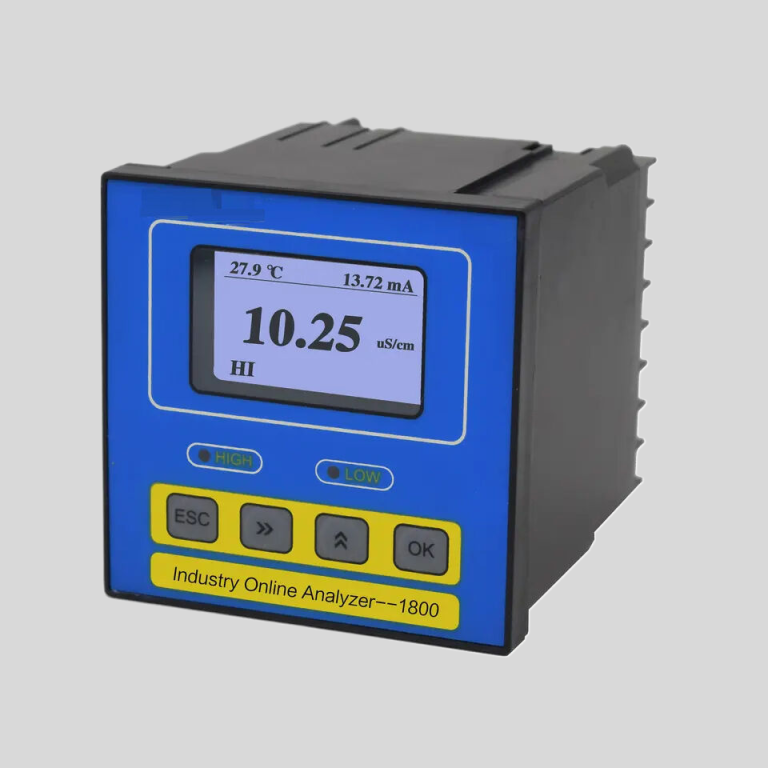
ChiMay’s online turbidity analyzers provide reliable measurement across the full range of industrial applications:
| Model | Range | Application | Key Features |
|---|
| TU-100 | 0-100 NTU | Drinking water, pharmaceuticals | Ultra-low detection limit |
|---|
| TU-10K | 0-10,000 NTU | Industrial wastewater, sludge | High solids tolerance |
|---|
Common Features:
Return on Investment Analysis
Online turbidity monitoring investments generate returns through multiple mechanisms:
| Benefit Category | Typical Value | Calculation Basis |
|---|
| Avoided regulatory penalties | $10,000-$100,000/year | Compliance violation avoidance |
|---|
| Process optimization savings | $20,000-$100,000/year | Chemical and energy reduction |
|---|
| Product quality protection | Variable | Avoided recalls and rework |
|---|
Most facilities achieve payback periods of 6-18 months on online turbidity monitoring investments, with ongoing operational savings continuing throughout the sensor’s service life.
Conclusion
Online turbidity monitoring represents a valuable investment for any facility where water quality affects regulatory compliance, process performance, product quality, or equipment protection. The technology delivers immediate visibility into water quality conditions, enabling rapid response to problems while generating the documentation regulators increasingly expect.
ChiMay’s online turbidity analyzers provide the measurement capability facilities require across all application ranges, from ultra-low level drinking water monitoring to high-range industrial wastewater applications. Combined with ChiMay’s application engineering support, these sensors enable facilities to implement turbidity monitoring programs that deliver measurable operational benefits while meeting regulatory requirements.