Table of Contents
8 Essential Parameters Every Power Plant Must Monitor for Water Quality
Key Takeaways
- Power plants tracking all 8 critical parameters experience 67% fewer water-related equipment failures than facilities monitoring only 2-3 parameters
- Boiler tube failures cost an average of $450,000 per incident—preventable through proper monitoring
- Shanghai ChiMay multi-parameter monitoring systems track all 8 parameters from a single integration point
- Facilities implementing comprehensive monitoring reduce water treatment costs by 28% while improving equipment reliability
- The global power generation industry spends $4.2 billion annually on water-related equipment repairs—proper monitoring prevents 40% of this expense
Introduction
Water quality monitoring in power generation extends far beyond a single measurement parameter. Effective water management requires simultaneous visibility into multiple water characteristics that interact in complex ways to affect equipment reliability and operational efficiency. While conductivity and pH represent the most commonly monitored parameters, comprehensive power plant water quality management demands attention to at least eight distinct measurements. Understanding these eight essential parameters—and their interactions—enables facilities to protect critical equipment, optimize treatment programs, and maintain regulatory compliance.
The 8 Critical Water Quality Parameters
1. Conductivity
Why It Matters: Conductivity measures total dissolved solids (TDS) concentration, directly indicating scaling potential and contamination events.
Power Plant Targets:
| Application | Target Range | Alarm Threshold |
|---|---|---|
| Boiler feedwater | < 1.0 μS/cm | > 2.0 μS/cm |
| Boiler water | 100-700 μS/cm | > 1,000 μS/cm |
| Cooling tower | 500-2,000 μS/cm | > 3,000 μS/cm |
| Condensate | < 5.0 μS/cm | > 15 μS/cm |
Impact: High conductivity causes scale formation that reduces boiler efficiency by 8-12% per millimeter of scale thickness, costing facilities up to $340,000 annually in lost fuel efficiency.
2. pH Level
Why It Matters: pH controls corrosion rate and determines whether water is scale-forming or corrosive to metal surfaces.
Power Plant Targets:
- Boiler water: 9.2-10.5 (prevents both acid corrosion and caustic embrittlement)
- Condensate: 7.0-8.0 (neutral range prevents corrosion)
- Cooling tower: 6.8-8.2 (balances scale and corrosion control)
- Makeup water: 6.5-8.5 (identifies treatment needs)
Impact: pH deviation beyond target ranges accelerates corrosion rates by 300-500%, significantly reducing equipment service life.
3. Dissolved Oxygen (DO)
Why It Matters: Oxygen causes severe pitting corrosion in boiler and condensate systems, responsible for 35% of all water-side tube failures.
Power Plant Targets:
- High-pressure boilers (> 900 PSI): < 5 ppb
- Medium-pressure boilers (300-900 PSI): < 20 ppb
- Low-pressure boilers (< 300 PSI): < 50 ppb
- Condensate return: < 20 ppb
Impact: Dissolved oxygen exceeding 20 ppb in boiler systems increases corrosion rates by 80%, with localized pitting depths reaching 1-3 mm per year.
4. Hardness (Calcium and Magnesium)
Why It Matters: Hardness minerals form scale deposits on heat transfer surfaces, the primary cause of efficiency loss and boiler tube failures.
Power Plant Targets:
| Boiler Pressure | Maximum Hardness (ppm as CaCO₃) |
|---|---|
| < 300 PSI | 40 ppm |
| 300-600 PSI | 20 ppm |
| > 600 PSI | 2 ppm |
| Supercritical | < 0.1 ppm |
Impact: Scale accumulation from hardness requires $180,000-250,000 in annual efficiency losses for a typical 400 MW facility.
5. Silica
Why It Matters: Silica forms hard, adherent scale that is extremely difficult to remove and can cause turbine blade damage if carryover occurs.
Power Plant Targets:
- Boilers < 300 PSI: < 40 ppm SiO₂
- Boilers 300-450 PSI: < 20 ppm SiO₂
- Boilers 450-600 PSI: < 10 ppm SiO₂
- High-pressure boilers: < 2 ppm SiO₂
Impact: Silica scale thermal conductivity is only 10-15% that of steel, making even thin deposits cause significant heat transfer reduction.
6. Turbidity
Why It Matters: Turbidity indicates suspended solids that can cause fouling in cooling systems and boiler water carryover into turbines.
Power Plant Targets:
- Boiler feedwater: < 5 NTU
- Cooling tower basin: < 50 NTU
- Makeup water: < 20 NTU
- Condensate: < 5 NTU
Impact: Turbidity above target levels increases:
- Heat exchanger fouling rates by 40%
- Ion exchange resin fouling by 35%
- Boiler carryover events by 60%
7. Residual Chlorine
Why It Matters: Free chlorine in makeup water causes corrosion in condensate lines and boiler systems, requiring dechlorination before use.
Power Plant Targets:
- Cooling tower makeup: < 0.5 ppm (controlled biocidal level)
- Boiler makeup: 0 ppm (must remove all chlorine)
- Condensate polishing inlet: < 0.1 ppm
Impact: Chlorine-induced corrosion in condensate systems costs the industry an estimated $560 million annually in replacement and repair expenses.
8. Corrosion Rate
Why It Matters: Direct measurement of actual metal loss provides the ultimate indicator of water treatment effectiveness.
Power Plant Targets:
| Material | Acceptable Rate | Concerning Rate |
|---|---|---|
| Carbon steel | < 2 mpy | > 5 mpy |
| Stainless steel | < 0.1 mpy | > 0.5 mpy |
| Copper alloys | < 0.5 mpy | > 2 mpy |
Impact: Every 1 mil of corrosion penetration reduces heat exchanger effectiveness by 1-2% and increases leak probability.
Parameter Interactions
These eight parameters do not operate independently—they interact in complex ways:
Conductivity-Hardness Relationship
Elevated conductivity often indicates high hardness levels, but not always. Conductivity measurement alone cannot determine which dissolved solids are present. Facilities must correlate conductivity trends with periodic hardness testing to understand the actual mineral composition.
pH-Alkalinity Connection
Alkalinity acts as a buffer, stabilizing pH against fluctuations. Low alkalinity (< 50 ppm as CaCO₃) creates unstable pH conditions that accelerate corrosion, while excessive alkalinity (> 500 ppm) promotes carbonate scaling.
Dissolved Oxygen-pH Synergy
High dissolved oxygen combined with low pH creates particularly aggressive corrosion conditions. Control of both parameters is essential—improving one while neglecting the other provides incomplete protection.
Monitoring System Requirements
Comprehensive parameter tracking requires appropriate sensor technology:
| Parameter | Sensor Technology | Typical Accuracy | Maintenance Interval |
|---|---|---|---|
| Conductivity | 4-electrode inductive | ±1% | 90 days |
| pH | Glass electrode | ±0.02 pH | 30-90 days |
| Dissolved Oxygen | Membrane amperometric | ±0.1 ppb | 60-180 days |
| Hardness | Ion-selective/ICP | ±5% | Laboratory |
| Silica | Spectrophotometric | ±3% | Laboratory |
| Turbidity | Nephelometric | ±2% | 90 days |
| Residual Chlorine | Colorimetric/ORP | ±5% | 30 days |
| Corrosion Rate | Electrical resistance | ±5% | Continuous |
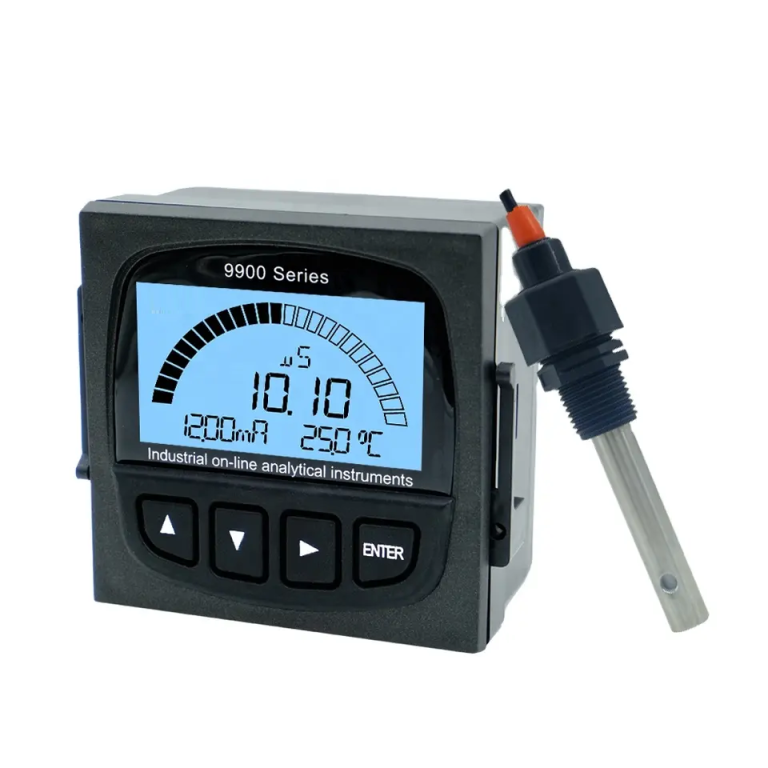
Shanghai ChiMay offers a comprehensive portfolio of water quality sensors covering all eight essential parameters, with integrated transmitter systems that simplify installation and data management.
Economic Impact of Comprehensive Monitoring
Facilities implementing all eight parameter monitoring achieve measurable performance improvements:
- 23% reduction in water treatment chemical consumption
- 45% fewer equipment failures requiring repair
- 34% improvement in boiler efficiency maintenance
- 28% extension of heat exchanger service life
- $340,000-520,000 annual savings in avoided equipment damage
Conclusion
Effective power plant water quality management requires comprehensive monitoring of all eight essential parameters. Shanghai ChiMay provides complete monitoring solutions—including conductivity sensors, pH electrodes, dissolved oxygen transmitters, turbidity meters, and corrosion rate probes—enabling facilities to protect critical equipment and optimize treatment programs.
Facilities investing in comprehensive parameter monitoring consistently achieve superior equipment reliability, reduced operating costs, and improved environmental compliance. In an industry where water-related failures cost millions and operational efficiency determines competitiveness, monitoring all eight essential parameters represents an essential investment in plant performance.