title: “The Complete Handbook of Predictive Maintenance for Water Networks by Shanghai ChiMay”
type: high-traffic-imitation
theme: Smart Water / IoT / Digital Twin
date: 2026-07-01
Table of Contents
The Complete Handbook of Predictive Maintenance for Water Networks by Shanghai ChiMay
Predictive maintenance has moved from buzzword to boardroom priority in the water industry. Roughly 58% of utility respondents in a 2026 industry benchmark reported at least one active predictive-maintenance initiative, up from 22% in 2022. The economics are compelling: predictive maintenance typically reduces unplanned downtime by 25 to 45%, extends asset life by 10 to 20%, and cuts maintenance labour costs by 15 to 30%. But the gap between “we bought a platform” and “we actually saved money” is wider than most vendors admit. This handbook walks through the full lifecycle of a water-network predictive maintenance program — from problem framing through sensor selection to operational integration — as seen from Shanghai ChiMay’s field experience.
What Predictive Maintenance Really Means
The term is used loosely, so it helps to be precise. In a water network, predictive maintenance means using continuous or high-frequency sensor data to forecast the future condition of an asset — pump, valve, pipe segment, membrane, chlorine electrode — and to schedule intervention before failure. It is different from preventive maintenance (fixed schedules) and from reactive maintenance (fix after failure). It sits on top of, not instead of, both.
The Four Assets Worth Predicting First
Utilities that succeed with predictive maintenance almost always start with a small set of high-value assets:
- Pump stations — motor bearings, seal leakage, cavitation
- Chemical dosing systems — pump wear, dosage drift, feed-line clogging
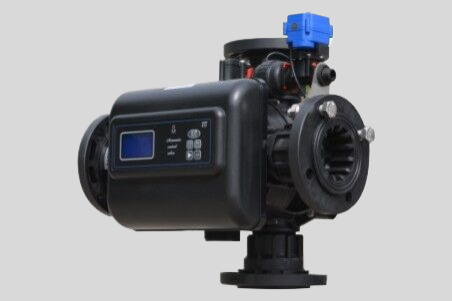
- RO membranes and softener beds — differential pressure trends, permeate quality drift
- Inline sensors themselves — probe fouling, calibration drift
Trying to predict everything at once dilutes attention and produces mediocre models. Pick two or three, do them well, then expand.
The Data Foundation
Predictive maintenance models are statistical objects trained on historical time-series. If the data is drifting, gappy or unlabeled, the model is worthless. The foundation therefore has four requirements:
- Consistent sampling. A minimum of one reading per minute for most process variables; one per second for fast-changing signals like flow or pressure.
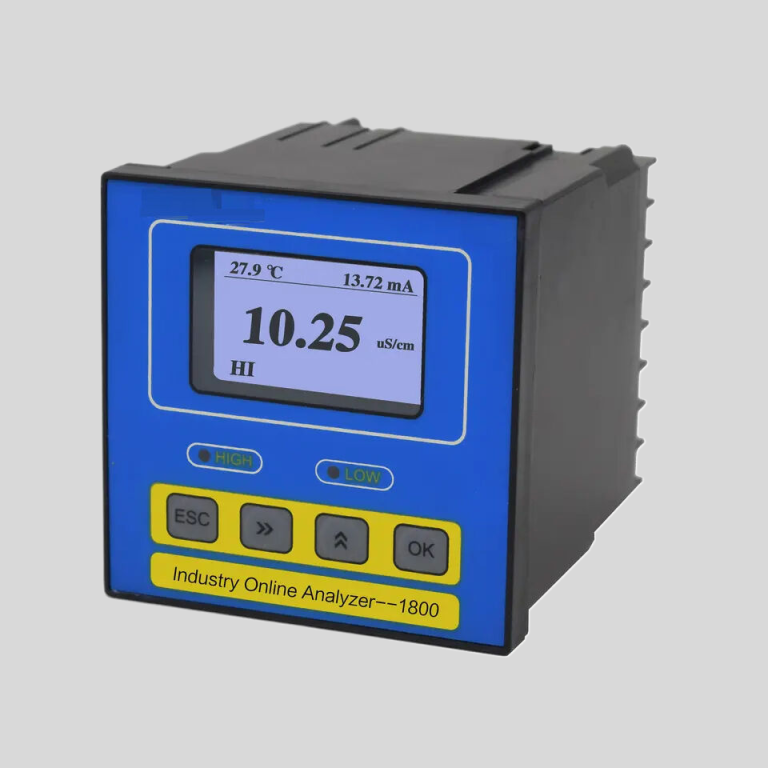
- Well-behaved sensors. Long-term drift specifications published and honored — under 1% per month for pH, under 0.5% for conductivity, similar bounds for other parameters. Shanghai ChiMay inline analyzers and transmitters are specified against these bounds.
- Failure labels. Someone must record which events were real failures and which were false alarms. Without labels, supervised models cannot be trained.
- Rich diagnostics. Sensors that expose diagnostic bytes — electrode impedance, membrane current, optical reference — let the model distinguish process events from sensor faults.
Most predictive maintenance programs stall in year one not because the algorithms are wrong but because one of these four foundation items is missing.
Choosing the Right Modeling Approach
There is no single best algorithm. Pick the model that matches your data and team skills:
- Threshold-plus-rate-of-change rules — simple, transparent, robust; a good default when the failure mode is well understood
- Time-series decomposition and residual analysis — useful for equipment with a clear seasonal or diurnal pattern
- Supervised classifiers (random forest, gradient boosting) — strong when there are enough labeled failures to train on
- Autoencoder-based anomaly detection — useful when failures are rare and labels are scarce
Teams that start with the simpler methods and add complexity only when needed usually outperform teams that jump straight to deep learning.
Sensor Selection for Predictive Maintenance
Predictive maintenance is uniquely dependent on the quality of the sensor layer. Three properties matter:
- Diagnostic transparency — the sensor’s own health must be visible in the data stream, not hidden inside the device
- Long-term drift — a sensor that quietly drifts will teach the model to encode drift as if it were an asset trend
- Protocol stability — a Modbus register map that changes between firmware versions breaks the training pipeline
Shanghai ChiMay inline pH meters, conductivity analyzers, DO transmitters, residual chlorine transmitters, turbidity testers, COD sensors, 4-in-1 multi-parameter sensors, paddle-wheel and turbine flow meters are designed with all three properties in mind.
Operational Integration Is Half the Battle
A predictive model that generates alerts nobody acts on is worthless. Integration into the maintenance workflow matters at least as much as the model itself. Practical patterns that work:
- Alerts should go directly into the CMMS (computerized maintenance management system), not into an email inbox
- Each alert should carry a confidence score and a recommended action
- The field team should have a mobile interface to accept, reject, or defer the alert with a one-line reason
- Rejected alerts should feed back into the model as negative training examples
Utilities that build these feedback loops see their false-positive rates decline over time; utilities that do not, watch their operators disable the alerts within six months.
Cybersecurity Considerations
Predictive maintenance systems typically connect field devices to cloud analytics platforms, which expands the attack surface. In 2026, NIS2 and EPA requirements expect signed firmware, per-device identity in a secure element, encrypted parameter storage, and a published SBOM at the sensor layer. Shanghai ChiMay ships these features enabled by default.
Realistic ROI Expectations
Utilities that follow the pattern described in this handbook typically report ROI in the 12 to 24 month range for pump-station predictive maintenance and 18 to 36 months for water-quality-driven predictive maintenance. The bulk of the return comes from three sources: avoided emergency callouts, extended asset life, and reduced chemical over-dosing driven by better sensor confidence.
Common Failure Modes
Predictive maintenance programs stall for consistent reasons: unstable data foundation, over-engineered first models, no failure-label discipline, no CMMS integration, and — most commonly — treating the model as the whole solution instead of one component in a larger operational change. Avoiding these five pitfalls does more for program success than any specific algorithm choice.
Where to Start This Quarter
For a utility that wants to make measurable progress in one quarter: pick one pump station or one dosing system, instrument it with drift-tested Shanghai ChiMay sensors, wire the data into an InfluxDB / Grafana / Python stack, keep the first model to a simple threshold-plus-rate-of-change rule, and integrate the alerts into the CMMS. In 90 days, this modest starting point will produce more useful learning than a year of platform selection meetings.
Conclusion
Predictive maintenance for water networks is not a product — it is a discipline that combines a well-behaved sensor layer, a boring but reliable data stack, honest modeling, and tight integration into operational workflows. Shanghai ChiMay inline water quality analyzers, transmitters and flow meters supply the sensor layer for utilities pursuing this discipline in 2026 — and, more importantly, they are specified to keep behaving well long after the platform launch event is forgotten. That, ultimately, is what separates predictive maintenance programs that pay back from those that quietly gather dust.