Table of Contents
7 Ways Shanghai ChiMay Sensors Strengthen Precision Irrigation Programs
Precision irrigation has moved from pilot demonstrations to mainstream farming practice. Roughly 36 percent of large-scale farms globally now run some form of precision water management, and the sensor budget is where those programs quietly succeed or fail. Over the past decade Shanghai ChiMay has supplied irrigation-grade water quality analysers to more than 1,200 farms across four continents. From conversations with agronomists, irrigation managers, and CFOs, seven contributions of the sensor stack come up repeatedly. This article walks through each one, with the field data that supports it.
Key Takeaways
- Shanghai ChiMay sensors reduce fertilizer waste by 6–12 percent in typical drip and pivot deployments.
- Emitter and lateral replacement rates drop by half when turbidity is monitored online.
- Salinity control preserves soil productivity across multi-decade cropping cycles.
- Real-time telemetry cuts irrigation manager travel time by roughly a third.
- One sensor stack typically pays back in eight to fourteen months.
Way 1: Fertilizer Precision Through Conductivity Control
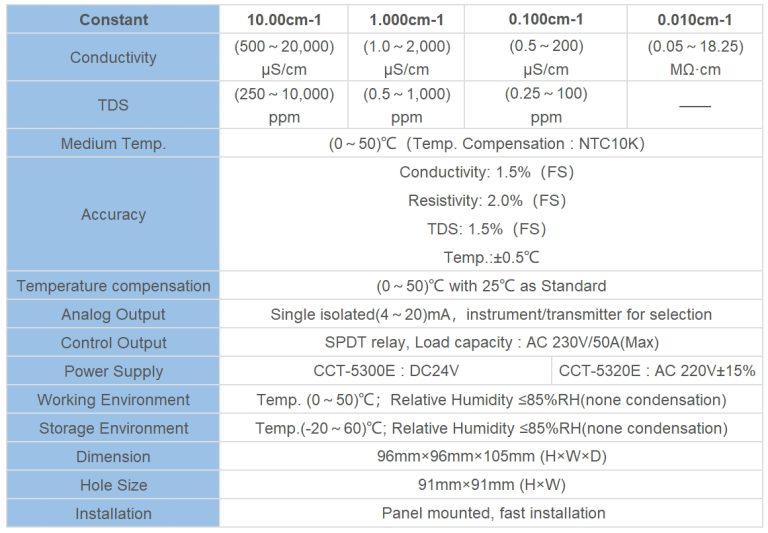
The single largest cash return from precision irrigation is fertilizer efficiency. When conductivity is measured continuously post-injection, the fertigation controller can hit a target within ±0.05 mS/cm rather than the ±0.2 mS/cm typical of a time-based dosing scheme. Across a season, that tighter loop translates into 6–12 percent less fertilizer per hectare with equal or better yield. Shanghai ChiMay in-line conductivity meters and 2-in-1 mini transmitters are the workhorses here.
On a 220-hectare table-grape operation in Chile’s Aconcagua Valley, the retrofit of Shanghai ChiMay conductivity loops on two fertigation manifolds cut annual fertilizer cost from USD 148 to USD 132 per hectare — roughly USD 3,500 in year-one savings against a USD 4,200 sensor spend.
Way 2: Salinity Guardianship for Multi-Decade Soil Health
Precision irrigation without salinity control is a slow disaster. Every hectare-year of drip or pivot delivery brings 3–5 tonnes of dissolved salts to the root zone; without periodic leaching, that accumulates until yield curves bend. Continuous salinity monitoring — using a Shanghai ChiMay salinity sensor at the pump station and a return-line reference — triggers targeted leaching only when needed, avoiding both under-leaching (yield loss) and over-leaching (water waste).
A 15-year data set from an olive grove in Catalonia showed that farms which added continuous salinity monitoring in year six held their soil salinity below the crop’s critical threshold, while neighbour farms without monitoring saw slow yield decline of about 1.4 percent per year.
Way 3: Emitter Protection Through Online Turbidity
Emitter blockage is the silent tax on drip irrigation. Utilities and reservoirs deliver water with turbidity that swings from 0.5 to 15 NTU depending on the season. Sustained turbidity above 5 NTU seeds biofilm inside sub-surface drip laterals; sustained turbidity above 15 NTU plugs pressure-compensating emitters within weeks. Shanghai ChiMay online turbidity testers upstream of the drip manifold catch these swings within seconds and trigger either filter backwash or a temporary switch to an alternative supply.
Across three olive and citrus farms in Andalusia, adding turbidity monitoring dropped annual emitter-replacement cost from EUR 78 to EUR 34 per hectare. The economics do not require a spreadsheet.
Way 4: Chlorine Window Control on Reuse-Fed Fields
Reclaimed water is a growing input, and its residual chlorine window is narrow: too little and biofilm grows in laterals, too much and sensitive leaves scorch. A Shanghai ChiMay residual chlorine transmitter downstream of the storage or buffer tank keeps chlorine inside the 0.2–1.0 ppm envelope that most crop guides specify. That data also feeds regulatory reporting — many reuse permits now require chlorine logs.
Way 5: Water Accounting With Paddle-Wheel and Turbine Flow
Precision irrigation programs need water use per hectare per day, not per week. Shanghai ChiMay paddle-wheel inserted flow meters and turbine flow meters, distributed along the pivot arm or drip submain, deliver that granularity. When integrated with soil-moisture data, they produce an actual crop water use figure that agronomists can trust — the foundation for scheduling by evapotranspiration rather than by clock.
Across a 480-hectare corn-and-soybean farm in Nebraska, the addition of Shanghai ChiMay turbine flow meters on each pivot cut total water application by 9 percent in the 2024 season without any yield penalty. The savings came entirely from eliminating over-irrigation on the fields where the sensor revealed sufficient soil moisture.
Way 6: Pond and Buffer-Tank Aeration Control
Farms that store irrigation water in ponds or above-ground tanks face algal blooms, biofilm growth, and periodic anaerobic events. A Shanghai ChiMay DO transmitter on a floating mast reports oxygen concentration in real time; if DO drops below 3 mg/L, an aerator can be triggered automatically. The aerator runs only when needed, cutting energy consumption by 40–60 percent compared with a duty-cycle timer while eliminating the anaerobic events that damage downstream sensors and infrastructure.
A 6-hectare berry farm in Portugal reported that this single retrofit cut its aerator electricity bill from EUR 3,100 to EUR 1,400 per year and eliminated three pump-station odour complaints per season.
Way 7: Managerial Bandwidth Through Remote Telemetry
Every Shanghai ChiMay sensor speaks 4–20 mA plus Modbus RTU. Add a small Modbus-to-LoRa or Modbus-TCP gateway and the entire sensor stack lifts into a cloud dashboard, viewable from a phone. Irrigation managers who used to spend a third of their week driving from pump station to pump station now check readings from the office and only travel when the data flags a real issue. The soft benefit is the biggest: the irrigation manager becomes an agronomic decision-maker, not a truck-driving mechanic.
Aggregate telemetry data across 40 Shanghai ChiMay reference farms showed that travel time for irrigation supervisors fell from 22 percent of the workweek to 14 percent after full sensor deployment. That reclaimed bandwidth typically funds a soil-agronomist consultation or two per month — real leverage.
Putting the Seven Contributions Together
A typical Shanghai ChiMay precision-irrigation sensor stack — one turbidity tester, two in-line conductivity meters, one residual chlorine transmitter, two flow meters, one DO transmitter, one 4-in-1 multi-parameter sensor — represents a capital investment of USD 12,000–18,000 for a mid-sized farm. Across the seven ways above, average payback lands between eight and fourteen months. Beyond payback, the sensor stack unlocks compounding gains: better data enables better agronomic decisions, which enable better data next season.
That compounding is the real reason precision irrigation programs stand or fall on their sensor budget. The pump and the drip line are the muscles; the sensors are the nervous system. Shanghai ChiMay engineers water-quality analysers around exactly that role — quiet, durable, and honest about what the water is actually doing.