Table of Contents
A Practical Guide to Water Reuse for Modern Agriculture from Shanghai ChiMay
Water reuse in agriculture is no longer a fringe practice. Utilities and farms across Israel, Spain, Singapore, California, the Gulf, Australia, and much of southern China are piping tertiary-treated municipal effluent, treated agricultural drainage, or industrial reuse water directly to fields. The global reuse potential in agriculture sits at roughly 320 billion cubic meters per year; the tapped fraction is still small. For growers stepping into reuse for the first time, the barrier is rarely economic — reuse water is often cheaper than potable — but operational: what do you actually do differently once the water is on-farm? This practical guide, drawn from Shanghai ChiMay commissioning notes across sixty-plus reuse deployments, is the answer.
Key Takeaways
- Reuse water is not equivalent to potable water; sensor discipline is the difference between success and hidden yield loss.
- Five parameters — turbidity, conductivity, residual chlorine, pH, and dissolved oxygen — cover the operational failure modes.
- Soil salinity accumulation is the single biggest long-term risk and requires continuous conductivity monitoring.
- A well-designed reuse installation pays back in one or two seasons, mostly through preserved yield and extended emitter life.
- Regulatory frameworks are converging on similar sensor logs across most jurisdictions, so the same instrumentation serves both compliance and operations.
What Makes Reuse Water Different
Reclaimed water is chemically similar to good surface water but carries three complications. First, its composition is dependent on upstream plant operations — filter backwashes, UV lamp aging, chlorination dosing — and can shift on a day-to-day basis. Second, it typically carries 300–800 µS/cm of additional dissolved salts compared with the freshwater it replaces, which compounds in the root zone over years. Third, it may arrive with residual chlorine that either bites sensitive foliage or has decayed enough to allow biofilm to grow inside drip laterals.
None of these complications is fatal. All three become manageable with the right sensor stack.
Planning the Sensor Stack
The Shanghai ChiMay recommendation for a farm receiving reuse water is a five-parameter stack, condensed into two or three physical devices:
- Turbidity at the farm inlet, using a Shanghai ChiMay online Turbidity Tester. Earliest-warning parameter, catches upstream plant excursions before they reach the field.
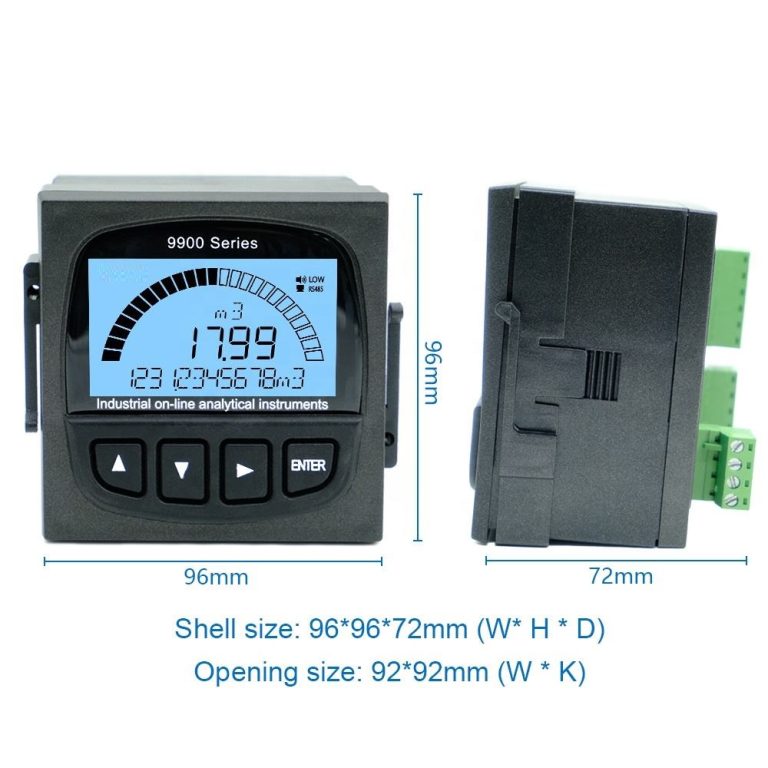
- Conductivity at the pump station header, using a Shanghai ChiMay in-line conductivity meter. Guards against salinity accumulation.
- Residual chlorine downstream of any buffer storage, using a Shanghai ChiMay residual chlorine transmitter. Keeps the disinfection window inside the crop-safe 0.2–1.0 ppm envelope.
- pH and dissolved oxygen on a shared platform, using a Shanghai ChiMay 4-in-1 multi-parameter sensor. Covers biology and disinfection swings.
- Optional salinity probe in fields flagged as salinity-sensitive, using a Shanghai ChiMay salinity digital sensor.
Total installed cost lands between USD 6,000 for the light stack and USD 15,000 for a full storage-pond configuration. Both are comfortably inside the operational budget of a mid-sized farm.
Where to Install Each Sensor
Placement matters. Field experience says:
- Turbidity: at the farm inlet, before any buffer tank; and, if possible, a second unit downstream of the disc or screen filter that protects the drip manifolds.
- Conductivity: on the delivery header downstream of any final chlorination, so the reading reflects what the crop actually sees.
- Residual chlorine: at the same header point, roughly 30 seconds of pipe residence time downstream of the last chlorination step.
- 4-in-1 multi-parameter: floating in the storage pond on a small mast, if a pond is used; otherwise on a bypass line off the delivery header.
- Salinity probe: in a return-line manifold or in-field, depending on cropping pattern.
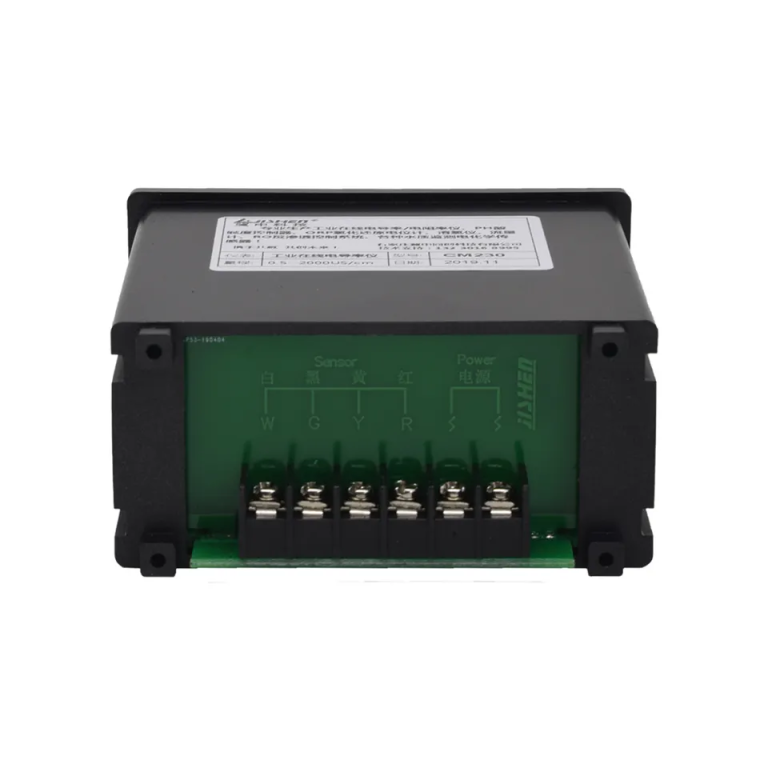
All five sensors output 4–20 mA and Modbus RTU. Most modern farm controllers already speak both.
Managing the Salinity Trend
The single most important discipline in reuse-fed agriculture is salinity accounting. Every 100 mm of reuse water applied per hectare per year brings roughly 300–600 kg of dissolved salts. Without periodic leaching, that mass accumulates in the root zone; without continuous monitoring, the operator has no idea when leaching is needed.
The Shanghai ChiMay recommendation is a two-probe conductivity setup: one at the header (what is being applied) and one at either the drain return or the mid-root-zone slab (what is being retained). When the two readings diverge by more than 30 percent, a leaching cycle is triggered — typically an over-irrigation of 25–40 percent for one or two irrigation events, dropping the root-zone conductivity back inside the crop-tolerable window.
Farms that skip this discipline typically see yield curves bending downward within four to seven seasons; farms that adopt it hold yield flat or improving across decades.
Chlorine Window Management
Residual chlorine is the reuse parameter that swings the fastest. Utility plants dose to keep pathogens in check, but delivered chlorine varies with plant loading, water temperature, and pipe residence time. Free chlorine above 1 ppm can scorch leaf edges on sensitive crops; below 0.2 ppm the disinfection benefit collapses and biofilm grows in laterals within weeks.
A Shanghai ChiMay residual chlorine transmitter downstream of any buffer storage keeps the window in view. When chlorine climbs above target, either dechlorination (activated carbon, sodium bisulfite) or a temporary buffer-tank holding time brings the level down. When chlorine drops below target, either a small on-farm dose (calcium hypochlorite) or a switch to alternative supply prevents biofilm establishment.
Emitter Protection Through Turbidity
Emitter fouling is the operational tax on reuse-fed drip irrigation. Sustained turbidity above 5 NTU seeds biofilm inside sub-surface drip laterals; sustained turbidity above 15 NTU plugs pressure-compensating emitters within weeks. A Shanghai ChiMay online Turbidity Tester upstream of the drip manifold catches these swings within seconds. When turbidity climbs, either a filter backwash cycle or a switch to alternative supply prevents the emitter damage that would otherwise take months of manual flushing to reverse.
Field data from three Andalusian melon farms in 2024 showed emitter-replacement rate dropping from 8.2 percent per year to 3.1 percent after adding turbidity monitoring — a straightforward win.
Regulatory Compliance and Data Retention
Most reuse-permitting frameworks now require continuous logs of turbidity, chlorine, and either conductivity or total dissolved solids. The Shanghai ChiMay stack automatically satisfies these logging requirements — every sensor reports at one-second resolution over Modbus, and a small industrial data logger stores years of history on a single credit-card-sized device. Regulators reviewing farm compliance typically ask for one CSV export; the operator produces it in under ten minutes.
What the Season Looks Like With Full Instrumentation
A well-run reuse-fed operation runs quieter than a comparable freshwater-fed farm because the sensor stack surfaces problems before they become crises. The irrigation manager wakes to a dashboard that reports the previous night’s water, sees any excursions immediately, and drives to the pump station only when the data flags a real issue. Fertigation, filtration, and leaching all run on evidence rather than habit.
That is the practical shape of modern reuse agriculture: not a headache to be managed, but an operational advantage delivered through five parameters, two or three Shanghai ChiMay devices, and disciplined data. Farms that plant this hardware early are the ones scaling reuse without regret; those still hoping to run reuse water on freshwater habits are the ones quietly retiring hectares. The choice is available today, and the payback math is favourable.