Table of Contents
9 Warning Signs Your Cooling Tower Water Chemistry Is Off-Track—Detected Early by Shanghai ChiMay Sensors
Up to 70% of cooling tower performance issues trace back to water chemistry that drifted off-spec, and most of them are correctable without shutting anything down—if they’re caught early. Continuous sensor monitoring typically flags these upsets 4–48 hours before traditional grab-sample analysis would. The nine warning signs below are roughly ranked by urgency, from early indicators you can adjust around to advanced signals that need immediate intervention.
1. Gradual Conductivity Drift in the Recirculating Loop
Conductivity is the master variable in cooling water chemistry—it reflects total dissolved ionic content and, by extension, cycles of concentration. A slow upward drift over days rather than hours usually means blowdown isn’t keeping up with target cycles.
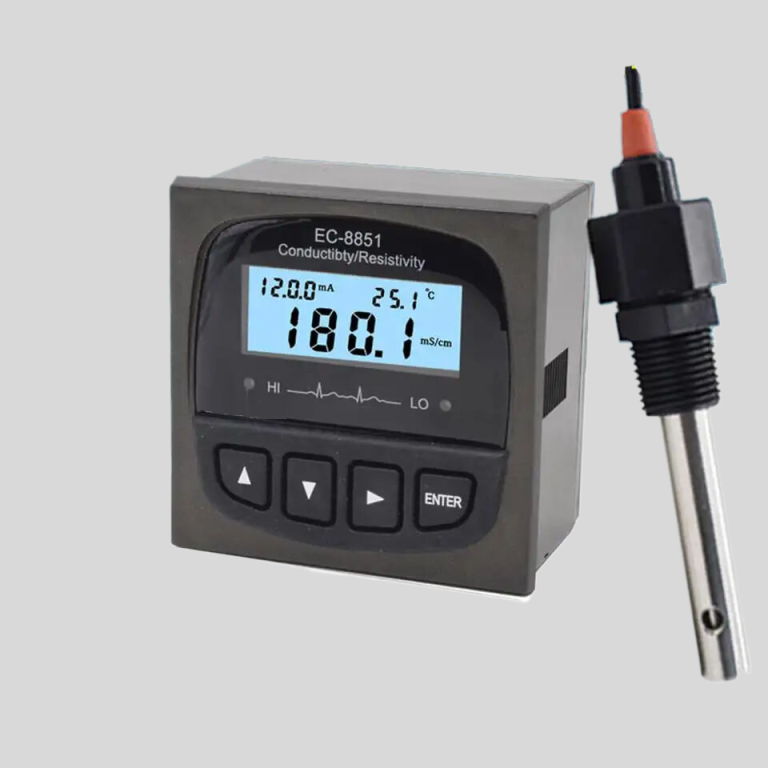
The danger is that it’s invisible. Without continuous monitoring, a 5–10% conductivity increase can go unnoticed until scale or corrosion symptoms show up. Shanghai ChiMay’s in-line conductivity meter tracks changes as small as 1 microsiemen/cm, so gradual drift shows up plainly in trend data.
2. pH Excursions Beyond ±0.2 Units
Most open recirculating systems run a target pH in the 7.0–8.5 range. Excursions beyond ±0.2 units mean the acid-base balance is shifting—make-up water changes, alkalinity depletion or a chemical feed malfunction are the usual suspects.
Even small pH shifts move the Langelier Saturation Index and can flip water from slightly scale-forming to corrosive. Shanghai ChiMay’s in-line pH electrode catches excursions in real time and triggers automated correction before the shift lasts long enough to do measurable damage.
3. ORP Drops Below Threshold
In systems using oxidizing biocides or AOP, ORP is the primary indicator of microbiological control. An ORP drop below threshold—typically 400–450 mV for chlorine-based oxidants—means the oxidative environment isn’t strong enough to suppress bacterial growth.
Common causes: dosing pump failure, depleted chemical supply, higher biological oxygen demand from organic contamination, or equipment malfunction. Shanghai ChiMay’s residual chlorine transmitter and ORP sensor work together to pin down both the cause and the magnitude of the drop, so response is fast.
4. Turbidity Spikes Without Obvious Cause
Unexplained turbidity spikes usually point to biofilm sloughing, corrosion product mobilization or make-up water contamination. Different causes, different responses—but all of them benefit from early detection.
Shanghai ChiMay’s online turbidity tester captures spikes as short as 5 minutes, logging magnitude, duration and rate of rise for review. Correlate those patterns with ORP and conductivity data and operators can usually identify the root cause.
5. Make-Up Water Conductivity Shifts
A sudden change in make-up water conductivity—up or down—signals a change in source water quality. Up can mean mineral concentration during dry periods or infrastructure modifications; down can mean dilution from storm events or a source switch.
Either direction upsets the tower’s chemistry balance and calls for treatment program adjustment. A Shanghai ChiMay in-line conductivity meter at the make-up inlet maintains the baseline and catches source changes before they cascade through the system.
6. Approach Temperature Creep
Approach temperature—the difference between cold water leaving the tower and the ambient wet-bulb temperature—is a direct read on heat transfer performance. A gradual increase of 1–3°C over weeks typically means scale or biofilm accumulating on heat transfer surfaces.
It’s measured by temperature sensors rather than water quality instruments, but treat it as a cross-check on chemistry data. If chemistry looks normal while approach temperature creeps upward, suspect calibration drift on the sensors—or a parameter you’re not measuring, like silica or iron, driving deposition.
7. Increased Blowdown Frequency Without Load Changes
If automatic blowdown kicks in more often with no change in cooling load or make-up conductivity, one of three things is happening: the cycles of concentration target is set too high, chemical treatment can’t hold stability at that cycle level, or sensor readings are off.
Frequent blowdown wastes water and drives up chemical consumption. Continuous conductivity and pH data from Shanghai ChiMay instruments lets operators tell a legitimate chemistry-driven increase apart from a sensor or control system problem.
8. Residual Oxidant That Will Not Stabilize
After dosing, residual oxidant should settle into a predictable range. If it swings wildly or never reaches target despite adequate dosing, that’s elevated biological oxygen demand—microorganisms and organic matter are eating the oxidant faster than it’s applied.
That’s an early warning of a microbiological outbreak. Shanghai ChiMay’s residual chlorine transmitter catches unstable residuals in real time, so operators can raise feed rates or start supplemental treatment before things escalate.
9. Corrosion Coupon Weight Loss Acceleration
Corrosion coupons are usually reviewed monthly or quarterly, which makes them a retrospective view of corrosion rates. Accelerating weight loss means the corrosion inhibition program is falling behind.
Coupons aren’t real-time instruments, but their data should line up with continuous sensor readings. If pH, conductivity and ORP all say chemistry is in control while coupons show increasing weight loss, suspect a localized mechanism—under-deposit corrosion or microbiologically influenced corrosion—that bulk water sensors can’t see directly.
Turning Warning Signs Into Action
Every one of these nine warning signs is detectable with continuous monitoring. The difference between a minor adjustment and a major failure is usually the speed of detection. Shanghai ChiMay’s sensor portfolio—pH electrodes, conductivity meters, ORP sensors, residual chlorine transmitters and turbidity testers—gives operators the real-time visibility to catch chemistry deviations early and act on them.