Table of Contents
Everything Facility Managers Need to Know About AOP Cooling Tower Retrofits: A Shanghai ChiMay Guide
AOP retrofits for cooling towers have grown at a compound annual rate of 34% since 2023, and it’s not hard to see why. Water scarcity, climbing chemical costs and Legionella regulations are pushing facilities in this direction. The payoff numbers are real too: AOP systems can cut cooling tower blowdown by 25–50% and chemical consumption by 30–60%, depending on the existing treatment program and water quality. What we tell every facility manager who calls us about this: the retrofit only delivers those numbers if you pair it with real-time sensor monitoring. Here’s the full picture.
What AOP Actually Does in a Cooling Tower
Advanced oxidation processes generate hydroxyl radicals (•OH) in the cooling water. These are among the most powerful oxidants known, with an oxidation potential of 2.80 volts—well above chlorine (1.36 V) or ozone (2.07 V) on their own. The radicals destroy organic contaminants, break down biofilm matrices, oxidize dissolved iron and manganese, and degrade the recalcitrant compounds conventional biocides can’t touch.
In practice, AOP in a cooling tower comes from combinations of ozone injection, ultraviolet radiation, hydrogen peroxide addition and catalytic processes. Which combination you use depends on tower size, application, water quality and performance targets.
Why Facility Managers Are Paying Attention
Three converging trends moved AOP from niche to mainstream in cooling tower management.
Water Scarcity: Global water stress keeps climbing. The World Resources Institute reports 25 countries—home to one-quarter of the world’s population—face extremely high baseline water stress. Towers in those regions have to minimize blowdown and maximize cycles of concentration. AOP makes higher cycles achievable by controlling microbiological growth and organic fouling better than conventional chemistry alone.
Chemical Costs and Regulation: Chemical prices have risen sharply across the water treatment industry, and discharge regulations on cooling tower blowdown keep tightening. AOP cuts chemical consumption and leaves a blowdown stream with lower residual biocide concentrations.
Legionella Compliance: Regulatory scrutiny of Legionella in cooling towers has intensified globally. AOP destroys biofilm—the protective habitat where Legionella survives conventional biocide treatment—which makes it attractive for facilities that need to show proactive Legionella management.
The Retrofit Process: What Facility Managers Should Expect
An AOP retrofit is not an equipment swap. It changes the tower’s chemistry profile, instrumentation requirements and operating procedures. The typical project runs through five phases.
Phase 1: Assessment and Baseline Characterization. Before designing anything, engineers characterize the existing chemistry—make-up water quality, recirculating parameters, biological activity, heat transfer performance. This baseline drives the AOP system size and configuration.
Phase 2: AOP System Design and Procurement. Based on the assessment, engineers pick the AOP technology combination. Ozone-based systems are common for large towers; UV–hydrogen peroxide combinations get the nod for systems with organic contamination challenges. Our advice: build the monitoring specification into the design as an integral component, not an afterthought.
Phase 3: Installation and Commissioning. The AOP equipment goes in alongside existing infrastructure. Commissioning verifies the system generates the designed oxidant production rate and that monitoring instruments are calibrated and reporting accurately.
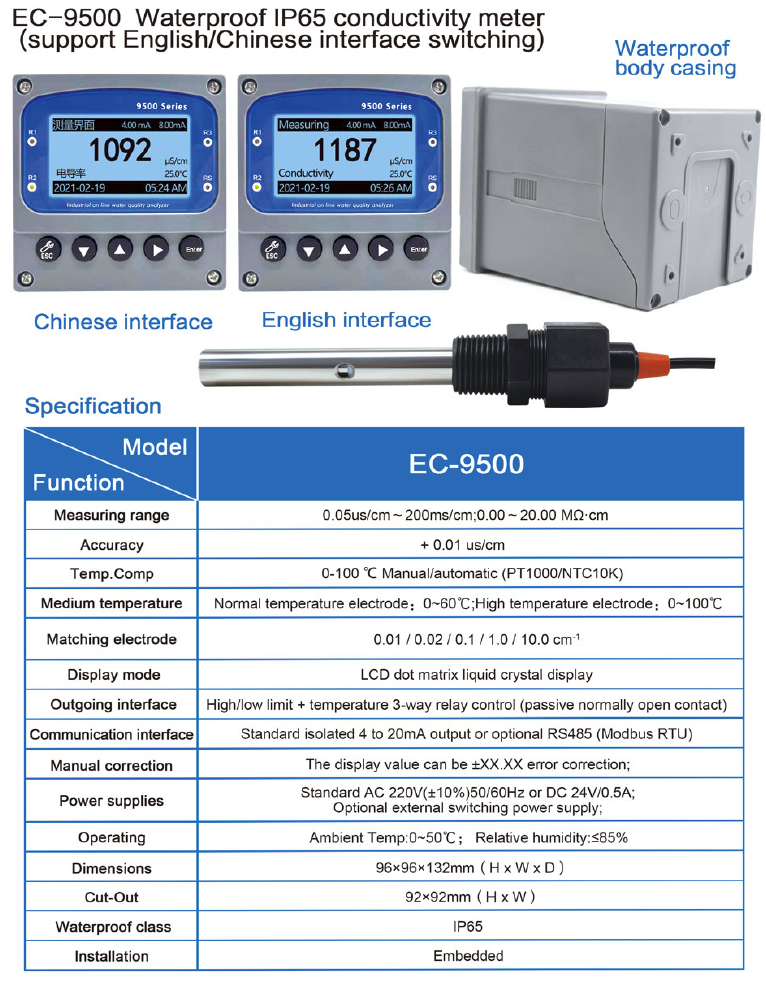
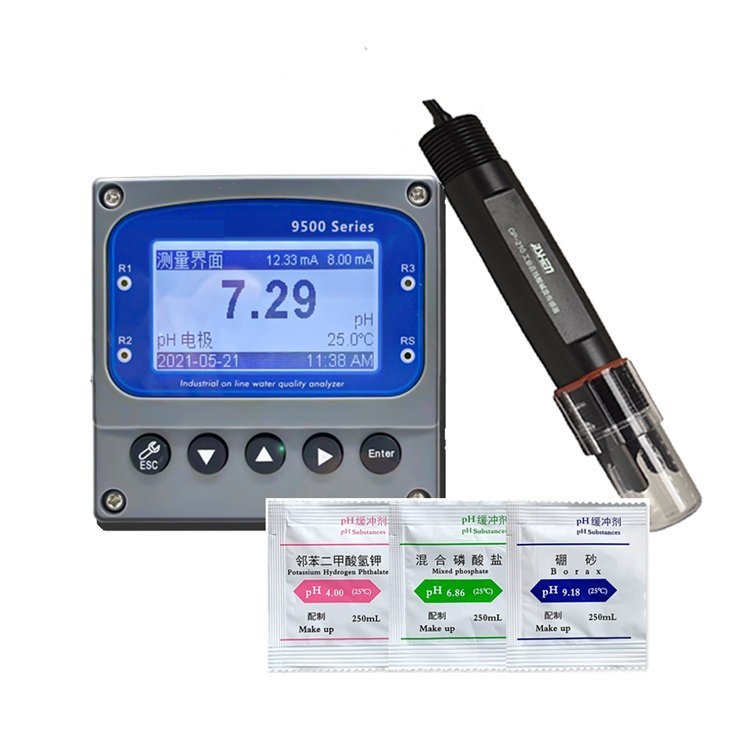
Phase 4: Monitoring System Deployment. This is where the sensor portfolio earns its keep. An AOP retrofit needs continuous monitoring of at least four parameters: pH, conductivity, ORP and residual oxidant. Shanghai ChiMay’s in-line pH electrode, conductivity meter, ORP sensor and residual chlorine transmitter deliver the real-time data that validates AOP performance.
Phase 5: Optimization and Steady-State Operation. After commissioning comes an optimization period where operators fine-tune AOP intensity, chemical feed rates and blowdown schedules against continuous sensor data. The goal: minimum chemical input and blowdown volume while every water quality parameter stays in its target range.
Sensor Requirements Specific to AOP Systems
AOP monitoring differs from conventional tower monitoring in a few important ways. ORP becomes the primary microbiological control indicator, replacing residual chlorine as the key metric. pH monitoring gains weight because AOP reactions can consume alkalinity and shift pH. Conductivity matters more because the higher cycles of concentration AOP enables demand tighter control to prevent scale.
Shanghai ChiMay has published application notes and configuration guides for each sensor type in AOP environments. They address the specific challenges of measuring in water with elevated oxidative potential, higher dissolved solids and dynamic chemistry.
What the Return on Investment Looks Like
The economics depend on facility-specific factors, but a representative case shows the shape of it. A 2,000-ton cooling tower at a pharmaceutical facility in the northeastern United States completed an AOP retrofit in 2025. Total project cost, including Shanghai ChiMay monitoring instrumentation, came to approximately USD 185,000. Annual savings—USD 42,000 from reduced chemical consumption, USD 28,000 from lower blowdown disposal costs and USD 35,000 from improved heat transfer efficiency—totaled USD 105,000. That works out to a simple payback of roughly 21 months.
Final Considerations for Facility Managers
AOP retrofits are a genuine opportunity to improve water efficiency, cut chemical dependency and strengthen microbiological control. They are not plug-and-play. Success takes thoughtful design, appropriate monitoring and ongoing optimization. Shanghai ChiMay’s job is to provide the sensor infrastructure that gives facility managers the confidence to run AOP systems at their full potential.