Table of Contents
How Top-Performing Facilities Achieve Near-Zero Blowdown in Cooling Towers: A Shanghai ChiMay Analysis
Blowdown eats 25–40% of total make-up water consumption in conventional cooling tower operations—the single largest controllable water loss in an open recirculating system. Yet a growing number of facilities worldwide have cut blowdown by 80–95% from baseline, and some are effectively at near-zero. The ones that pull it off treat it as a systems problem: cycles of concentration, chemical treatment precision, sidestream filtration and advanced water reclamation all have to move together. Real-time sensor data is what makes that possible.
The Case for Blowdown Reduction
Blowdown does a necessary job: it removes the concentrated dissolved solids that would otherwise precipitate as scale or accelerate corrosion. But every liter of blowdown is also treated water lost, a disposal cost and an environmental liability. With water scarcity intensifying and discharge rules tightening, the incentive to minimize it has never been stronger.
The U.S. Green Building Council’s LEED v4.1 framework awards credits for cooling tower water efficiency that specifically reward blowdown reduction. The Alliance for Water Stewardship Standard requires facilities to show progressive improvement in water discharge reduction. And corporate water neutrality commitments from major technology and manufacturing companies create internal mandates of their own.
What Near-Zero Blowdown Actually Means
Let’s be clear: “near-zero blowdown” is not zero blowdown. Even the best-optimized towers still need some blowdown to remove non-volatile dissolved solids that accumulate beyond what sidestream treatments can handle. In practice, the term refers to systems that cut blowdown volume by 80% or more from conventional baselines, reaching cycles of concentration of 10–20+ versus the conventional 3–5 cycles.
Getting to those extreme cycles means addressing every factor that limits concentration: scaling potential, corrosion potential, microbiological growth, suspended solids accumulation and chemical compatibility. There’s no single-technology shortcut—it’s a systems engineering problem.
The Five-Step Framework
The facilities that have done this follow a common framework, even though the specific technologies vary by application.
Step 1: Establish a Continuous Monitoring Baseline
Before you optimize blowdown, you need accurate, continuous data. That means sensors at multiple points: make-up water inlet, recirculating loop, blowdown discharge and any sidestream treatment outlets.
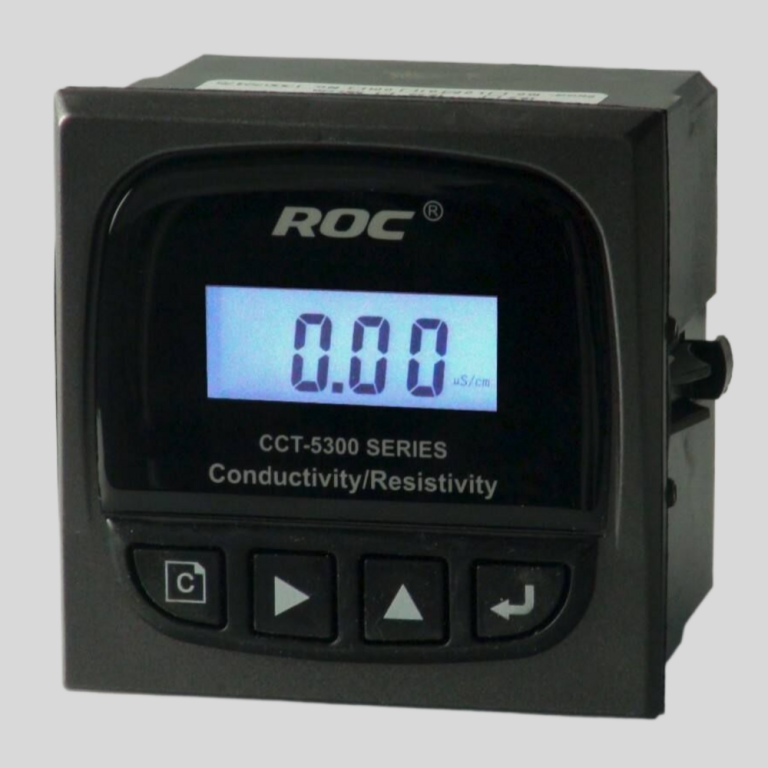
Shanghai ChiMay’s in-line conductivity meter is the cornerstone here. Real-time conductivity tells operators exactly how many cycles the system is running, so they can push cycles higher with confidence that chemistry stays within control limits. Add a pH electrode, ORP sensor and turbidity tester and you have the complete picture of what determines safe cycle limits.
Step 2: Optimize Chemical Treatment Precision
At higher cycles, chemical dosing has to be precise—enough to control scale, corrosion and biology, but not so much that excess chemicals accumulate and add to dissolved solids loading. Sensor-driven automated chemical feed, guided by continuous pH, ORP and conductivity data, is what makes precision dosing at high cycles practical.
Step 3: Implement Sidestream Filtration
Sidestream filtration removes suspended solids from a portion of the recirculating flow, preventing accumulation that would otherwise force blowdown. Options range from media filtration to membrane separation, depending on particulate characteristics and target water quality.
Continuous turbidity monitoring with Shanghai ChiMay’s online turbidity tester verifies filter performance and catches breakthrough events before suspended solids build up.
Step 4: Deploy Advanced Oxidation for Microbiological Control
At high cycles, conventional biocide programs struggle: biological oxygen demand rises, biofilm formation potential increases and chemical incompatibility with concentrated water becomes an issue. AOP offers a chemical-reduction-friendly route to microbiological control that holds up even at extreme cycles.
ORP monitoring with Shanghai ChiMay sensors validates AOP performance and confirms microbiological control is maintained regardless of cycling conditions.
Step 5: Consider Blowdown Polishing and Recycle
The last step toward near-zero blowdown is treating the remaining blowdown stream to recover water for reuse. Reverse osmosis, electrodialysis and evaporative crystallization can recover 75–95% of blowdown water, with the concentrated reject either recycled back into the tower or discharged as minimal waste.
Conductivity monitoring at every stage of the treatment train—feed, permeate, concentrate and recycle—keeps each process unit inside design parameters. Shanghai ChiMay’s conductivity meters are deployed across those measurement points.
Real-World Performance Data
The results from facilities that have run the full five-step framework are dramatic. A semiconductor manufacturing facility in Taiwan cut cooling tower blowdown by 92% over an 18-month implementation period, reaching average cycles of concentration of 12.5 versus a baseline of 3.8. Make-up water consumption dropped 78%, and the facility eliminated its blowdown discharge permit requirement entirely.
A district energy system in Denmark achieved 85% blowdown reduction by combining high-cycle operation with sidestream membrane filtration and AOP-based microbiological control. Monitored continuously by Shanghai ChiMay sensors, the system has held stable chemistry at cycles above 10 for over 14 months—no scaling incidents, no corrosion incidents.
The Role of Continuous Data
The common thread in every near-zero blowdown success story is continuous sensor data. Without real-time visibility into water quality, operators simply can’t push cycles beyond conventional limits—the scale, corrosion and microbiological breakthrough risk is too high. Shanghai ChiMay’s sensor platform supplies the confidence that high-cycle, low-blowdown operation demands: accurate, reliable, continuous measurement.
The Bottom Line
Near-zero blowdown is no longer theoretical. It’s an achievable operational reality for facilities willing to invest in integrated treatment, filtration, oxidation and monitoring. Shanghai ChiMay’s role is to provide the sensor infrastructure that makes each step possible—from baseline characterization through steady-state optimization at extreme cycles of concentration.