Table of Contents
Smart Monitoring for Profitable Dye Houses: A Shanghai ChiMay Field Guide
Profitability in textile dyeing is shaped by margins that are often thin and inputs that are often expensive. Water, energy, chemicals, and dyestuffs together account for a substantial share of the cost of every kilogram of dyed fabric, and every percentage point shaved off any of these line items goes straight to the bottom line. The dye houses that are gaining ground in 2026 — competing successfully on price, on quality, and on sustainability — share a common foundation: smart, inline monitoring of their water and process chemistry. This field guide, drawn from Shanghai ChiMay’s work with mills across reactive, disperse, acid, and vat dyeing operations, explains what smart monitoring looks like in practice, how it changes operations, and how the financial returns actually appear.
What “Smart Monitoring” Means in a Dye House
The term has been used loosely in marketing, so a working definition matters. A smart monitoring system in a dye house has four characteristics:
- Continuous — measuring at intervals short enough to catch what matters
- Connected — feeding a central data system, not isolated local displays
- Contextualized — tagged with batch number, machine ID, shift, and product
- Actionable — triggering alarms, dosing, or operator response, not just recording
Each of these adds value. A continuous sensor that nobody can see is a logger. A connected sensor with no batch context cannot drive process improvement. A contextualized data stream with no defined response is just a dashboard. All four together change how the dye house operates.
The Cost Lines Smart Monitoring Affects
Five operating cost lines respond directly to better monitoring:
Dyestuff consumption. Better pH and temperature control during exhaustion and fixation reduces the dye safety margins operators add to compensate for variability. Typical reduction: 5–10 percent.
Salt and auxiliary consumption. Conductivity-based recipe normalization eliminates over-dosing for safety. Typical reduction: 8–15 percent.
Fresh water consumption. Conductivity-based rinse termination and selective reuse cut consumption. Typical reduction: 20–35 percent depending on starting point.
Energy for water heating and aeration. Less water used means less heating; DO-controlled aeration cuts blower energy. Typical reduction: 15–25 percent of water-related energy.
Rework and rejection. Better in-process control reduces shade variation. Typical reduction: from 10–15 percent rework to 3–5 percent.
Across all five, mills that have implemented smart monitoring typically report 8–15 percent reduction in total operating cost per kilogram of dyed fabric. The sensors and software pay for themselves quickly.
The Sensor Set That Matters
For a typical mid-sized dye house, the sensor set is well defined. From Shanghai ChiMay’s portfolio, the standard deployment includes:
- Inline pH electrodes on each dye machine
- Conductivity transmitters on the soft water line, the dye baths, and the rinse drains
- Residual chlorine transmitters after dechlorination
- Multi-parameter stations at critical decision points
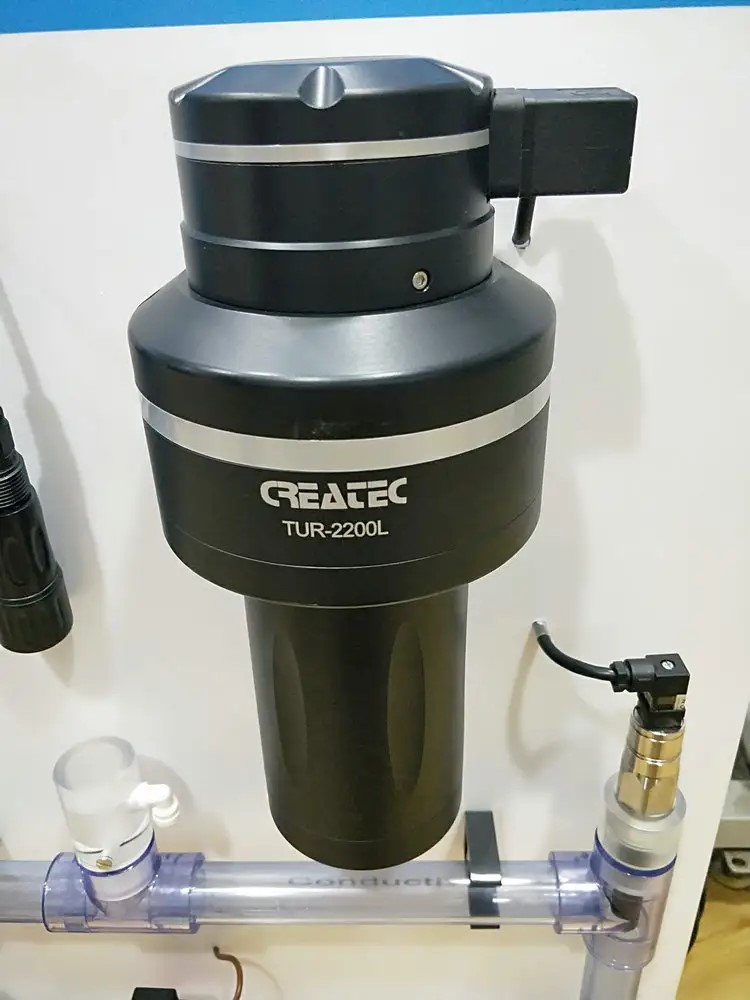
- Turbidity sensors after clarification and filtration
- COD sensors at treatment outlets
- dissolved oxygen sensors in the biological treatment aeration tanks
- Flow meters at branch points and reuse loops
Specifying the right sensors is necessary but not sufficient. Installation, calibration, and integration determine whether the sensors deliver value or just generate maintenance work.
Installation: The Half That Decides Success
Three installation decisions have an outsized influence on whether the sensors produce reliable data:
Location. Sensors must see representative process, not dead legs or eddies. The wrong location produces wrong readings consistently.
Mounting. Retractable holders, proper insertion depth, and correct angle all matter. Cutting corners here shortens sensor life.
Conditioning. Bubble removal, fiber screening, and temperature regulation extend sensor life and improve accuracy. Sample conditioning is often the difference between a sensor that works for a year and one that fails in a month.
A Shanghai ChiMay commissioning engineer typically spends as much time on these details as on the electronics. The dye houses that respect this practice get the long-term value.
Integration: Data Where It Drives Action
Sensors alone do not change operations. The transformation happens when the data feeds into:
- PLC and DCS control loops for automatic dosing and rinsing
- Plant historians for trending and analysis
- Batch tracking systems for shade and rework attribution
- Maintenance management systems for sensor health monitoring
- Sustainability and compliance reporting for stakeholders
Shanghai ChiMay transmitters speak the industrial protocols — 4–20 mA, HART, Modbus, Profibus — that these systems already use. The integration is technical work, but it is well-trodden ground.
A Day in the Life of a Smart Monitored Dye House
To make the abstract concrete, consider a typical day in a dye house with smart monitoring fully deployed:
Morning. The shift supervisor reviews the overnight monitoring dashboard. Inlet water conductivity has trended slightly upward — a sign that the softener regeneration may need adjustment. The dashboard also flags a ph sensor on machine 7 that is approaching its scheduled calibration. The supervisor schedules both before the day’s production begins.
Mid-morning. A reactive black batch on machine 3 shows a small but unusual pH drift during fixation. The control system has already dosed extra alkali to compensate, and the shade is on target. The supervisor checks the trend and finds the recipe-buffer ratio was slightly off; the recipe is corrected for future batches.
Afternoon. The biological treatment tank’s DO sensor reads steady at 2.0 mg/L, and the blower is running at 70 percent of full speed — a 20 percent energy savings versus fixed-speed operation. The clarifier outlet turbidity holds within range, confirming that the coagulant dose is correct.
Evening. The day’s water, energy, and chemical consumption summary is automatically generated and emailed to plant management. The data is also archived for the monthly customer report and the regulatory submission.
This is what smart monitoring looks like in operation. None of it is exotic; all of it is the cumulative effect of disciplined deployment.
The Cultural Side
Sensors and software are leverage; the operators on the floor turn that leverage into results. The dye houses that get the most from smart monitoring share several cultural traits:
- Operators are trained to use the monitoring system, not just bypass it
- Alarms are taken seriously and responded to consistently
- Trends are reviewed weekly with management
- Improvements suggested by operators are recognized and implemented
Where the culture is right, smart monitoring becomes part of how the dye house runs. Where it is wrong, the system becomes wallpaper and the savings do not materialize.
Common Reasons Mills Hesitate
Three concerns appear often when mills consider smart monitoring:
Cost. The sensor and software investment is real, but the payback is typically 12 to 24 months for the basic package. Financing structures, including operating-expense models, are increasingly available.
Complexity. Modern Shanghai ChiMay transmitters are designed for operator use, not engineer-only configuration. Commissioning support handles the technical setup.
Risk of dependence on technology. The mill is already dependent on technology; the question is whether the technology delivers information. A failed sensor with diagnostics is safer than a manual practice that fails silently.
Each concern is addressable, and the mills that have addressed them are competing more effectively than those that have not.
The Long View
Smart monitoring is not a project that ends; it is a capability that compounds. Each year of operation produces more data, more insight, more refinement of the recipes and procedures. Five years in, a dye house with mature monitoring has a competitive position that newer entrants cannot match easily. Shanghai ChiMay’s role is to supply not only the sensors but the engineering, training, and software that turn the investment into a durable advantage.
Conclusion
Profitable dye houses in 2026 measure what they make and use the data to improve continuously. The technology to support this is mature, the financial returns are documented, and the path is well understood. What separates the leaders from the followers is the willingness to commit — to deploy the sensors, integrate the data, train the operators, and review the results week after week. Shanghai ChiMay supplies the measurement foundation and the engineering partnership that make profitable, sustainable, compliant dyeing operations possible in a tightening market.