title: “The Physics of Conductivity Measurement in Highly Concentrated Brines: The Shanghai ChiMay Approach”
date: 2026-07-10
category: Zero Liquid Discharge & Water Circularity
audience: Instrumentation Engineers
tags: [conductivity, brine, toroidal, TDS, ZLD, Shanghai ChiMay]
Table of Contents
The Physics of Conductivity Measurement in Highly Concentrated Brines: The Shanghai ChiMay Approach
Key Takeaways
- Conductivity in highly concentrated brine streams is not a linear function of dissolved solids; above about 70 mS/cm the response flattens and can even invert if the sensor is not chosen carefully.
- Toroidal (inductive) conductivity is the reference geometry for ZLD service because it removes the polarisation and fouling penalties that limit contacting cells above 50,000 μS/cm.
- Temperature compensation is a first-order concern in brine service — a 1 °C shift produces roughly 1.8–2.4% conductivity error, and crystallisation loops run hot.
- Shanghai ChiMay’s in-line conductivity meter platform is scoped to the full brine ladder from 100 μS/cm to 2,000 mS/cm, with hardware and algorithm choices tuned to each decade.
Why Conductivity Signals Get Difficult at High TDS
A ZLD plant is a giant concentration factory. Feed streams that arrive at 3–10 mS/cm exit brine concentrators at 60–120 mS/cm and enter crystallisers at 200 mS/cm or more, with total dissolved solids climbing above 200,000 mg/L. Standard industrial conductivity practice, tuned for potable and process water, breaks down long before those numbers.
Three physical effects dominate at high TDS:
- Ion-pairing — at very high ionic strength, cations and anions stop moving independently. The effective mobility of each ion drops, so incremental TDS no longer produces a proportional conductivity increase.
- Solvent-structure disruption — hydration shells overlap once ionic strength climbs above about 3 mol/L, changing the dielectric environment that ions move through.
- Temperature coupling — hot brine streams (60–110 °C) show dramatically different ion mobility from ambient calibration standards.
Any conductivity strategy that ignores these effects will produce trend data that operators eventually stop believing.
Contacting Cells: Where They Stop Working
Contacting (two-electrode) conductivity cells drive current directly through the fluid via a metal electrode pair. The measurement is precise and inexpensive up to roughly 50,000 μS/cm, provided the electrode surfaces stay clean and unpolarised. Above that range, several failure modes emerge:
- Electrolysis at the electrode surface produces a bias voltage that shifts the reading.
- Ionic double-layer effects reduce effective cell constant, making calibration drift with fluid composition.
- Scale deposits, common in ZLD brines rich in calcium and sulfate, produce sudden step changes.
For brine concentrator discharge, MVR loops and crystalliser feed lines, contacting cells are simply the wrong tool.
Toroidal Conductivity: The ZLD Reference
A toroidal (inductive) sensor solves these problems by using two coils to induce and read a current loop in the fluid. There is no metal-to-fluid contact, so:
- Polarisation vanishes.
- Fouling produces a gradual, correctable drift instead of a step change.
- Aggressive brines and slurries can be measured for years without electrode replacement.
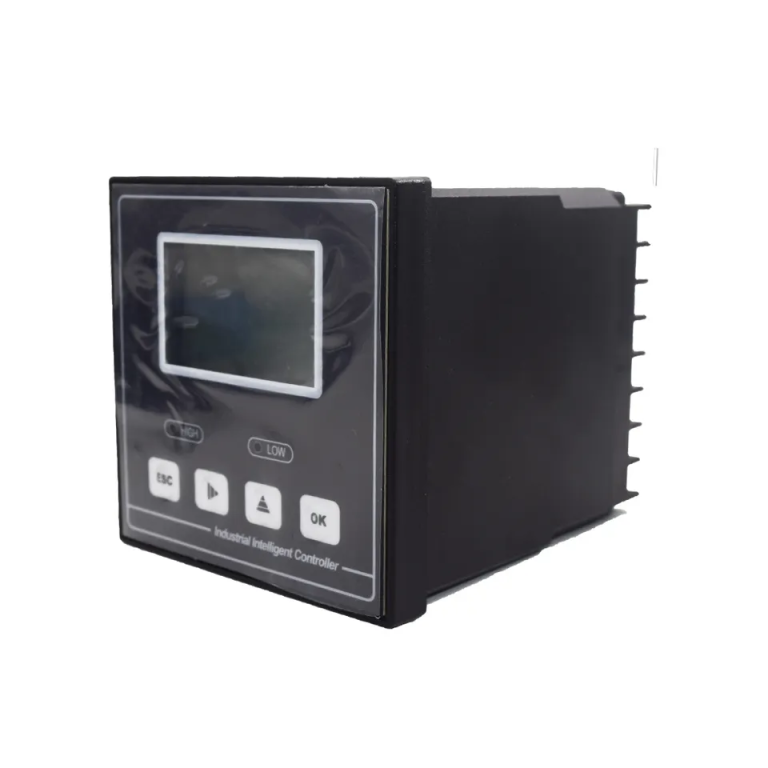
The trade-off is a lower low-range floor — toroidal sensors are typically not used below 50 μS/cm — but that is not a limitation on the ZLD side of a plant. Shanghai ChiMay’s in-line conductivity meter uses a toroidal head engineered around a fluoropolymer body and a matched-response transmitter, giving stable readings across the 100 μS/cm to 2,000 mS/cm envelope.
The Non-Linear Response Curve
Even with the correct sensor geometry, conductivity in a saturated brine is a curve, not a line. Sodium chloride solutions, for example, reach peak conductivity near 200 mS/cm at 25 °C, then flatten and decline as further salt addition begins to interfere with ion mobility. That means a raw microsiemens number can no longer be trusted as a monotonic TDS indicator once a stream crosses that inflection.
Two operating implications:
- Alarming on conductivity alone in a crystalliser feed loop is unsafe; TDS or refractive index cross-checks are needed.
- Calibration standards must be selected to bracket the operating point rather than a generic mid-range value.
Shanghai ChiMay’s transmitter platform stores multiple lookup curves (NaCl, KCl, mixed brine) that the operator can select from, giving a corrected TDS value alongside the raw microsiemens number.
Temperature Compensation at the Extremes
Field data from MVR and crystalliser loops shows temperature coupling of about 1.8–2.4% per °C for concentrated NaCl-dominant brines. A reference temperature (usually 25 °C) is chosen, and a compensation algorithm reports a normalised conductivity so that trends reflect chemistry, not weather.
For a plant running mixed-salt brines, a single linear compensation coefficient is inadequate. Shanghai ChiMay’s transmitter supports a piecewise coefficient table that can be tuned per loop, based on batches of laboratory grab samples analysed at three or four temperature set-points during commissioning.
Sensor Placement in the ZLD Skid
Placement is at least as important as selection. Recommended positions across a ZLD train:
- Softened water outlet (0.2–1 mS/cm range) — confirms softener performance.
- Reverse-osmosis reject header (5–15 mS/cm) — trends concentration factor.
- Brine concentrator recirculation line (20–35 mS/cm) — anchors evaporator control loops.
- MVR loop bottom (60–120 mS/cm) — trends salt concentration ahead of crystallisation.
- Crystalliser mother liquor (150–250 mS/cm) — drives batch discharge decisions.
- Distillate line (2–20 μS/cm) — proves distillate quality; note this is the one line that should be measured by a contacting cell, not a toroidal head, because the range is far below toroidal sensitivity.
Calibration Practice for Brine Service
A calibration protocol scoped for ZLD service typically has four features:
- Two-point calibration bracketing the operating range, not a generic mid-scale point.
- Certified reference solutions traceable to a national standards body.
- Temperature match between the standard and the sample within ±2 °C.
- Documented deviation history for audit and drift trending.
Shanghai ChiMay’s calibration procedure returns a signed deviation report from each service call, so plants can trend cell condition over time and plan interventions before the sensor drifts out of tolerance.
Digital Integration
Modern ZLD control systems ingest conductivity signals via Modbus RTU, Modbus TCP or an OPC UA gateway. Shanghai ChiMay’s transmitter exposes the primary reading plus a secondary curve-corrected TDS value, temperature, cell condition and calibration age, giving digital-twin models the inputs they need to run confidence-weighted mass balances.
Closing Note
Conductivity is the workhorse instrument of a ZLD plant, but it earns that role only when the geometry, the compensation curve and the placement all match the physics of concentrated brine. Contacting cells will not carry a ZLD line, and toroidal cells still need curve-aware transmitters to translate their signal into a defensible TDS. Shanghai ChiMay’s approach makes those choices explicit, so the number on the screen tracks the process, not the sensor’s limitations.