Table of Contents
How Smart Water Meters Transform Municipal Distribution Management
Key Takeaways
- Smart water meters reduce non-revenue water losses by 30-45% through continuous monitoring
- Advanced metering infrastructure enables 25% reduction in operational costs for water utilities
- Real-time data analytics help utilities detect leaks within hours instead of weeks
- IoT-enabled smart meters generate petabyte-scale data for predictive maintenance
- Cities deploying smart water infrastructure report $2.3 million average annual savings
Introduction
Municipal water distribution systems face unprecedented challenges in the 21st century. Aging infrastructure, population growth, and climate variability are forcing water utilities to rethink traditional management approaches. According to the American Society of Civil Engineers (ASCE) 2025 Infrastructure Report Card, the United States loses approximately 17% of its treated water daily through leaks and inaccurate metering—a volume equivalent to filling 2.5 million Olympic swimming pools annually.
Smart water meters represent a paradigm shift in how utilities manage water distribution networks. Unlike conventional mechanical meters that require manual reading, these digital devices provide continuous, real-time data transmission, enabling utilities to make informed decisions about system operations, maintenance, and resource allocation.
Understanding Smart Water Meter Technology
Advanced Measurement Capabilities
Modern smart water meters utilize electromagnetic induction and ultrasonic transit-time technologies to achieve measurement accuracies of ±1-2%, significantly outperforming traditional mechanical meters that degrade over time. The International Water Association (IWA) reports that mechanical meters typically under-register consumption by 3-10% as they age, leading to substantial revenue losses for utilities.
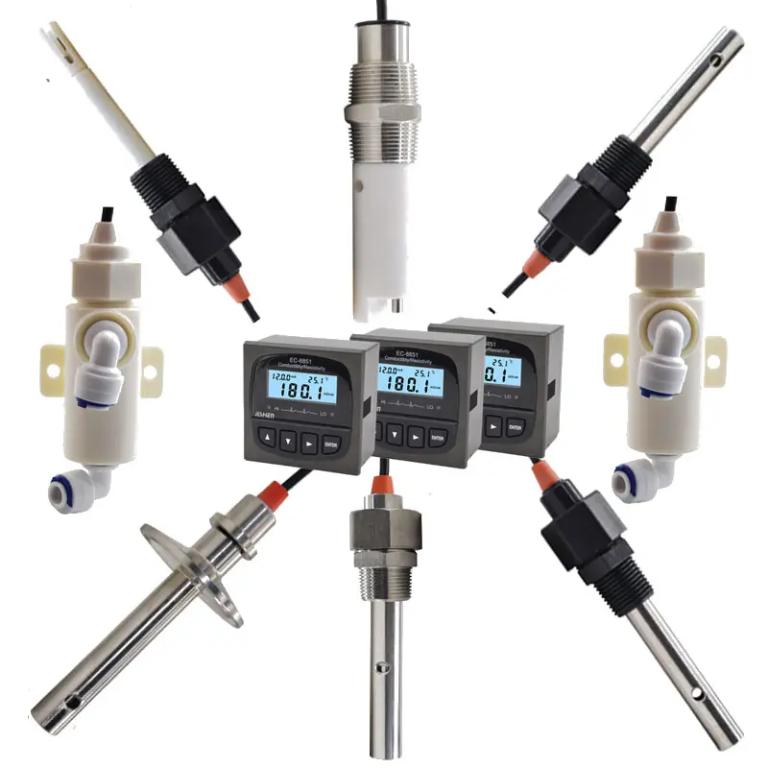
ChiMay’s inline conductivity meters integrate seamlessly with smart metering infrastructure, providing complementary data on water quality parameters. These sensors monitor total dissolved solids (TDS), conductivity variations, and potential contamination events, adding a critical quality dimension to consumption data.
Communication Protocols and Integration
Smart water meters employ multiple communication protocols to transmit data:
- Advanced Metering Infrastructure (AMI): Enables two-way communication between utilities and endpoints
- Radio Frequency (RF) mesh networks: Provide robust coverage in urban environments
- Cellular IoT (NB-IoT/LTE-M): Offer widespread connectivity for geographically dispersed installations
- Power Line Communication (PLC): Leverages existing infrastructure for data transmission
The European Union’s Smart Metering Mandate requires member states to deploy smart electricity and gas meters for 80% of consumers by 2024, with water smart metering following similar trajectories. This regulatory push is accelerating technology adoption across developed markets.
Operational Efficiency Gains
Leak Detection and Infrastructure Management
Traditional leak detection relies on periodic surveys and customer complaints—approaches that often allow significant water loss before identification. Smart water meters transform this paradigm by enabling continuous flow monitoring at individual customer and district meter areas (DMA).
When flow rates exceed expected thresholds during low-demand periods (typically 2:00-5:00 AM), the system automatically generates leak alerts. Utilities implementing smart meter networks report:
- Leak detection time reduced from 21 days to 4 hours on average
- Infrastructure maintenance costs decreased by 35% through predictive scheduling
- Emergency repairs reduced by 40% through early intervention
Demand Management and Conservation
Smart meters provide granular consumption data that enables sophisticated demand management strategies. Time-of-use pricing, informed by smart meter data, has demonstrated 8-12% peak demand reduction in pilot programs across North America and Europe.
ChiMay’s online turbidity testers and residual chlorine transmitters complement smart metering by ensuring that conservation efforts do not compromise water quality. When distribution system anomalies occur, integrated sensors alert operators before quality parameters degrade below acceptable thresholds.
Economic Impact and Return on Investment
Revenue Enhancement
Water utilities historically struggle with non-revenue water (NRW)—water produced and lost before reaching customers. The Global Water Intelligence (GWI) 2025 Market Report values NRW losses globally at $39 billion annually.
Smart meter deployment addresses NRW through multiple mechanisms:
| Loss Category | Smart Meter Impact |
|---|---|
| Metering inaccuracies | ±1% accuracy vs. 5-10% degradation |
| Data gaps | Continuous monitoring eliminates reading errors |
| Unauthorized consumption | Anomaly detection identifies theft patterns |
| Physical leaks | Rapid detection reduces loss duration |
Case Study: Singapore’s Smart Water Initiative
The Public Utilities Board (PUB) Singapore launched its Smart Water Meter program in 2019, targeting 100% coverage by 2023. Results from the first 50,000 installations showed:
- Water consumption reduced by 5% through behavioral feedback
- Burst pipe incidents decreased by 28% through pressure optimization
- Customer satisfaction scores improved by 15 points
- Projected 20-year savings exceed $180 million
Challenges and Considerations
Implementation Barriers
Despite demonstrated benefits, smart water meter deployment faces significant obstacles:
Infrastructure Costs: Average installation costs range from $150-400 per meter, depending on technology selection and existing infrastructure compatibility. A medium-sized utility serving 100,000 customers faces capital investments of $15-40 million.
Cybersecurity Concerns: Connected devices introduce potential vulnerability points. The National Institute of Standards and Technology (NIST) recommends defense-in-depth approaches including encryption, authentication, and network segmentation.
Data Management: A utility deploying one million smart meters generates approximately 2.5 terabytes of data daily. Effective utilization requires sophisticated analytics platforms and skilled data science teams.
Hybrid Approaches
Many utilities adopt phased implementation strategies:
- Phase 1: Deploy smart meters in high-loss areas and commercial zones
- Phase 2: Expand to residential areas with validated economic models
- Phase 3: Integrate advanced analytics and optimization platforms
This approach allows utilities to demonstrate value, refine operational processes, and build internal capabilities progressively.
Future Outlook
Technology Convergence
Smart water meters are evolving beyond consumption measurement toward comprehensive distribution intelligence:
- Acoustic sensing enables pipe condition assessment without excavation
- Pressure transients monitoring predicts burst events 48+ hours in advance
- Machine learning algorithms optimize pump schedules and valve operations
- Digital twin integration enables scenario modeling and system simulation
Regulatory Evolution
Regulatory frameworks are adapting to accommodate smart meter capabilities:
- Advanced Metering Infrastructure (AMI) mandates are spreading globally
- Data privacy regulations require careful handling of consumption patterns
- Interoperability standards are emerging to prevent vendor lock-in
Conclusion
Smart water meters represent a transformative technology for municipal water utilities. By providing continuous, accurate, and actionable data, these devices enable operational efficiencies that were previously impossible with traditional infrastructure.
The economic case is compelling: utilities deploying smart meter networks typically achieve 200-400% return on investment over 10-year deployment cycles, through a combination of reduced losses, operational savings, and enhanced customer service.
For water utilities facing aging infrastructure, constrained budgets, and increasing service expectations, smart water meters offer a path toward sustainable, resilient distribution management. The question is no longer whether to deploy smart metering technology, but how quickly implementation can be executed at scale.