Table of Contents
Key Takeaways
Introduction
Electrical conductivity stands as one of the most fundamental water quality parameters measured across industrial applications. The parameter provides a direct indication of dissolved ion concentration, enabling facilities to assess water purity, detect contamination events, and optimize process performance. The global conductivity meter market exceeded $2.1 billion in 2025, driven by stringent quality requirements in semiconductor manufacturing, pharmaceutical production, and power generation.
Conductivity measurement原理 involves applying an alternating electrical current between electrodes and measuring the resulting voltage drop. The ratio of current to voltage yields conductance, which scales with electrode geometry to express conductivity in standardized units of microsiemens per centimeter (μS/cm). However, translating this simple principle into reliable industrial instrumentation requires sophisticated engineering to address electrode polarization, temperature effects, and fouling challenges.
ChiMay’s conductivity measurement technology incorporates decades of sensor development to deliver measurement performance meeting the most demanding industrial requirements. The company’s approach combines advanced electrode materials, intelligent signal processing, and robust mechanical design to provide continuous, accurate measurements in challenging process environments.
Electrode Design and Measurement Configurations
Two-Electrode Systems
Traditional conductivity measurement employs a simple two-electrode configuration where current application and voltage measurement occur through the same electrode pairs. While straightforward in concept, this design suffers from polarization effects that introduce measurement errors at high conductivity values.
When direct current flows through the electrode-solution interface, ion accumulation creates a voltage potential opposing the applied current. Although alternating current mitigates this effect, residual polarization persists and increases with conductivity. At conductivity values above 1,000 μS/cm, polarization errors can exceed 5%, making two-electrode sensors unsuitable for many industrial applications.
Four-Electrode Technology
ChiMay’s conductivity sensors employ a four-electrode configuration that fundamentally eliminates polarization errors. The design separates current application from voltage measurement:
This configuration ensures that voltage measurement occurs at equilibrium conditions, free from polarization artifacts. The measurement circuit draws negligible current through the voltage electrodes, maintaining a stable potential regardless of ion accumulation at the current electrodes.
The four-electrode approach delivers several performance advantages:
| Feature | Two-Electrode | Four-Electrode |
|---|
| Polarization Error | Up to 5% at high conductivity | Eliminated |
|---|
| Fouling Tolerance | Sensitive | Resistant |
|---|
| Calibration Stability | Requires frequent verification | Extended intervals |
|---|
Contactless Capacitive Measurement
For applications requiring complete isolation from the process fluid, ChiMay offers toroidal inductive sensors that measure conductivity without any electrodes in contact with the solution. The sensor consists of two toroidal coils—one transmitting an alternating magnetic field, the other receiving the induced signal. The received signal amplitude decreases proportionally to solution conductivity.
Capacitive conductivity measurement eliminates electrode fouling concerns entirely, making it ideal for applications with coating-prone solutions, high solids content, or biological growth. However, the technology exhibits lower sensitivity at low conductivity values and typically requires larger sensor dimensions compared to electrode-based systems.
Temperature Compensation Methodology
Conductivity measurements exhibit strong temperature dependence, with most aqueous solutions showing a 2% per °C temperature coefficient. This relationship means that a solution at 50°C exhibits approximately 50% higher conductivity than the same solution at 25°C, even with identical ion concentration.
Accurate temperature compensation requires knowledge of the solution’s specific temperature coefficient. Different ionic species exhibit different coefficients:
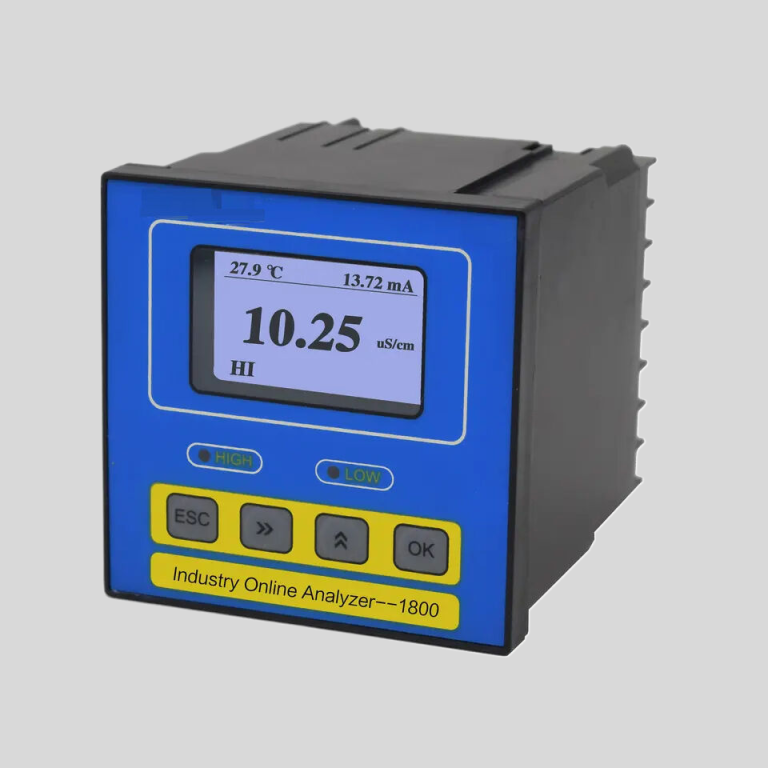
ChiMay’s conductivity transmitters incorporate adaptive temperature compensation algorithms that adjust compensation parameters based on measured conductivity ranges. At low conductivity values typical of deionized water, the algorithm switches to a variable coefficient model that more accurately represents the actual temperature behavior of high-purity water.
The sensor’s integrated Pt1000 RTD element provides temperature measurement with ±0.3°C accuracy, ensuring precise compensation calculations. For applications requiring ultra-high accuracy, the transmitter supports custom coefficient programming to match specific solution characteristics.
Electrode Materials and Surface Treatments
The selection of electrode materials significantly impacts sensor performance, longevity, and maintenance requirements. ChiMay’s conductivity sensors utilize materials selected for specific application requirements:
Stainless Steel (316L): Provides excellent durability for general industrial applications. The material resists corrosion in neutral solutions and tolerates moderate fouling. Typical service life exceeds 5 years in municipal water monitoring applications.
Titanium: Offers superior corrosion resistance for aggressive chemistry including acidic and alkaline solutions. Titanium electrodes maintain stable calibration in applications where conventional stainless steel would corrode within weeks. The material’s passivation layer resists chemical attack while maintaining electrical contact.
Platinum: Delivers the highest measurement stability for laboratory and pharmaceutical applications. Platinum’s inert surface prevents ion exchange reactions that could affect measurement. While more expensive, platinum electrodes provide unmatched long-term calibration stability.
Graphite: Provides an economical option for applications requiring resistance to mechanical impact and thermal shock. Graphite electrodes tolerate aggressive cleaning procedures and demonstrate good fouling resistance due to their relatively inert surface.
Application-Specific Configurations
Semiconductor Pure Water Systems
Semiconductor manufacturing requires ultra-pure water with conductivity below 0.055 μS/cm (resistivity exceeding 18 MΩ·cm). At these extreme purity levels, even trace contamination dramatically impacts measurements. ChiMay’s sanitary conductivity sensors feature electropolished surfaces that resist particle adhesion and support sterile-in-place cleaning procedures. The sensors maintain ±1% accuracy at the lowest measurable conductivity values, enabling reliable detection of resin exhaustion or membrane breaches.
Power Plant Condensate Monitoring
Power generation facilities monitor condensate conductivity to detect heat exchanger leaks and resin contamination. The measurement range typically spans 0.1-10 μS/cm, requiring sensors optimized for low conductivity accuracy. ChiMay’s sensors incorporate zero-drift compensation algorithms that maintain accuracy over extended deployment periods, reducing the need for frequent recalibration during 6-12 month maintenance cycles.
Brine Concentration Monitoring
Salt concentration monitoring in chlor-alkali plants and desalination facilities requires measurements extending to 200,000 μS/cm. At these extreme conductivity values, polarization effects become dominant, making four-electrode technology essential. ChiMay’s high-conductivity sensors feature optimized electrode spacing and advanced signal processing that maintain ±0.5% accuracy across the full measurement range.
Wastewater Discharge Monitoring
Industrial wastewater monitoring applications require sensors tolerant of biological growth, suspended solids, and variable chemistry. ChiMay offers sensors with self-cleaning electrode configurations and anti-fouling coatings that extend maintenance intervals to 3-6 months in typical wastewater applications. The sensors’ built-in diagnostics detect fouling conditions and alert operators before measurement accuracy degrades.
Installation and Integration Best Practices
Proper sensor installation significantly impacts measurement performance and longevity:
Orientation: Vertical installation with the sensor head pointing downward prevents air bubble accumulation in the measurement cell. For toroidal sensors, ensure the sensor torus remains completely submerged with no dry spots.
Flow Conditions: The sensor requires adequate flow to maintain representative sampling. Minimum flow rates of 0.3 m/s prevent stratification effects where concentration gradients develop across the measurement zone. Excessive velocity above 3 m/s may cause vibration-induced noise.
Sample Conditioning: For applications with high suspended solids, particulate filters or flow-through cells with settling chambers protect the sensor from fouling. Temperature stabilizers ensure the measurement occurs at known, stable temperatures.
Electrical Integration: Shielded cable connections prevent electrical interference from variable frequency drives and other industrial equipment. Grounding connections should reference a single point to prevent ground loops that introduce measurement noise.
Conclusion
ChiMay’s conductivity measurement technology provides industrial facilities with accurate, reliable measurements across the full conductivity range from ultra-pure water to concentrated brines. The four-electrode design eliminates polarization errors that compromise conventional sensors, while advanced temperature compensation algorithms ensure accurate readings despite changing process conditions.
Successful conductivity monitoring investments require matching sensor specifications to application requirements. ChiMay’s application engineering team assists customers with sensor selection, installation design, and system integration to maximize the value of conductivity monitoring investments. With proper selection and installation, conductivity sensors provide years of trouble-free operation while delivering the water quality data facilities need to protect product quality and process efficiency.