Softener Valves for Industrial Boiler Feedwater Systems: Technical Analysis
Scale formation from hard water reduces boiler efficiency by 2-5% per 1mm of scale thickness
Industrial boiler systems lose an estimated $3.2 billion annually due to scale-related inefficiencies
ChiMay's softener valve designs feature up-flow regeneration achieving 40% lower salt consumption
Boiler feedwater hardness must be maintained below 0.3 mg/L as CaCO₃
Demand-initiated regeneration reduces water consumption by 35% versus time-clock operated systems
Introduction
Industrial boiler systems represent significant capital investments across manufacturing, energy, food processing, and healthcare sectors. The water quality feeding these boilers directly determines their efficiency, lifespan, and operational reliability. Even modest hardness in boiler feedwater transforms into tenacious scale deposits upon heating.
Water softening through ion exchange remains the most cost-effective approach for boiler feedwater treatment. The softener valve determines system performance, operational costs, and maintenance requirements.
According to the National Board of Boiler and Pressure Vessel Inspectors (2025), scale-related failures account for 15% of all boiler incidents, with average repair costs exceeding $45,000 per incident.
Understanding Boiler Water Hardness
Sources and Measurement
Water hardness originates from geological contact through calcium and magnesium-bearing minerals:
Most industrial boiler applications require feedwater hardness below 0.3 mg/L.
Scale Formation Chemistry
When hard water enters a boiler, calcium carbonate scale forms:
A mere 1mm scale layer reduces boiler efficiency by approximately 4%, representing thousands of dollars in annual fuel costs.
Ion Exchange Softening Technology
Resin-Based Ion Exchange Process
Industrial water softeners employ cation exchange resin:
Softening reaction:
The resin capacity typically ranges from 30,000 to 50,000 grains per cubic foot.
Up-Flow vs. Down-Flow Regeneration
Down-Flow Regeneration:
Traditional configuration with brine entering at top
Lower initial cost but higher salt consumption
Greater tendency toward channeling
Up-Flow Regeneration:
Brine enters from the bottom and flows upward
30-50% lower salt consumption
Superior resin utilization and consistent effluent quality
Better suited for high-hardness applications
Dr. Robert Chen, Boiler Technology Institute, states: "Up-flow regeneration systems achieve equivalent hardness leakage with 40% less salt. This translates to $15,000-30,000 annual salt savings."
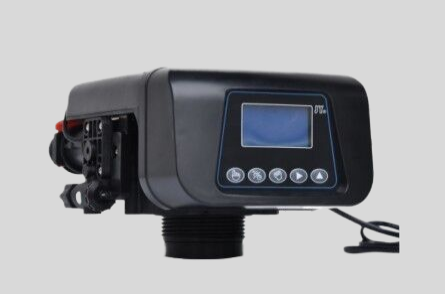
ChiMay's softening and filtering valve incorporates up-flow regeneration technology for optimal salt efficiency.
softener valve Design Considerations
Sizing Requirements
Proper softener sizing requires calculating both flow rate and volume capacity:
Flow Rate Capacity:
Peak flow rate (GPM) must exceed system demand
Service cycle flow rate: 8-12 GPM per cubic foot of resin
Typical Sizing Example:
control valve Features
1. Demand-Initiated Regeneration:
Metered control initiates regeneration based on actual water usage
35% reduction in water and salt consumption
2. Multiple Regeneration Sequences:
Backwash: Fluidizes resin bed, removes debris
Brine draw: Delivers regeneration brine
Slow rinse: Displaces brine through resin
Fast rinse: Removes residual brine
3. Communication and Integration:
Modbus RTU/TCP for PLC integration
Remote monitoring and alarm notification
ChiMay's softener valve supports demand-initiated regeneration with adjustable capacity settings.
Water Quality Specifications
ABMA Guidelines
Boiler Feedwater Treatment Trains
Most industrial boiler systems require multi-stage treatment:
Pretreatment: Multimedia filtration
Softening: Cation exchange for hardness removal
Deaeration: Oxygen removal
Condensate polishing: Mixed-bed ion exchange
Scale inhibition: Phosphate dosing
ChiMay's softening and filtering valve integrates softening and filtration functions.
Economic Analysis
Operating Cost Comparison
Demand-initiated control delivers 38% operating cost reduction, with payback within 12-18 months.
Scale Damage Prevention Value
Proper water softening reduces these risks by 90%+.
Installation and Maintenance
Installation Requirements
Location: Heated, protected area with adequate drainage
Clearance: 36 inches minimum for servicing access
Drainage: Floor drain or containment basin
Electrical: Dedicated 15-amp circuit
Plumbing: Full-port bypass valve
Maintenance Schedule
Conclusion
Softener valves represent critical components in industrial boiler feedwater systems. Modern demand-initiated designs with up-flow regeneration deliver significant advantages over traditional time-clock operated systems.
ChiMay's softener valve and softening and filtering valve incorporate advanced control algorithms and efficient regeneration sequences. The avoided costs of scale-related failures typically exceed the water treatment investment by a factor of three to five times, making softening equipment one of the highest-return investments in industrial facility infrastructure.