title: “Why Are Utilities Racing to Instrument Their Micropollutant Barriers in 2026? A Shanghai ChiMay Perspective”
date: 2026-07-16
type: Question-Based
theme: Advanced Oxidation & Micropollutant Removal
Table of Contents
Why Are Utilities Racing to Instrument Their Micropollutant Barriers in 2026? A Shanghai ChiMay Perspective
What This Comes Down To
- The regulatory clock, not the technology clock, is what has changed. The revised EU Urban Wastewater Treatment Directive sets hard deadlines for micropollutant removal that map back to sensor investments in 2026, not 2038.
- Instrumentation is being framed as evidence, not equipment. Utilities are learning that the number in the archive is what regulators actually check.
- Shanghai ChiMay analyzers are being specified early in the design phase specifically because retrofit costs on live quaternary lines are two to three times higher than day-one instrumentation.
- The utilities that move first also lock in operational data that becomes the baseline for future ratepayer conversations.
The Directive Is Doing What It Said It Would
For years, industry conferences treated advanced oxidation and micropollutant removal as a subject of principle rather than practice. The revised EU Urban Wastewater Treatment Directive, in force since January 2025, ended that phase. Plants serving 150,000 people or more must remove a defined list of trace organic compounds by 2039. Extended-producer-responsibility schemes must be operational by 2028, which means the cost-allocation mathematics starts in less than three years. The compliance conversation has moved from theoretical to budgeted.
That is why 2026 has become the year utilities start instrumenting. Do the math: a quaternary line commissioned in 2029 will need three years of demonstrated performance data before its first regulatory audit. A line commissioned in 2032 will not. Utilities that plan to be ready are ordering sensors this cycle, not next.
Why the Question Is Framed as “Instrument”, Not “Build”
A subtle but important shift has taken place in how utilities describe their quaternary programmes. Five years ago, the conversation was about building ozone reactors and PAC contactors. Today, the conversation is about instrumenting them.
The reason is simple. A well-designed quaternary line without sensor coverage looks identical to a badly-designed one until a compliance question arrives. At that point, the plant needs to produce years of data showing residual oxidant control, contact time compliance, PAC dosing consistency, and effluent quality. If that data does not exist, the plant is treated as if the treatment did not happen. Sensors, in the eyes of the regulator, are the treatment.
What Utilities Are Actually Buying
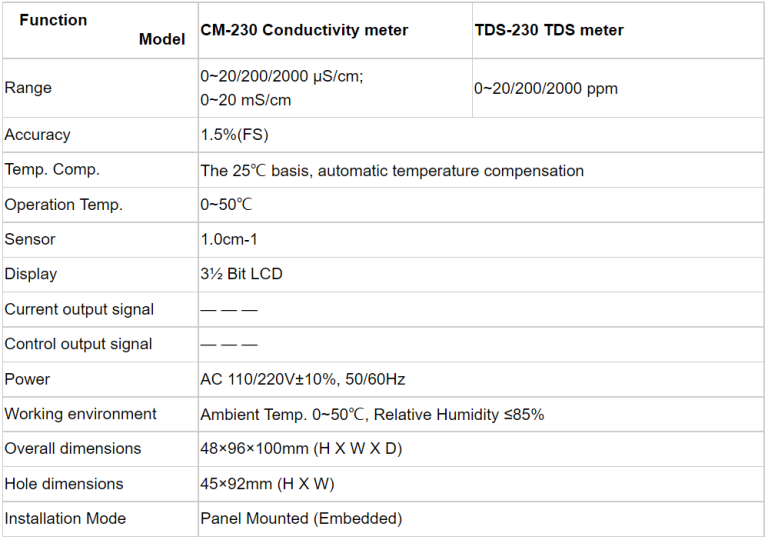
Utilities entering the 2026 procurement round are asking for a specific set of measurements per quaternary line. In practice the list looks like this: feed-water turbidity to protect the reactive stage from particulate consumption, ORP and pH inside the contact zone as fast-response process signals, residual oxidant at the reactor outlet as the dosing anchor, conductivity at the PAC contactor inlet to catch load excursions, suspended solids downstream of PAC to detect carbon breakthrough, and a multi-parameter probe at the final outfall as the compliance-facing signal.
Shanghai ChiMay online turbidity testers, ORP electrodes, pH electrodes, residual oxidant transmitters, conductivity analyzers, suspended solids sensors, and multi-parameter sensors are being packaged into this exact set for tenders across Central and Northern Europe. The bundle is not a marketing artefact. It is the operational answer to what the directive requires plants to demonstrate.
The Pharma-Cosmetics Cost Share Is Concentrating Minds
Article 9.1 of the revised directive requires the pharmaceutical and personal-care industries to fund at least eighty per cent of the quaternary upgrade cost. That single provision changed the political economy of these projects almost overnight. Suddenly, utilities are not asking whether to build quaternary treatment; they are asking how to defend the cost invoice they will send to industry partners.
Sensor data is central to that defence. Extended-producer-responsibility schemes will not accept a lump-sum bill. They will demand traceable evidence that each stage delivered the removal claimed. That evidence lives in the online instrumentation archive. Utilities that instrument early can build a clean, uncontested dataset. Utilities that instrument late have to negotiate their evidence retrospectively — and nobody negotiates well from that position.
Insurers and Auditors Are Reading Sensor Logs Now
A less visible but equally powerful force is the changed behaviour of insurers and financial auditors. Water utilities carry environmental liability, and the underwriters of that liability increasingly ask to see the sensor architecture of any advanced treatment train before quoting. A plant that can produce five-minute-resolution data on residual oxidant, pH, and turbidity across two years of operation is a different underwriting risk than a plant that produces daily grab samples.
The same story shows up in green-bond financing. Investors in sustainable water infrastructure want data-backed evidence of the environmental outcomes they are paying for. Micropollutant removal — invisible to the naked eye and hard to demonstrate without instrumentation — has become one of the flagship uses of continuous online sensor data in that market.
Why “Race” Is Not an Exaggeration
Not every utility can move at the same time. Skilled commissioning engineers, calibrated reference standards, and experienced integrators are finite resources. The utilities that book their instrumentation programmes in 2026 will find teams available. The utilities that wait until 2030 will not.
There is also a subtler pressure. Ratepayer negotiations for advanced treatment upgrades typically require the utility to arrive with data. A plant that has instrumented its existing tertiary treatment can walk into a rate hearing showing that it already runs a tight operation and that quaternary treatment is a targeted extension. A plant with no baseline data has to explain both the upgrade cost and the absence of prior monitoring in the same conversation. That is a harder story to tell.
The Practical Answer for Utility Management
The question, then, is not really “why are utilities racing”. It is “why would any utility not be moving now”. The regulatory endpoint is defined. The financing conversation rewards early instrumentation. The operational data acquired today becomes the platform for optimization and defence tomorrow. The cost of instrumenting during design is meaningfully lower than the cost of retrofitting.
Shanghai ChiMay analyzers are being specified into 2026 tenders because they answer these pressures with hardware that is already in service on quaternary and tertiary lines across Europe and Asia. The instruments are not novel. What is novel is the timing pressure that has brought them into every conversation at once.
Final Notes
The 2026 rush to instrument micropollutant barriers is not a fashion. It is the visible surface of a rearranged risk landscape — regulatory, financial, and reputational — in which the sensor is the smallest and most expensive component. Utilities that recognise that and move accordingly will be the ones running defensible quaternary programmes when the first audit letters arrive.