Table of Contents
Key Takeaways
- Four-electrode conductivity sensors eliminate polarization errors that degrade two-electrode measurement accuracy by up to 15%
- The technology delivers stable measurement in high-conductivity solutions exceeding 20,000 μS/cm
- Temperature compensation algorithms improve measurement accuracy to ±0.5% across operating ranges
- Industrial conductivity measurement market reaches $2.1 billion globally by 2028
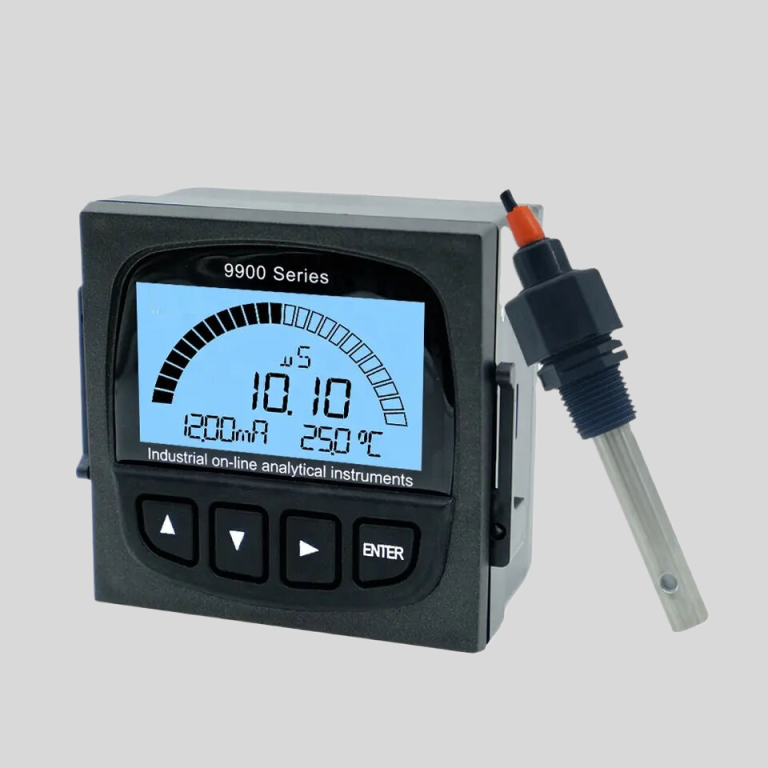
- ChiMay's inline conductivity meters employ four-electrode technology for precision measurement in demanding applications
Introduction
Conductivity measurement ranks among the most common water quality monitoring applications across industrial, municipal, and environmental sectors. From monitoring boiler feedwater purity to controlling cooling tower blowdown cycles, conductivity data enables process optimization, quality control, and regulatory compliance.
Despite its widespread use, conductivity measurement technology receives less attention than flashier parameters like pH or dissolved oxygen. Yet the physics underlying conductivity measurement create challenges that sophisticated sensor designs must address. Understanding four-electrode technology—the premium approach for demanding industrial applications—illuminates why sensor selection matters for measurement reliability.
Conductivity Measurement Physics
Fundamental Principles
Electrical conductivity measures a solution's ability to conduct electric current through ion movement. When an electrical potential applies across a solution, cations migrate toward the negative electrode while anions move toward the positive electrode. This ion migration constitutes electrical current flow.
The measured conductivity depends on both ion concentration and ion mobility—the speed at which specific ions move under electric field influence. Different ions contribute differently to conductivity based on their charge and size. Sodium chloride contributes more conductivity than calcium sulfate at equivalent concentrations because chloride ions move faster than sulfate ions.
Conductivity sensors measure this ion-mediated current flow by applying an alternating voltage across measurement electrodes and detecting the resulting current. The current magnitude, combined with cell geometry, enables calculation of solution conductivity.
The Polarization Problem
When direct current or low-frequency alternating current passes through solution, electrode surfaces accumulate charge that opposes current flow—this phenomenon is electrode polarization. The polarization effect artificially increases apparent resistance, creating measurement errors that can exceed 10-15% in high-conductivity solutions.
Early conductivity sensors used simple two-electrode designs that suffered from polarization errors. These sensors required careful frequency selection and electrode material choices to minimize the effect, but could not eliminate it entirely.
Higher frequency alternating current reduces polarization effects by reversing electrode charge before significant accumulation occurs. Most modern conductivity sensors operate at frequencies between 500 Hz and 4 kHz, substantially reducing polarization errors compared to low-frequency designs.
Four-Electrode Technology Explained
Measurement Configuration
Four-electrode conductivity sensors employ two current electrodes and two voltage-sensing electrodes in a configuration that inherently compensates for polarization effects. The current electrodes inject measurement current into the solution, while the voltage electrodes sense the potential difference that this current creates across the measurement zone.
The key innovation is electrical isolation between current injection and voltage measurement. Because voltage electrodes draw virtually no current, they do not polarize—they simply measure the potential difference that the current electrodes establish. This isolation eliminates polarization error from the voltage measurement regardless of solution conductivity.
Cell Constant Considerations
The cell constant relates measured resistance to solution conductivity through the relationship: Conductivity = K × (1/Resistance), where K is the cell constant determined by electrode geometry.
Four-electrode sensors provide inherent cell constant stability because the voltage-sensing electrodes define the measurement zone geometry. Unlike two-electrode sensors where electrode spacing can vary with mounting and temperature, four-electrode sensors maintain stable geometry through rigid mechanical construction.
This geometric stability translates to measurement stability over time—four-electrode sensors maintain calibration longer than two-electrode alternatives because cell constant drift is minimized.
Current Drive Limitations
Four-electrode sensors must inject sufficient current to create measurable voltage at the voltage electrodes while avoiding polarization effects that would compromise measurement integrity. The sensor electronics must balance these competing requirements across the full conductivity range.
High-conductivity solutions require less current for adequate voltage generation, while low-conductivity solutions require more. Modern four-electrode sensors employ automatic current range selection that optimizes drive for each measurement range.
Temperature Compensation Requirements
The Temperature Dependence Challenge
Solution conductivity varies with temperature—approximately 2% per degree Celsius for typical ionic solutions. This temperature dependence means that conductivity readings must reference a standard temperature for meaningful comparison.
The International Society of Automation (ISA) standard reference temperature for conductivity measurement is 25°C. All conductivity measurements should report compensated values at this reference temperature to enable trend analysis and comparison.
Compensation Algorithm Approaches
Temperature compensation converts measured conductivity at ambient temperature to equivalent conductivity at reference temperature. The conversion requires knowledge of solution temperature coefficient—the fractional conductivity change per degree temperature difference.
Different solution types exhibit different temperature coefficients. Sodium chloride solutions show approximately 2.1% per °C compensation requirements, while calcium carbonate solutions vary from 2.5-3.0% per °C depending on concentration.
Modern conductivity transmitters incorporate automatic temperature compensation using standard curves for common solution types. The American Society for Testing and Materials (ASTM) D1125 standard provides reference temperature coefficient data for major solution categories.
Application Performance Comparison
High-Purity Water Measurement
Ultrapure water applications require measurement at conductivities below 1 μS/cm—conditions that challenge all conductivity measurement approaches. At these low conductivities, even tiny polarization effects create substantial relative errors.
Four-electrode sensors excel in high-purity applications because polarization compensation enables accurate low-conductivity measurement. The technology has largely displaced two-electrode designs for semiconductor, pharmaceutical, and power generation water purity monitoring.
The Semiconductor Industry Association specifications for ultra-pure water require conductivity measurement accuracy better than 0.1 μS/cm—performance that four-electrode technology routinely achieves.
High-Conductivity Industrial Process Solutions
Industrial process streams often exhibit conductivities exceeding 10,000 μS/cm—conditions where two-electrode sensors struggle with polarization errors that consume substantial fraction of the measurement signal.
Four-electrode sensors maintain accuracy in these challenging conditions because the voltage-measuring electrodes remain unpolarized regardless of current magnitude. The technology enables reliable measurement in brine solutions, concentrated chemical process streams, and other high-conductivity applications.
Variable Conductivity Applications
Applications where conductivity varies across wide ranges benefit from four-electrode technology's range-independent accuracy. Cooling tower monitoring, for example, spans from 500 μS/cm in makeup water to 5,000 μS/cm in concentrated basin water.
Two-electrode sensors calibrated for one range often exhibit degraded accuracy when measuring outside the calibration range. Four-electrode sensors maintain consistent accuracy across wide ranges because polarization compensation does not vary with conductivity level.
Installation Considerations
Flow Cell Design
Conductivity sensor installation typically employs flow cells that provide controlled solution flow past the measurement electrodes. The flow cell design affects response time, bubble handling, and maintenance accessibility.
Inline flow cells provide continuous measurement with minimal response lag—appropriate for applications requiring real-time process control. Bypass flow cells enable sensor removal without process interruption but introduce response lag proportional to bypass loop volume.
Electrode Material Selection
Four-electrode sensors employ various electrode materials including stainless steel, titanium, Hastelloy, and graphite. Material selection depends on chemical compatibility, temperature requirements, and measurement range.
Graphite electrodes offer excellent chemical resistance and low polarization characteristics but may degrade in oxidizing environments. Metal electrodes provide durability but require compatibility verification with process fluids.
Conclusion
Four-electrode conductivity measurement technology represents the premium approach for demanding industrial applications. The electrical isolation between current injection and voltage measurement eliminates polarization errors that compromise two-electrode sensor accuracy—enabling reliable measurement across the full conductivity range from ultrapure water to concentrated brines.
The technology's inherent advantages in measurement stability, temperature compensation accuracy, and wide-range performance justify the typically higher initial cost compared to two-electrode alternatives. For applications where conductivity measurement reliability affects process outcomes, quality specifications, or regulatory compliance, four-electrode technology delivers the performance that professional monitoring programs require.
ChiMay's inline conductivity meters employ four-electrode measurement technology throughout the product line, providing consistent measurement quality regardless of specific application requirements. This technology foundation ensures that customers receive the accuracy and reliability that demanding industrial applications demand.