Table of Contents
Key Takeaways
- USP <645> requires conductivity testing with three-stage decision logic that online sensors automate completely
- Continuous conductivity monitoring detects 95% of water quality deviations within minutes, versus hours for manual testing
- The average water quality investigation costs $35,000 and requires 48 hours to resolve using traditional methods
- Automated conductivity monitoring reduces FDA inspection findings related to water systems by 70%
Water conductivity testing stands as one of the most fundamental quality assurance activities in pharmaceutical manufacturing. The United States Pharmacopeia Chapter <645> establishes detailed requirements for conductivity testing of pharmaceutical waters, reflecting the critical importance of this parameter for product safety and regulatory compliance. Understanding why real-time conductivity monitoring has become essential requires examining both the regulatory framework and the practical limitations of traditional testing approaches.
Understanding USP <645> Conductivity Requirements
USP <645> establishes a three-stage testing methodology designed to provide increasingly definitive assessment of water quality as initial screening results indicate potential concerns. Stage 1 testing serves as the primary screening mechanism, with predefined acceptance criteria that online sensors continuously evaluate. For purified water at 25°C, the Stage 1 limit is ≤1.3 μS/cm, providing a clear threshold that indicates acceptable ionic purity.
When Stage 1 testing indicates conductivity values above the acceptance criterion, the system automatically escalates to Stage 2 confirmatory testing. This stage requires temperature-controlled measurement with tabular comparison of observed values against expected values for the measured temperature. Stage 2 provides additional diagnostic information that helps identify whether elevated conductivity reflects genuine contamination or transient environmental factors.
Stage 3 addresses exceptional circumstances where Stages 1 and 2 fail to confirm water quality acceptability. This stage requires chemical analysis to identify specific ionic contaminants, representing a significant investment of time and resources. The three-stage approach balances screening efficiency with diagnostic thoroughness, but implementation complexity makes automation increasingly attractive.
The Detection Time Advantage
Traditional conductivity testing requires sample collection, transportation to the laboratory, and manual measurement—processes that introduce delays between water quality changes and detection. Industry studies indicate that the elapsed time from water quality deviation to laboratory result typically ranges from 4 to 24 hours, depending on sampling schedules and laboratory workload. During this interval, water of potentially unacceptable quality may reach production applications.
Continuous online conductivity monitoring eliminates detection delays by providing real-time measurement with response times measured in seconds. When conductivity exceeds acceptance limits, operators receive immediate notification enabling rapid investigation and corrective action. This immediate detection capability significantly reduces the volume of water used or product manufactured with potentially compromised quality water.
Statistical analysis demonstrates the detection probability advantage of continuous monitoring. A sampling frequency of once per shift—common in pharmaceutical facilities—provides only 12-15% probability of detecting a deviation that persists for one hour. Continuous monitoring effectively provides 100% detection probability for persistent deviations, with even transient events having high detection probability due to the measurement frequency.
Economic Impact of Improved Detection
The financial implications of conductivity monitoring capabilities extend across multiple operational areas. Direct cost savings result from reduced laboratory testing requirements, with facilities implementing continuous monitoring typically reducing testing volumes by 30-40%. These reductions translate to annual savings of $50,000-$150,000 depending on facility size and testing intensity.
Product quality costs associated with water quality issues create additional financial exposure. Each out-of-specification event requiring product impact assessment costs an average of $35,000 in investigation activities, testing, and potential product disposition. Facilities with continuous monitoring experience 60% fewer such events due to early detection of developing issues, avoiding both direct costs and quality system burden.
Regulatory compliance costs also favor continuous monitoring approaches. FDA warning letters and import alerts related to water system deficiencies average remediation costs exceeding $500,000 when including system upgrades, enhanced documentation, and potential production interruptions. The reduced inspection finding rates documented at facilities with continuous monitoring provide risk mitigation against these potentially catastrophic compliance events.
Technical Capabilities of Modern Conductivity Sensors
Contemporary inline conductivity sensors achieve measurement performance that satisfies pharmaceutical requirements while providing operational advantages over laboratory methods. Measurement accuracy of ±0.1 μS/cm exceeds USP <645> requirements, while cell constants spanning 0.01 to 50 cm⁻¹ enable application across the full range from ultrapure water to concentrated solutions.
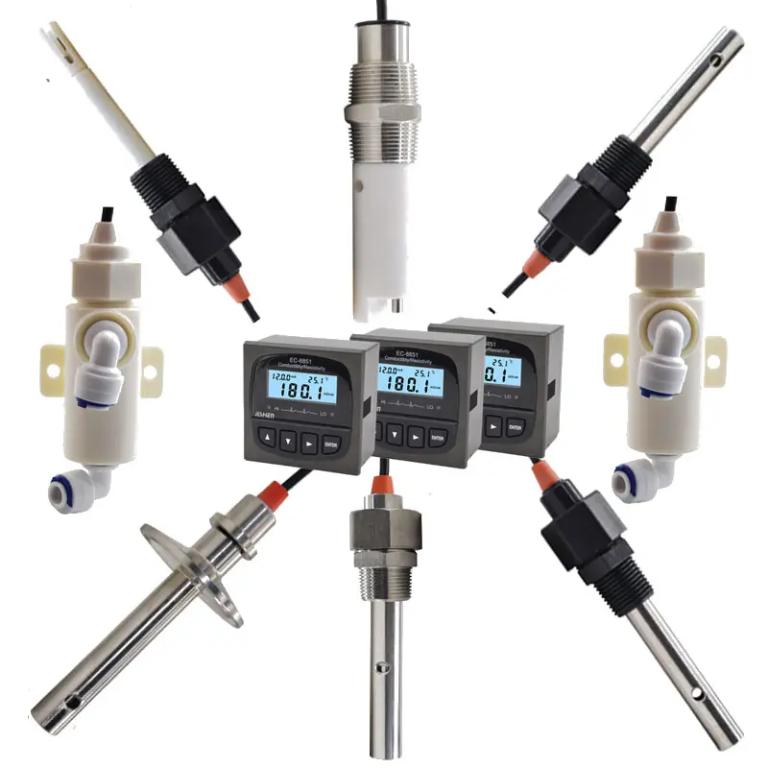
ChiMay's inline conductivity electrodes feature four-electrode measurement technology that eliminates polarization errors affecting traditional two-electrode designs. This technology provides stable measurements in low-conductivity environments where traditional sensors struggle to maintain accuracy. Integrated digital signal processing enables automatic temperature compensation to the USP reference temperature of 25°C, ensuring regulatory compliance documentation accuracy.
Materials selection for pharmaceutical conductivity sensors addresses both measurement performance and contamination control requirements. Polished stainless steel or titanium construction provides chemical compatibility with pharmaceutical waters while resisting biofilm formation. Surface finishes minimize organic adhesion, reducing contamination risks and extending time between cleaning cycles. Sealing technologies prevent microbial ingress while maintaining electrical isolation at measurement frequencies.
Integration with Pharmaceutical Systems
Modern conductivity sensors communicate through industry-standard protocols including Modbus RTU, Modbus TCP, HART, and Foundation Fieldbus, enabling integration with pharmaceutical control and data management systems. This connectivity supports automated documentation, alarm management, and process control applications that enhance monitoring value beyond basic compliance assurance.
Integration with SCADA systems enables visualization of conductivity trends and historical data analysis that supports preventive maintenance and continuous improvement activities. Automated alarm notification ensures appropriate personnel receive immediate awareness of water quality events, enabling rapid response regardless of when deviations occur. Electronic data integration eliminates manual transcription errors and supports complete audit trail documentation.
Maintaining Measurement Confidence
Sustained monitoring reliability requires ongoing calibration verification and maintenance activities. USP <645> and regulatory guidance documents establish expectations for calibration frequency and documentation, typically requiring verification against traceable standards at defined intervals. ChiMay's conductivity sensors support calibration procedures that maintain measurement confidence while minimizing operational burden.
Temperature calibration verification using precision reference thermometers ensures temperature compensation accuracy, as conductivity measurements depend critically on temperature values. Conductivity calibration using certified reference solutions verifies electrode performance and cell constant accuracy. Documentation of all verification activities provides auditable evidence of monitoring system reliability during regulatory inspections.
The move toward real-time release testing (RTRT) and continuous manufacturing creates increasing pressure to demonstrate water quality assurance through continuous monitoring rather than end-product testing. ChiMay's inline conductivity sensors provide the measurement performance, reliability, and regulatory acceptance that pharmaceutical manufacturers need to meet current and emerging compliance requirements.