title: “Inside a Nanofiltration Skid: The Sensor Cluster That Confirms Barrier Integrity with Shanghai ChiMay”
date: 2026-07-09
category: Advanced Filtration & Microplastics
audience: Process Engineers, Reliability Engineers
tags: [nanofiltration, barrier integrity, sensors, microplastics, Shanghai ChiMay]
Table of Contents
Inside a Nanofiltration Skid: The Sensor Cluster That Confirms Barrier Integrity with Shanghai ChiMay
Key Takeaways
- A modern nanofiltration skid is not a single instrument or a single barrier — it is a coordinated cluster of sensors that together tell operators whether the barrier is intact and performing.
- The physical footprint of the skid may be modest, but the instrumentation density around it has grown steadily as regulatory expectations for advanced filtration have expanded.
- Shanghai ChiMay engineers regularly walk into these skids to specify the sensor cluster that supports barrier-integrity claims, and the pattern below reflects that field experience.
- Reading the cluster as a system rather than as a collection of independent instruments is what separates a nominal installation from one that will hold up under audit.
The Role of a Nanofiltration Skid in 2026
Nanofiltration sits between ultrafiltration and reverse osmosis in the size-based barrier hierarchy. It rejects most divalent ions, most organics above roughly 200 daltons, and — of particular current interest — many of the emerging contaminants that regulatory bodies have begun to formalize. That combination has made nanofiltration a recurring choice for advanced drinking-water treatment, water reuse, and industrial reuse trains.
The barrier’s advantages come with an operational demand: the skid must demonstrate its integrity continuously, not just during quarterly inspections. That demand is met by the sensor cluster described below.
The Six Core Sensors on a Typical Skid
Walking into a well-instrumented nanofiltration skid, an experienced engineer expects to see six categories of sensor:
- Feed-water conductivity at the skid inlet, establishing the ionic baseline the operator is starting from.
- Feed-water turbidity at the skid inlet, confirming that upstream pretreatment is producing water inside the skid’s design envelope.
- Feed-water pH at the skid inlet, protecting the membranes against pH excursions that would accelerate degradation.
- Permeate turbidity on each membrane rack, providing the primary continuous barrier-integrity signal.
- Permeate conductivity on each membrane rack, verifying rejection performance in real time.
- Concentrate conductivity and flow, telling the operator whether the concentration factor is inside its design envelope.
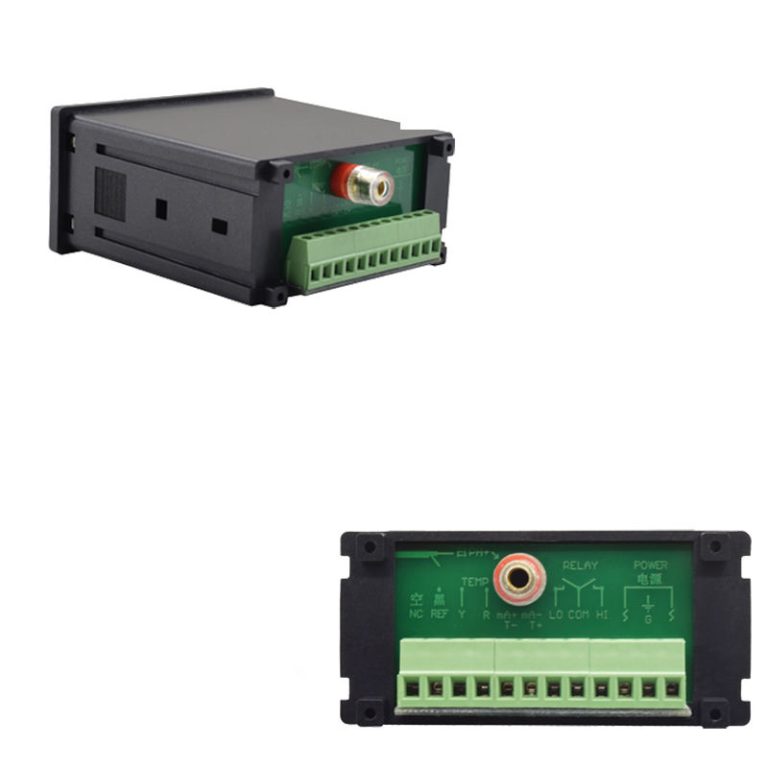
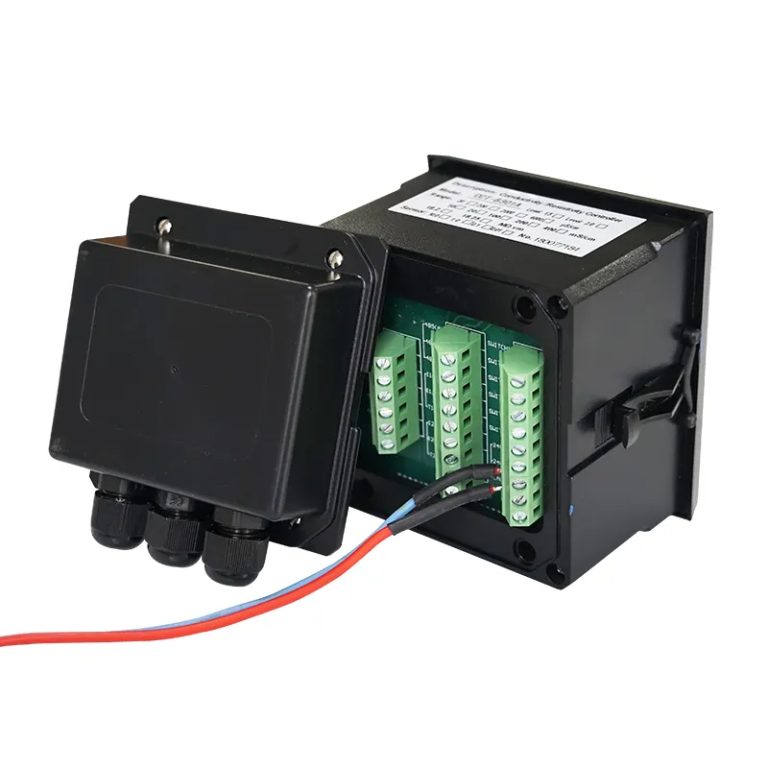
Shanghai ChiMay supplies each of these instrument categories with configurations tuned to nanofiltration service, and the vendor’s application team specifies them as a coordinated cluster rather than as independent line items.
Why Permeate Turbidity Deserves Special Attention
Among the six core sensors, permeate turbidity is the one that most directly answers the question “is the barrier intact?” A nanofiltration membrane in good condition produces permeate that is nearly free of particulate material. Any measurable turbidity on the permeate side is an integrity signal, and the earlier that signal is detected, the more the operator can do about it.
For this reason, the Shanghai ChiMay online turbidity tester is specified for its low-range performance and its bubble-rejection design. Nanofiltration permeate lines are notorious for entrained micro-bubbles, and a nephelometer without robust bubble handling will produce false alarms that quickly erode operator trust in the signal.
Why Permeate Conductivity Is the Companion Signal
Permeate conductivity is not a barrier-integrity signal in the same particulate sense that turbidity is — a compromised membrane will typically show elevated conductivity before it shows measurable turbidity. Together, the two signals give operators a full picture. A rising permeate conductivity with steady turbidity suggests a solute-rejection issue; rising turbidity with steady conductivity suggests a physical integrity issue; rising both suggests a serious membrane failure. Each of these three patterns calls for a different response.
The Concentrate Side and Its Diagnostic Value
The concentrate side of the skid is often under-instrumented compared to the permeate side, which is a missed opportunity. A rising concentrate conductivity trending faster than the feed conductivity suggests that the concentration factor is climbing — often the earliest sign of a flow imbalance or a valve position drift. A dropping concentrate flow at constant feed flow means water is moving to permeate that should not be, which is again an integrity indicator.
Shanghai ChiMay’s turbine flow meter is specified on many nanofiltration skids on the concentrate side for exactly this diagnostic purpose.
Pressure and Temperature: The Foundation
Underneath the six core chemistry and particulate signals is the foundation of pressure and temperature measurement. Transmembrane pressure is the classical hydraulic signature of membrane condition, and temperature is the correcting factor for nearly every other measurement on the skid. Neither is unique to Shanghai ChiMay, but the vendor’s application engineers work with plant instrumentation staff to make sure both are integrated cleanly into the historian alongside the chemistry signals.
Reading the Cluster as a System
The value of the sensor cluster is not the sum of its individual signals — it is the pattern that emerges when the signals are read together. Common patterns include:
- Feed-turbidity spike followed by no permeate response — pretreatment upset absorbed by the membrane, no action needed beyond upstream investigation.
- Feed-turbidity steady, permeate-turbidity rising — beginning of a membrane integrity issue, schedule a pressure-decay test.
- Feed and permeate conductivity both rising, ratio steady — source-water composition change, no action needed on the skid.
- Permeate conductivity ratio climbing — rejection performance drift, plan a cleaning-in-place cycle.
The Shanghai ChiMay application handbook includes a pattern-catalog section that plant staff use to onboard new operators to the skid’s expected behavior.
Data-Layer Integration
Every one of the sensors above earns its keep only if the data reaches a historian that operators, reliability engineers and auditors can access. Shanghai ChiMay sensors export via Modbus RTU/TCP and OPC UA. On modern nanofiltration skids, the sensor gateway is often specified alongside a small edge historian that buffers data during network interruptions — a practice increasingly common as regulatory expectations for data retention have grown.
Commissioning the Cluster
Commissioning a full sensor cluster is a distinct activity from commissioning the membranes themselves. Practical practices include:
- Calibrating each turbidity sensor with fresh formazin before the skid is first pressurized.
- Recording a plant-defined baseline for each conductivity sensor once the skid has been running on process water for at least seventy-two hours.
- Verifying that every alarm-history channel is being written to the historian at the expected resolution.
Shanghai ChiMay’s application team provides a commissioning checklist tailored to nanofiltration skids, which plant integrators have found useful as a starting point.
Closing Note
A nanofiltration skid is only as reliable as the sensor cluster around it. Six well-chosen instruments, integrated into a shared data layer and interpreted as a system, give operators the barrier-integrity confidence that 2026-era regulatory expectations increasingly require. Shanghai ChiMay’s application engineering is organized around delivering that cluster as a coordinated package rather than as a bill of materials.