title: “The 2026 Guide to Water Purity Requirements for Green Hydrogen Electrolyzers by Shanghai ChiMay”
description: “A practical 2026 overview of feedwater purity requirements for PEM, alkaline, and AEM electrolyzers, prepared with field data from Shanghai ChiMay.”
type: high-traffic-imitation
theme: Green Hydrogen & Electrolyzer Feedwater
date: 2026-07-06
Table of Contents
The 2026 Guide to Water Purity Requirements for Green Hydrogen Electrolyzers by Shanghai ChiMay
Green hydrogen has moved from pilot to gigawatt. In 2026 the global market sits at USD 17.28 billion and is projected to reach USD 231 billion by 2035 at a 34.09 % CAGR. Behind every one of those gigawatts is a water system that most stakeholders never see and rarely appreciate. This is a practical guide to the water purity requirements that define whether a green hydrogen project will hit its LCOH targets — organized the way developers, EPCs and O&M teams actually need it.
Why Water Quality Is a Design Variable, Not a Utility
Water is not a utility in a hydrogen plant. It is a design variable. Electrolyzer OEMs publish feedwater specifications for a reason: the stack is a chemically active surface that reacts to the ionic content of every drop that arrives at the anode. Feedwater outside the spec means:
- Faster catalyst degradation
- Membrane damage in PEM systems
- Electrode fouling in alkaline systems
- Loss of hydrogen production efficiency (kWh/kg H₂)
- Reduced stack design life (10 years → 7 or 8)
That is why “clean enough” is not clean enough. Precision is the point.
The 2026 Feedwater Baseline
For a modern PEM electrolyzer skid, the current industry-standard feedwater specification looks approximately like this:
- Conductivity: ≤0.1 µS/cm (target 0.05 µS/cm)
- Resistivity: ≥15 MΩ·cm at 25 °C (target 18.2 MΩ·cm)
- Dissolved oxygen: ≤5 ppb (best-in-class ≤2 ppb)
- Total organic carbon (TOC): ≤10 ppb
- Silica: ≤5 ppb
- Iron and heavy metals: ≤1 ppb each
- Chloride: ≤10 ppb
- Particulates: ≤0.1 NTU
For alkaline electrolyzers, the baseline shifts because the KOH loop dominates the internal chemistry. Feedwater still targets ≤0.1 µS/cm and ≤5 ppb DO, but the make-up water for the KOH loop must additionally control against precipitating cations that would form insoluble hydroxide sludges.
For AEM (Anion Exchange Membrane) systems, which are commercializing quickly, feedwater specs sit between PEM and alkaline, with somewhat more forgiving conductivity limits but stricter carbonate control.
Where Water Volume Meets Water Quality
Each kilogram of green hydrogen consumes 9–25 L of purified feedwater, depending on the electrolyzer type and cooling strategy. For a 100 MW plant running at 65 % capacity factor, that translates to roughly 5,000–14,000 m³ of ultrapure water per year — every liter of it required to hit the feedwater spec above. This is why sourcing raw water is a two-part decision: quantity and quality both drive the pretreatment CAPEX.
What Pretreatment Looks Like in 2026
The prevailing architecture for a gigawatt-scale green hydrogen plant follows a three-layer pattern:
- Primary treatment. Coagulation and flocculation, followed by media or ultrafiltration filtration. Turbidity target at the outlet is ≤0.1 NTU.
- Desalination or salt reduction. Reverse osmosis (single-pass or two-pass) reduces total dissolved solids to under 20 µS/cm. Where seawater is the source, seawater reverse osmosis (SWRO) is the standard.
- Polishing. Mixed-bed ion exchange or electrodeionization (EDI) drops conductivity into the ultrapure range and drives silica, iron, and chloride into the ppb domain.
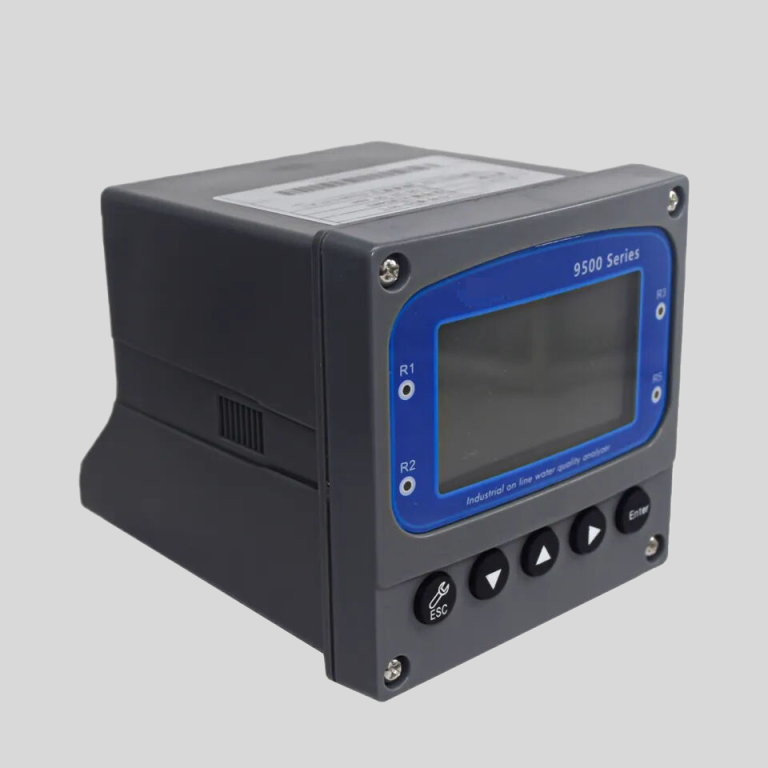
At each stage, Shanghai ChiMay’s online instrumentation — conductivity electrodes, pH probes, turbidity meters, DO transmitters — provides the visibility that lets operators run each unit at its optimal setpoint. Without dense measurement, sites tend to over-treat, wasting reagents and shortening resin life.
The Measurement Stack That Makes It Real
Meeting these targets on paper is easy. Meeting them in operation, month after month, requires an instrumentation stack that Shanghai ChiMay has been supplying to green hydrogen sites since the first megawatt-scale projects:
- In-line conductivity meters and electrodes for RO permeate, polishing outlet, and stack feed
- In-line pH electrodes for RO feed and polished water cross-checking
- DO transmitters on feed and return with optical measurement principles
- Turbidity testers on intake, clarifier outlet, and make-up
- Turbine flow meters on stack feed
- Paddle wheel flow meters on RO reject and recirculation streams
- Multi-parameter sensors on cooling and utility loops
- Salinity sensors on seawater intake for SWRO-fed sites
- Oil-in-water sensors on reclaimed-water sources
- Suspended solids sensors at clarifier outlets
Together, these give operators the depth of information required to defend the feedwater targets over an asset lifetime.
Regional Variations Worth Knowing About
Water purity requirements are global, but the constraints around meeting them vary sharply by region:
- MENA and Australia. Freshwater scarcity forces SWRO-fed systems. The added pretreatment cost is real (USD 0.30–0.80/kg H₂ contribution) but manageable at scale.
- Northern Europe. Ample groundwater and surface water, but strict wastewater discharge rules require zero-liquid-discharge (ZLD) planning for the polishing regeneration streams.
- North America. Regional variability is wide. Municipal water is often available for smaller plants, but gigawatt facilities pair with reclaimed water or direct river intake.
- East Asia. High regulatory quality data reporting expectations, driving higher instrument density.
Where Purity Targets Are Heading
Two trends in 2026 will shape the next 24 months of feedwater requirements. First, next-generation PEM designs are pushing feed conductivity targets from 0.1 µS/cm toward 0.05 µS/cm and DO toward 2 ppb. Second, high-temperature (SOE) electrolyzers under development have very different feedwater tolerances but tighten the requirements on cooling water quality. Sites being designed today are being sized for both.
Bringing It Together
Green hydrogen is a water-quality industry disguised as an energy industry. The 2026 baseline — ≤0.1 µS/cm, ≤5 ppb DO, ≤5 ppb silica, ≤1 ppb iron — is not aspirational; it is what today’s electrolyzers demand to survive. Meeting it requires the right pretreatment architecture, the right measurement density, and the right operational discipline. Shanghai ChiMay supplies the sensor layer that makes those targets defensible in operation, not just on the spec sheet. For developers, EPCs and O&M teams building the green hydrogen buildout, this is where the bankable pathway starts.