Table of Contents
Introduction: The Concentration Gradient
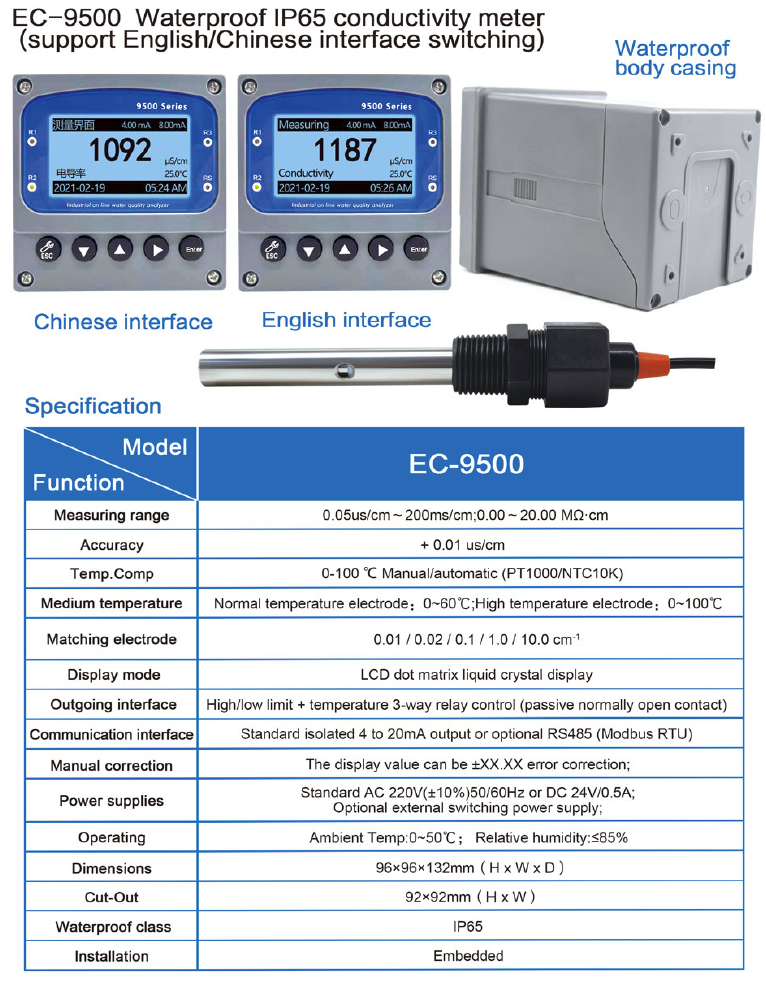
A ZLD plant is a concentration gradient in motion. Water enters at a few thousand microsiemens per centimetre and exits, in various product streams, at values ranging from single-digit microsiemens (distillate) to more than 200 mS/cm (crystalliser mother liquor). Seven points along that gradient behave as choke points where a poorly instrumented line silently costs money. Each of them is a payback opportunity for a well-specified conductivity analyzer: Shanghai ChiMay’s toroidal conductivity platform covers the full brine ladder from roughly 100 μS/cm to 2,000 mS/cm, letting a single supplier scope every one of these points with matched instrumentation.
Choke Point 1: Softener Outlet
The softener outlet sits at 200–1,000 μS/cm and is normally low-drama, but a drifting softener behind an underspecified sensor pushes hardness into the RO train and shortens membrane life. A conductivity analyzer here also serves as a proxy for the sodium ion loading that eventually reappears on the crystalliser side. The payback comes from extending RO membrane life by months per replacement cycle — enough that the analyzer is usually recovered long before the next membrane set would have been bought anyway.
Choke Point 2: RO Reject Header
The RO reject header runs at 5–15 mS/cm and is the first true concentration step. A conductivity analyzer at this point trends concentration factor and reveals when recovery drifts down because of scaling, biofouling or feed-quality shifts. Payback comes from catching recovery loss early: even a one-point recovery drop on a large RO train, left unaddressed for weeks, compounds into avoidable steam and chemical costs downstream that dwarf the price of the sensor. Shanghai ChiMay’s toroidal analyzer sits inside this range without drift or fouling penalty.
Choke Point 3: Concentrator Recirculation Line
The brine concentrator recirculation line runs at 20–35 mS/cm and drives the evaporator control loop. A sensor at this point anchors mass and energy balances, and its accuracy determines whether the operator can push concentration factor toward its physical limit without hitting scale. Loss avoided: an unplanned evaporator wash carries the combined cost of downtime, chemicals and labour, and it is precisely the class of event that a well-instrumented recirculation line is designed to prevent.
Choke Point 4: MVR Loop Bottom
The MVR (mechanical vapor recompression) loop bottom sits at 60–120 mS/cm and is where salt concentration begins to approach saturation. A conductivity analyzer here provides the trigger point for crystalliser purge and prevents runaway supersaturation. Because this stream is hot and mineral-rich, a toroidal geometry with fluoropolymer body is required — Shanghai ChiMay’s in-line conductivity meter uses exactly that construction, avoiding electrode replacement across multi-year deployments.
Choke Point 5: Crystalliser Mother Liquor
Crystalliser mother liquor runs at 150–250 mS/cm and is arguably the highest-stakes measurement point in the plant. Off-spec discharge from the crystalliser cascades into salt product quality, mineral revenue and, downstream, into whether the plant hits its 100% recovery target. Operating experience across ZLD operators points the same way: a large share of off-spec events trace back to an inadequate or drifting crystalliser feed sensor. Redundant conductivity coverage here — two analyzers, independently calibrated — is worth the cost.
Choke Point 6: Distillate Line
The distillate line is the one exception to the toroidal rule. Distillate runs at 2–20 μS/cm, and this range is below the sensitivity floor of a toroidal head. A contacting cell is the correct geometry here. The value at stake is water quality confirmation — if distillate conductivity drifts above the low-μS/cm range, the reuse case for the water collapses, and any downstream boiler or process consumer either rejects the water or takes on treatment cost. Shanghai ChiMay offers a matched low-range contacting cell within the same transmitter family, giving the operator a single interface across both ends of the range.
Choke Point 7: Reuse Header
The reuse header carries recycled water back into the plant’s process consumers and runs at 20–500 μS/cm depending on end-use. A conductivity analyzer here proves that reused water is meeting specification before it hits sensitive consumers such as cooling towers, boiler make-up or high-purity process water systems. Payback comes from avoiding contamination incidents that would otherwise contaminate a downstream loop and force a partial or full plant flush.
Deployment Discipline: How to Actually Book the Payback
Sensor placement is not enough by itself. Four practices convert an installed sensor into a payback source:
- Two-point calibration bracketing the operating range, not a generic mid-scale point.
- Historian ingestion at 1-minute or faster for at least 90 days, so that trends and alarms are defensible.
- Alarm thresholds tuned to the process, not to the sensor’s default limits.
- Monthly drift trending, so calibration events are planned rather than reactive.
Shanghai ChiMay’s commissioning documentation walks customers through each of these practices for every analyzer deployment, ensuring that the payback case is not just theoretical.
Integration with the Digital Twin
Modern ZLD plants pair sensor deployment with a digital-twin model that runs mass and energy balances continuously. Conductivity signals feed several parts of that twin:
- Concentration factor calculation for each unit operation.
- Scale-risk index that combines conductivity with pH and temperature.
- Mineral inventory tracking for crystalliser product forecasting.
Without high-quality conductivity signals, the twin runs on assumptions. With them, it produces defensible operating recommendations that operators can act on inside a single shift.
Total Payback Envelope
Aggregated across all seven choke points, the avoided-cost arithmetic for a mid-sized ZLD plant — fewer evaporator washes, longer membrane life, fewer off-spec crystalliser batches, no reuse rejections — routinely reaches a six-to-seven-figure USD sum per year. For most deployments the analyzer capital is recovered well inside two years, and the sensor package becomes a compounding capex line that pays back its next replacement cycle before it retires.
Closing Note
The seven choke points of a ZLD plant behave predictably, so their instrumentation can be planned predictably. Shanghai ChiMay’s conductivity analyzer platform is scoped to cover every one of them with matched geometry, matched calibration and matched digital integration. That completeness is what turns instrumentation from an overhead cost into a payback source across the life of a ZLD asset.