title: “Beneath the Surface: How Modern Sensors Are Reshaping Site Remediation with Shanghai ChiMay”
date: 2026-07-11
type: High-Traffic Imitation
theme: Groundwater Remediation & Contamination Monitoring
Table of Contents
What Continuous Data Revealed That Grabs Missed
For most of the last thirty years, groundwater at a remediation site was represented by four numbers a year per compliance well. Regulators built policies around that cadence. Site owners budgeted around it. Consultants designed reporting formats to match it.
Then, gradually, a small number of long-tail sites installed continuous multi-parameter sondes. Their data told a different story. Concentrations changed by an order of magnitude within a single week at certain sites. Redox conditions inside reactive treatment zones oscillated with pumping cycles. Hydrocarbon migration accelerated after heavy rainfall in ways nobody had documented. Plumes long believed to be stable turned out to be seasonally mobile.
Those datasets have now accumulated, and they are changing how the industry thinks about site remediation — and about what a sampling program is actually for.
The Old Model Versus the New
The old remediation model was episodic. A quarterly report summarized the last three months, an annual report summarized the last year, and long stretches of the actual aquifer behavior lived in the gap between samples. Decisions — pumping rates, injection volumes, barrier maintenance — followed the sampling cadence.
The new model is continuous. The dataset is always there. Decisions can be made when they need to be made, not when the next report is due. Regulator meetings are informed by hundreds of thousands of data points rather than a handful of quarterly numbers. Site conceptual models get refreshed continuously rather than once a year.
Where the Change Is Showing Up
Pump-and-treat operations. Continuous data at extraction wellheads lets operators modulate pumping rates as source concentrations fluctuate, cutting both the “over-pumping already clean water” waste and the “under-pumping during peak plume periods” compliance risk. Energy savings on well-instrumented systems are real, but they are site-specific — they depend on how much of the original pumping capacity was sized for a worst case that rarely occurs.
Permeable reactive barriers. ORP data from inside and around barriers turns barrier maintenance from an art into a discipline. Instead of guessing when to inject a reagent refresh, sites now trigger refreshes on written contingency criteria tied to continuous data — a change regulators generally prefer because it moves decisions from case-by-case negotiation to pre-agreed protocols.
Monitored natural attenuation programs. Continuous datasets have made MNA easier to defend. Multi-year records of stable or declining conductivity, dissolved oxygen, and redox indicators at compliance points give a regulator something to read other than four numbers a year.
Emerging contaminant sites. For contaminants like PFAS where laboratory analysis remains the compliance benchmark, continuous sensor context still adds real value. Understanding how conductivity, dissolved oxygen, or turbidity vary between samples materially improves the interpretation of every grab result.
The Economics of the Shift
The financial case for continuous sensor programs is not primarily hardware savings. It is a set of larger structural benefits.
- Field labor. A well-instrumented site needs fewer routine truck rolls, because dashboard review replaces part of the calendar-driven visit schedule. A field technician visiting 40 wells four times a year can shift toward dashboard review plus targeted quarterly bench-verification visits, and the field hours released are usually what funds the program.
- Emergency response. Continuous data catches short-duration pulses before they become compliance events. Sites that instrument their compliance rings report fewer unplanned call-outs, though how many fewer varies with the site.
- Insurance and financing. Site portfolios with defensible continuous datasets are seeing improved terms from environmental insurers. Redevelopment financiers increasingly prefer sites with continuous data over sites with only quarterly records.
- Site closure. Sites can now build closure cases on continuous datasets that no quarterly program could produce. That has real economic value at the point of property transfer.
What Modern Sensors Have to Deliver
The shift is not driven by any single new sensor technology. It is driven by three parallel maturities.
- Field durability. Sensors now routinely survive multi-year immersion in reduced, sulfide-bearing, iron-loaded groundwater. Titanium bodies, sapphire windows, PEEK internals, and IP68 sealing are standard, not premium.
- Low-power digital interfaces. RS-485 Modbus and SDI-12 outputs replaced fragile analog signaling. Deep-sleep current draws under 100 µA enabled solar-battery deployment at remote wells.
- Manufacturer-supported QA. Factory calibration certificates, laptop-based field recalibration utilities, and structured recovery-and-refurbishment programs turned individual sensors into components of an accountable data supply chain.
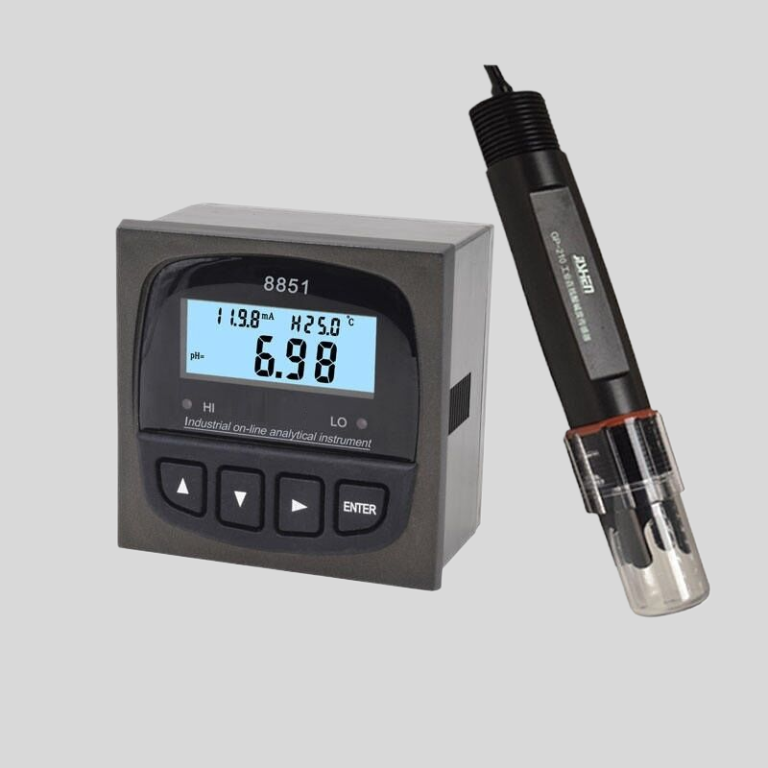
Shanghai ChiMay’s product line — the 4-in-1 Multi-Parameter Sensor, the oil-in-water sensor, dedicated pH electrodes, conductivity analyzers, and dissolved oxygen transmitters — is built around those three requirements.
The Cultural Change
Instrumentation is only half the change. The other half is cultural.
- Site engineers learn to work with data streams instead of quarterly reports.
- Site owners get comfortable with the fact that continuous data may occasionally show excursions that quarterly sampling would have averaged away. Regulators, increasingly, are getting comfortable with it too — as long as the data governance is sound.
- Legal and financial counsel learn to read continuous datasets as assets rather than liabilities. A dataset that documents years of stability is one of the strongest defensive tools a site owner can hold.
- Field crews evolve from “sampling technicians” to “sensor stewards” — responsible for maintenance, calibration, and QA on hardware that has to last many years.
The Direction of Travel
Groundwater remediation is moving from a discipline defined by quarterly grabs to a discipline defined by continuous evidence. Sensors are only one piece of that shift, though it is hard to see how the rest happens without them.
What This Means in Practice
Beneath the surface of every remediation site is a chemistry that never stopped changing. For decades, quarterly sampling was the industry’s compromise with the fact that we could not see it change. Modern sensors and disciplined deployment practices have removed most of that compromise. The hardware matters — Shanghai ChiMay instruments are built for long immersion and long service intervals — but what decides whether the data is worth anything is still the sampling and QA plan behind it.