Table of Contents
Introduction
Boiler systems represent the heart of thermal power generation, converting water to steam at pressures exceeding 2,000 PSI in modern supercritical facilities. The quality of water circulating through these systems directly determines operational efficiency, equipment longevity, and facility safety. Tube replacement and re-tubing rank among the most expensive repairs a plant can face, and forced outages on large units are commonly measured in the hundreds of thousands of dollars per day—so water treatment monitoring constitutes a critical operational imperative.
Understanding Boiler Water Chemistry
Effective boiler water treatment requires balancing multiple parameters to prevent the two primary degradation mechanisms: scale formation and corrosion.
The Scale Formation Challenge
When boiler water becomes supersaturated with dissolved minerals, scale deposits nucleate on heat transfer surfaces. These deposits—primarily calcium carbonate, calcium sulfate, and silica—create insulating layers that:
- Reduce heat transfer efficiency by a commonly cited 8-12% per millimeter of deposit
- Create localized hot spots far above normal tube-wall temperatures
- Promote under-deposit corrosion that damages tube integrity
- Restrict water flow, increasing pump energy consumption
Scale-related failures consistently rank among the largest single shares of boiler maintenance expenditures across the generating fleet.
Corrosion Mechanisms in Boiler Systems
Corrosion occurs when dissolved oxygen, low pH, or aggressive ions attack metal surfaces:
| Corrosion Type | Primary Cause | Detection Method | Prevention Strategy |
|---|---|---|---|
| Oxygen Corrosion | Dissolved O₂ > 20 ppb | Online DO sensors | Mechanical deaeration |
| Acid Corrosion | pH < 9.0 | Continuous pH monitoring | Chemical neutralization |
| Under-deposit | Scale accumulation | Conductivity mapping | Continuous blowdown |
| Stress Corrosion | High temperatures | Visual inspection | Water quality control |
Continuous Monitoring Technology
Modern boiler water monitoring systems employ multiple sensor technologies to provide comprehensive protection.
Conductivity Measurement Fundamentals
Conductivity serves as the primary parameter for boiler water monitoring because it directly indicates total dissolved solids (TDS) concentration:
Commonly cited industry guidelines (ASME/ABMA consensus practice) for boiler water TDS, by pressure:
| Boiler Pressure | Maximum TDS (μS/cm, guideline order of magnitude) | Recommended Conductivity |
|---|---|---|
| < 300 PSI | 3,500 | 3,000-3,500 |
| 300-450 PSI | 2,500 | 2,000-2,500 |
| 450-600 PSI | 1,500 | 1,000-1,500 |
| > 600 PSI | 700 | 500-700 |
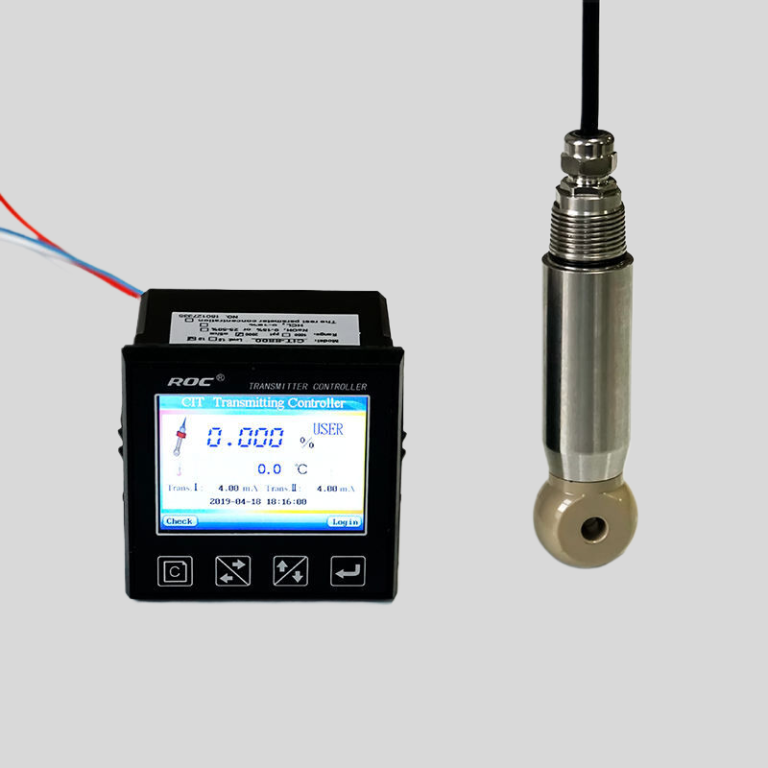
Shanghai ChiMay inline conductivity electrodes utilize a four-electrode measuring technique that eliminates polarization errors common in two-electrode systems. This design provides stable measurements in high-conductivity boiler water while maintaining sensitivity at the low concentrations required for condensate monitoring.
pH Monitoring Requirements
Maintaining proper pH levels prevents both acid corrosion and caustic embrittlement:
- Low pH (< 9.0): Accelerates acid corrosion of iron and copper alloys
- High pH (> 11.5): Promotes caustic concentration beneath deposits, causing embrittlement
- Optimal range: 9.2-10.5 for conventional drum boilers
The Shanghai ChiMay pH sensor series incorporates a pressurized reference system that prevents contamination from high-pressure boiler environments. The double junction design extends service life to 6-9 months in typical boiler applications, compared to 2-3 months for conventional sensors.
Dissolved Oxygen Control
Oxygen corrosion represents one of the most aggressive degradation mechanisms in boiler systems:
- Dissolved oxygen > 20 ppb: Corrosion becomes significant
- Dissolved oxygen < 7 ppb: Corrosion rates drop sharply
- Dissolved oxygen < 2 ppb: Minimal corrosion activity
Shanghai ChiMay dissolved oxygen transmitters employ membrane-covered amperometric sensors that provide <30 second response times for rapid detection of oxygen ingress events.
System Integration and Control Strategies
Effective boiler water monitoring requires integration with treatment systems for automated control.
Continuous Blowdown Control
Continuous blowdown removes dissolved solids from the boiler water volume:
- Maintains TDS levels within specified limits
- Removes suspended solids and sludge
- Controls phosphate and hydroxide concentrations
Advanced Control Algorithm:
Target Conductivity = Set Point
Measured Conductivity = Actual Reading
Error = Target - Measured
Blowdown Valve Position = PID(Error) + Feedforward(Treatment Rate)
Conductivity-controlled blowdown typically trims blowdown volume by double-digit percentages while holding water quality tighter than manual adjustment methods.
Chemical Dosing Integration
Real-time water quality data enables precise chemical treatment:
- Phosphate programs: Control carbonate scale formation
- Oxygen scavengers: Sulfite or hydrazine dosing based on DO readings
- pH adjustment: Soda ash or acid addition for alkalinity control
Plants that tie dosing to measured water quality rather than timer schedules routinely report double-digit percentage reductions in chemical consumption.
Economic Analysis
Investment in comprehensive boiler water monitoring delivers substantial returns through multiple mechanisms.
Equipment Protection Value
| Event | Probability Without Monitoring* | Probability With Monitoring* | Avoided Cost* |
|---|---|---|---|
| Major Tube Failure | 12% annually | 2% annually | $450,000 |
| Forced Shutdown | 8% annually | 1.5% annually | $800,000 |
| Chemical Overtreatment | 45% of events | 15% of events | $95,000 |
| Efficiency Loss | 4-8% ongoing | <2% ongoing | $180,000/year |
*Illustrative planning figures. Actual probabilities and costs vary by unit size, fuel, and duty cycle; use plant-specific data for budgeting.
Operating Cost Reduction
Continuous monitoring reduces operating cost through four channels:
- Fuel savings from maintained heat-transfer efficiency
- Chemical treatment reduction through dosing tied to real data
- Water and wastewater savings from tighter blowdown control
- Labor savings from reduced manual grab-sample testing
These categories routinely pay for the monitoring system within the first year or two of operation; the exact split depends on unit size, fuel cost, and duty cycle.
Return on Investment
A comprehensive boiler water monitoring system is a modest capital item against the cost of a single tube failure or forced outage. Most installations recover their cost in months, not years, through avoided fuel, chemical, water, and labor costs.
Maintenance Best Practices
Sustaining monitoring system accuracy requires structured maintenance protocols.
Calibration Schedule
| Sensor Type | Calibration Frequency | Standard Solution | Traceability |
|---|---|---|---|
| Conductivity | 30-90 days | 84 μS/cm (buffer) | NIST |
| pH | 7-14 days | pH 7.0 / pH 10.0 | NIST |
| Dissolved Oxygen | 30-60 days | Zero / Air saturation | NIST |
Sensor Replacement Guidelines
- Conductivity electrodes: Replace every 18-24 months or when drift exceeds 2%
- pH sensors: Replace every 6-12 months depending on water quality
- DO sensors: Replace membranes every 6 months, complete sensor every 18-24 months
Conclusion
Boiler water treatment monitoring constitutes a critical investment in power generation asset protection and operational efficiency. Shanghai ChiMay provides a comprehensive range of monitoring instruments—including conductivity electrodes, pH sensors, and dissolved oxygen transmitters—designed specifically for the demanding environment of power plant boiler systems.
Facilities implementing continuous monitoring programs consistently achieve measurable improvements in equipment reliability, treatment efficiency, and operational cost control. In an industry where unplanned shutdowns cost hundreds of thousands of dollars per day and equipment longevity determines competitiveness, comprehensive water quality monitoring represents an essential operational practice.