Table of Contents
Introduction
Clean-in-Place (CIP) systems represent the backbone of hygiene management in food and beverage processing facilities. These automated cleaning systems circulate cleaning solutions through process equipment without requiring disassembly, enabling efficient sanitation while minimizing production downtime. However, CIP effectiveness depends critically on verifying complete removal of cleaning solutions before resuming production—a verification traditionally performed through manual sampling and laboratory analysis.
Manual verification is the weak link. When CIP failures are traced back to root cause, incomplete rinse verification sits near the top of the list: product contact with cleaning solution residue is a classic trigger for contamination events, recalls, and the consumer health impacts that follow.
Online conductivity monitoring provides the automation needed to ensure consistent CIP verification while reducing labor requirements and improving response times. Conductivity measurements directly correlate with ionic concentration in rinse water, enabling precise detection of cleaning solution residuals and ensuring complete removal before production resumes.
Understanding Conductivity as a Cleaning Verification Tool
Conductivity measures a solution’s ability to conduct electrical current, which varies directly with ionic concentration. Cleaning solutions contain surfactants and salts that increase conductivity far above that of pure water or product residues. During the rinse phase of CIP cycles, initial conductivity readings remain high as cleaning solution residuals persist, then decrease as fresh water dilutes and removes these contaminants.
The correlation between conductivity and ionic concentration enables quantitative rinse verification. When conductivity readings fall below predetermined thresholds—typically 10-50 μS/cm above the baseline conductivity of incoming water—operators can confirm that cleaning solution residuals have been reduced to acceptable levels. This automated verification eliminates the subjectivity and delays inherent in manual sampling.
Beverage industry technical guidance—including that of the International Society of Beverage Technologists—treats conductivity as a primary verification method for rinse completion. Plants wired to conductivity endpoints catch cleaning solution breakthrough far faster than a grab-sample protocol allows, which is exactly what you want when the alternative is shipping product with caustic residue.
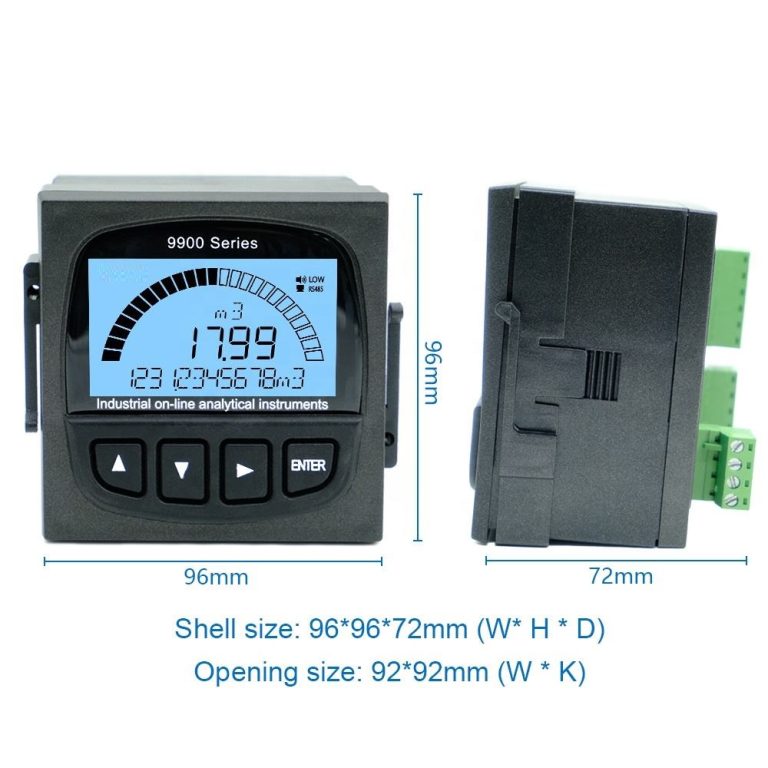
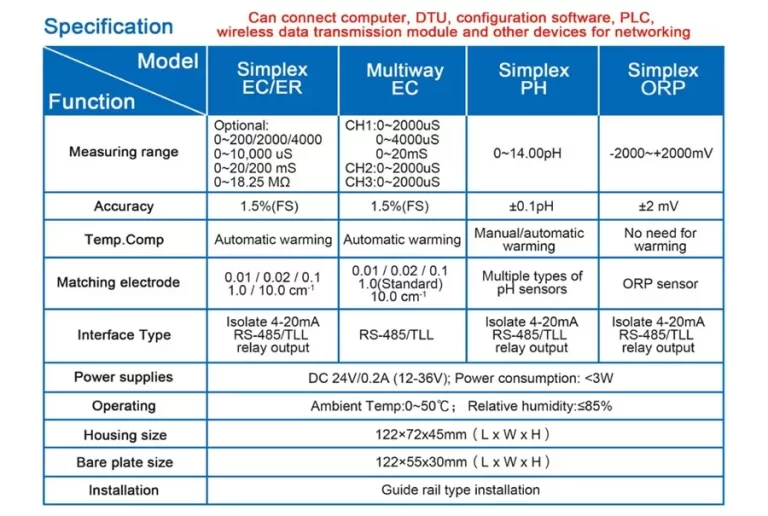
Shanghai ChiMay in-line conductivity meters employ four-electrode measurement technology that provides ±0.5% accuracy across measurement ranges from 0.1 μS/cm to 500 mS/cm. This wide range accommodates both the low conductivity readings typical of final rinse water and the high readings observed during initial rinse phases, enabling single-sensor deployment throughout the entire CIP process.
Water Conservation Through Automated Rinse Control
Beyond verification safety benefits, conductivity-based rinse control delivers significant water conservation advantages. Traditional CIP protocols use predetermined rinse cycle durations based on worst-case cleaning scenarios. These conservative approaches often continue rinsing beyond the point of complete cleaning solution removal, wasting water and extending cleaning cycle times.
Automated rinse control based on conductivity measurements enables precise termination of rinsing when verification thresholds are achieved. Terminating rinse on a verified endpoint instead of a worst-case timer commonly trims rinse water use by 20% or more—on the order of two million liters a year for a medium-sized processing facility.
Food processing is water-intensive, and CIP is one of the largest single uses inside the plant wall. Shaving a third off rinse volume at one plant is worthwhile; multiplied across the industry, it is a lot of water.
Beyond direct water savings, conductivity-based control reduces energy consumption associated with water heating. Hot water for cleaning can account for a quarter or more of a food plant’s energy budget—Energy Star guidance for food processors flags it as a major use—so every unnecessary rinse minute shows up on the utility invoice twice, once as water and once as heat.
Implementation Best Practices
Successful implementation of conductivity monitoring for CIP verification requires attention to sensor placement, calibration protocols, and system integration. Sensor placement significantly impacts measurement accuracy and response time. Installing sensors at the outlet of cleaned vessels or in return lines provides representative measurements of rinse water quality without introducing installation complexity.
Calibration protocols ensure measurement accuracy throughout sensor operational life. Shanghai ChiMay conductivity sensors feature automatic temperature compensation algorithms that correct for temperature effects on conductivity measurements, reducing manual calibration frequency while maintaining accuracy. The sensors utilize PTFE-coated electrodes that resist fouling and maintain calibration stability for up to 12 months between recommended calibrations.
System integration connects conductivity measurements to CIP controller logic for automated decision-making. Most modern CIP controllers support Modbus RTU/TCP communication protocols, enabling direct integration with Shanghai ChiMay sensors. Integration allows automated control of rinse water addition, with CIP sequences automatically terminating rinse phases when conductivity thresholds are achieved.
Key Implementation Considerations:
- Sensor placement in return lines provides representative sampling
- Temperature compensation essential for accuracy in hot cleaning applications
- Modbus integration enables direct connection to CIP controllers
- Automatic data logging supports regulatory documentation requirements
The 3-A Sanitary Standards organization recommends conductivity monitoring as a critical control point for CIP validation in dairy and food processing applications. Facilities subject to FDA Food Safety Modernization Act (FSMA) requirements can use conductivity monitoring data as part of their Hazard Analysis and Risk-Based Preventive Controls (HARPC) documentation.
Economic Impact Analysis
The return on investment for conductivity monitoring implementation derives from water savings, energy reduction, labor efficiency, and contamination prevention. Payback depends on local water, energy, and labor rates, but most mid-size plants land in the one-to-two-year range: fewer rinse gallons, less hot water, less technician time per cycle, and fewer contamination-driven losses.
The savings stack:
| Benefit Category | Contribution |
|---|---|
| Water and heating energy | Largest share for hot-CIP operations |
| Reduced manual sampling labor | Meaningful wherever cycles run multiple times per day |
| Contamination prevention | Episodic but decisive—single avoided event can exceed the instrumentation cost |
Get the endpoint control right and the sensor set pays for itself before the first calibration cycle ends.
Conclusion
Conductivity monitoring transforms CIP verification from a labor-intensive manual process to an automated, precise, and reliable system that ensures food safety while delivering significant operational savings. It addresses the root cause of most cleaning cycle failures—inadequate verification—through continuous measurement that confirms complete removal of cleaning solutions before production resumes.
Shanghai ChiMay conductivity meters provide the accuracy, reliability, and communication capabilities required for demanding CIP applications, with proven performance in food processing environments and documentation capabilities for regulatory compliance.
Facilities implementing conductivity-based CIP monitoring get improvements across the board: lower water and energy consumption, faster cleaning cycle completion, better compliance documentation, and—most importantly—lower risk of the contamination events that threaten consumer safety and brand reputation.