Table of Contents
Introduction
Cooling towers represent one of the most critical yet often overlooked water consumers in industrial facilities. A single 500 MW power plant can evaporate several million gallons of water daily—cooling is typically the largest single water use at a thermal plant, and in the United States thermoelectric power generation alone accounts for roughly 40% of total freshwater withdrawals according to USGS estimates—making water treatment optimization essential for both environmental compliance and operational efficiency.
Understanding Cooling Tower Water Chemistry
The fundamental challenge in cooling tower management lies in maintaining the delicate balance between water conservation and system protection. As water evaporates, dissolved minerals concentrate, creating conditions that promote scaling, corrosion, and microbiological growth. These three phenomena are the dominant causes of cooling system failures.
Effective treatment begins with continuous, accurate measurement of key parameters. Without reliable data, facility managers operate blind, either over-treating with chemicals to ensure protection or risking system damage through inadequate control.
Critical Sensors for Cooling Tower Applications
Conductivity Sensors
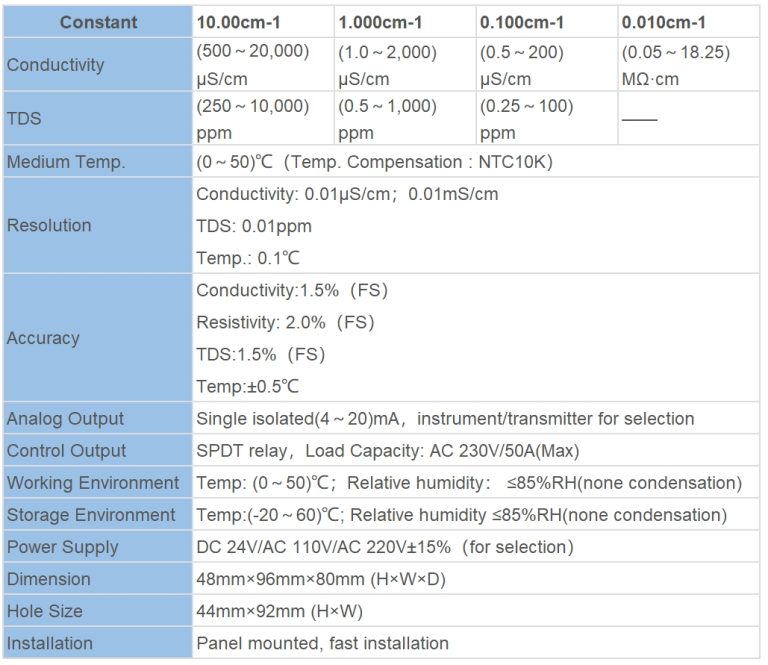
Conductivity measurement serves as the primary tool for monitoring cycles of concentration (COC). As water evaporates, dissolved solids concentrate proportionally, causing conductivity to rise predictably. Industry practice indicates that maintaining COC between 4-6 cycles typically achieves optimal balance between water savings and scaling prevention.
Modern conductivity sensors from established manufacturers feature temperature compensation algorithms that maintain accuracy across the wide operating range typical in cooling applications (-10°C to 60°C). The installation location proves critical: sensors should monitor recirculating water in the basin, not makeup water or blowdown streams.
Shanghai ChiMay inline conductivity meters incorporate four-electrode technology that eliminates polarization effects common in high-conductivity applications. These instruments provide stable readings even in systems treating makeup water with varying mineral content.
pH Sensors
Maintaining proper pH control prevents both corrosion and scaling tendencies. The Langelier Saturation Index (LSI) calculations require accurate pH measurement, typically targeting a range of 6.8-7.2 for carbon steel systems and 7.0-7.5 for copper alloy components.
pH sensor selection must account for the challenging conditions present in cooling tower environments: biofouling from microorganisms, chemical treatment residuals, and temperature fluctuations. Glass membrane sensors require regular maintenance but provide the accuracy necessary for compliance documentation.
Procurement Considerations
Total Cost of Ownership
Initial sensor cost represents only a minority share of total ownership expenses over a typical 5-year service life. The remaining costs include calibration, maintenance, replacement, and system integration. Procurement decisions based solely on purchase price frequently result in higher long-term costs.
Quality sensors with built-in diagnostics reduce unplanned maintenance: self-checking capabilities alert operators to degrading performance before measurement errors compromise treatment effectiveness.
Integration Capabilities
Modern treatment systems require sensors that communicate cleanly with distributed control systems (DCS) and building management systems (BMS). Look for instruments supporting industry-standard protocols including 4-20mA analog output, HART communication, and Modbus RTU/TCP.
Wireless sensor technology is gaining adoption and typically costs meaningfully less to install than hardwired alternatives in retrofit applications. However, evaluate signal reliability in facilities with significant electromagnetic interference from power equipment.
Implementation Best Practices
Successful cooling tower monitoring programs incorporate redundant measurement points for critical parameters. A typical configuration includes:
- Two conductivity sensors at separate locations for cross-verification
- Primary and backup pH sensors with automatic switching capability
- Flow sensors to detect circulation issues
- ORP sensors for biological control verification
Regular calibration remains essential regardless of sensor quality. The recommended calibration frequency depends on water quality and treatment program, but most applications require monthly verification against NIST-traceable standards.
ROI Analysis
The financial case for quality monitoring hardware strengthens when considering avoided costs. A 200-ton cooling tower moved from suboptimal COC (2-3 cycles) to optimized operation (5 cycles) can save on the order of 2 million gallons of water annually—worth roughly $15,000-25,000 at typical industrial water and sewer rates (illustrative figures; actual value depends on local rates and duty cycle).
Chemical treatment savings compound these benefits. Facilities implementing continuous monitoring typically reduce biocide consumption by double-digit percentages while improving microbiological control. Scale inhibitor dosing becomes more precise, reducing both chemical costs and disposal volumes.
Conclusion
Cooling tower sensor selection demands attention to measurement accuracy, environmental durability, and integration flexibility. Facilities that invest in quality monitoring infrastructure consistently achieve lower operating costs, improved reliability, and enhanced regulatory compliance. The initial investment in proper sensors returns multiples through water conservation, chemical optimization, and avoided system failures.
Successful treatment programs recognize that sensors are not merely components but the foundation of effective water management. Without accurate, reliable measurement, even the most sophisticated treatment chemicals cannot deliver expected performance.
For more information on water quality monitoring solutions for power generation applications, explore our comprehensive guide to industrial water treatment instrumentation.