Understanding the Importance of Flow Sensors in Measuring ml/min
Flow sensors play a crucial role in various industries, including healthcare, pharmaceuticals, and manufacturing. These sensors are designed to measure the flow rate of liquids or gases in a system, providing valuable data that can be used for monitoring and controlling processes. One common unit of measurement for flow sensors is ml/min, which stands for milliliters per minute. Understanding the importance of flow sensors in measuring ml/min is essential for ensuring accurate and efficient operations.
Flow sensors are used in a wide range of applications, from medical devices such as infusion pumps and ventilators to industrial processes like chemical production and water treatment. In the medical field, flow sensors are used to monitor the flow rate of medications and fluids being administered to patients. By accurately measuring the ml/min of these substances, healthcare providers can ensure that patients receive the correct dosage and treatment.
In pharmaceutical manufacturing, flow sensors are essential for ensuring the quality and consistency of products. By monitoring the flow rate of ingredients and chemicals during the production process, manufacturers can maintain precise control over their operations and prevent costly errors. Flow sensors can also help identify any issues or deviations in the production line, allowing for quick adjustments to be made to maintain product quality.
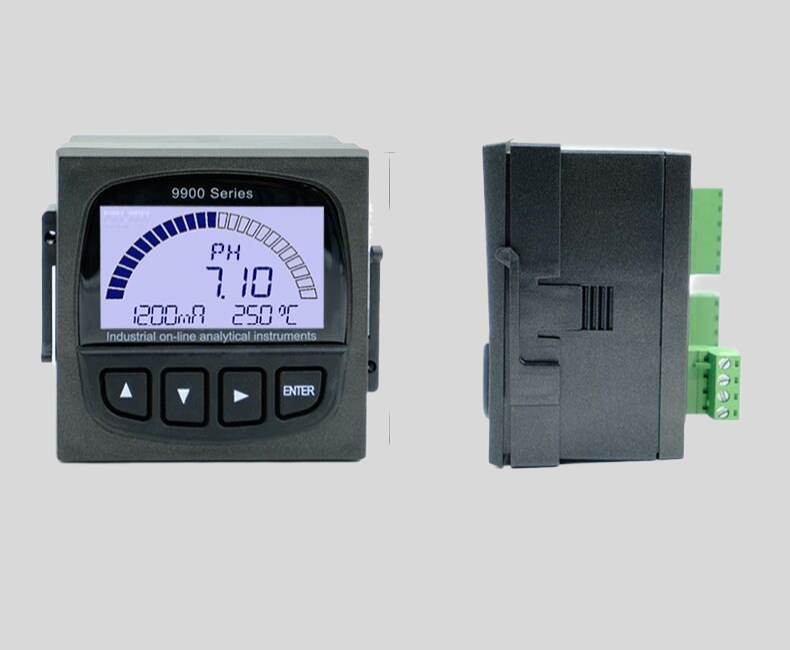
| Model | EC-8851/EC-9900 High Precision Conductivity/Resistivity Controller |
| Range | 0-200/2000/4000/10000uS/cm |
| 0-20/200mS/cm 0-18.25MΩ | |
| Accuracy | Conductivity:1.5%; Resistivity:2.0%(FS) |
| Temp. Comp. | Automatic temperature compensation based on 25℃ |
| Oper. Temp. | Normal 0~50℃; High temp 0~120℃ |
| Sensor | 0.01/0.02/0.1/1.0/10.0cm-1 |
| Display | LCD Screen |
| Current Output | 4-20mA output/2-10V/1-5V |
| Output | High/Low limit dual relay control |
| Power | DC24V/0.5A or |
| AC85-265V±10% 50/60Hz | |
| Working Environment | Ambient temperature:0~50℃ |
| Relative humidity≤85% | |
| Dimensions | 96×96×72mm(H×W×L) |
| Hole Size | 92×92mm(H×W) |
| Installation Mode | Embedded |
In the food and beverage industry, flow sensors are used to measure the flow rate of liquids such as water, milk, and juices. By accurately monitoring the ml/min of these substances, manufacturers can ensure that their products meet quality standards and regulatory requirements. Flow sensors can also help optimize production processes, leading to increased efficiency and cost savings.
| CCT-3300 | ||||
| Constant | 10.00cm-1 | 1.000cm-1 | 0.100cm-1 | 0.010cm-1 |
| Conductivity | (500~20,000) | (1.0~2,000) | (0.5~200) | (0.05~18.25) |
| μS/cm | μS/cm | μS/cm | MΩ·cm | |
| TDS | (250~10,000) | (0.5~1,000) | (0.25~100) | —— |
| ppm | ppm | ppm | ||
| Medium Temp. | (0~50)℃(Temp. Compensation : NTC10K) | |||
| Resolution | Conductivity: 0.01μS/cm;0.01mS/cm | |||
| TDS: 0.01ppm | ||||
| Temp.: 0.1℃ | ||||
| Accuracy | Conductivity:1.5%(FS) | |||
| Resistivity: 2.0%(FS) | ||||
| TDS:1.5%(FS) | ||||
| Temp:±0.5℃ | ||||
| Analog Output | Single isolated(4~20)mA,instrument/transmitter for selection | |||
| Control Output | SPDT relay,Load Capacity: AC 230V/50A(Max) | |||
| Working Environment | Temp: (0~50)℃;Relative humidity: ≤85%RH(none condensation) | |||
| Storage Environment | Temp:(-20~60)℃; Relative humidity ≤85%RH(none condensation) | |||
| Power Supply | DC 24V/AC 110V/AC 220V±15%(for selection) | |||
| Dimension | 48mm×96mm×80mm (H×W×D) | |||
| Hole Size | 44mm×92mm (H×W) | |||
| Installation | Panel mounted, fast installation | |||
In the automotive industry, flow sensors are used in fuel injection systems to measure the flow rate of gasoline or diesel fuel. By accurately monitoring the ml/min of fuel being delivered to the engine, automakers can optimize fuel efficiency and reduce emissions. Flow sensors can also help diagnose and troubleshoot issues with the fuel system, leading to improved performance and reliability.
Overall, flow sensors play a critical role in ensuring the accuracy, efficiency, and safety of various processes and systems. By measuring the flow rate in ml/min, these sensors provide valuable data that can be used to monitor and control operations in real-time. Whether in healthcare, pharmaceuticals, manufacturing, or other industries, flow sensors are essential for maintaining quality, consistency, and compliance with regulatory standards.
In conclusion, understanding the importance of flow sensors in measuring ml/min is essential for ensuring the smooth and reliable operation of systems and processes. By accurately monitoring the flow rate of liquids or gases, flow sensors provide valuable data that can be used to optimize performance, prevent errors, and improve overall efficiency. Whether in medical devices, industrial processes, or automotive systems, flow sensors are indispensable tools for achieving precision and control in a wide range of applications.