Table of Contents
The short version
- 5G’s low latency, down to about a millisecond in URLLC mode, is what makes closed-loop wireless control realistic
- Industrial 5G adoption is still early: HMS Networks’ 2025 industrial network survey found it a small slice of new nodes, held back by cost and integration complexity
- 5G targets far higher device density than 4G, which suits dense sensor networks
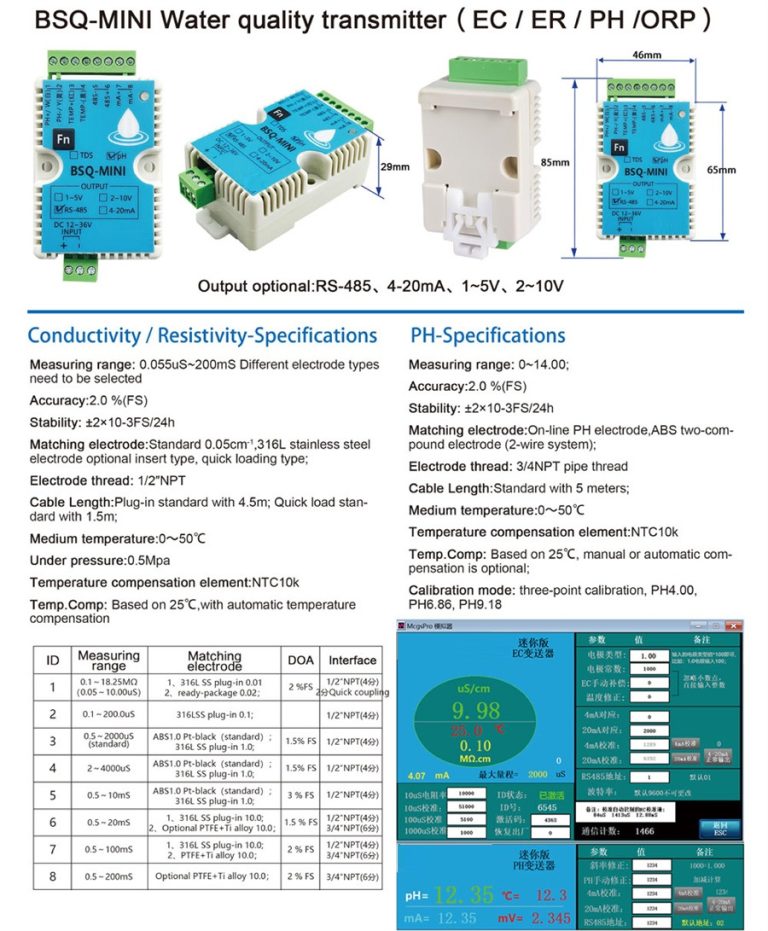
- Shanghai ChiMay IoT sensors connect through 5G gateways for remote and mobile monitoring duty
Introduction
Fifth-generation wireless technology—5G—is transforming industrial water monitoring. Beyond faster smartphone downloads, 5G delivers ultra-low latency, massive device density, and reliable communication in demanding environments.
Understanding 5G Technology
The Evolution
1G (1980s): Analog voice
2G (1990s): Digital voice and SMS
3G (2000s): Mobile data, early internet
4G/LTE (2010s): Broadband mobile data, streaming
5G (2020s): Ultra-reliable low latency, massive IoT
Ericsson Mobility Report (2026) puts global 5G subscriptions past 3 billion in 2026 and expects 5G to overtake 4G around 2027.
5G Technology Profiles
Enhanced Mobile Broadband (eMBB): High bandwidth for video and AR/VR. Peak rates to 10 Gbps.
Ultra-Reliable Low Latency Communication (URLLC): Mission-critical applications. Latency as low as 1 millisecond. Reliability of 99.999%.
Massive Machine-Type Communication (mMTC): Connecting vast IoT device numbers. Support for 1 million devices per square kilometer.
Key Technical Advances
- Millimeter wave spectrum: 24 GHz to 100 GHz with massive bandwidth
- Small cells: Dense low-power base stations for high capacity
- Beamforming: Directional antenna focusing signal energy
- Network slicing: Virtual partitions for application-specific performance
5G Benefits for Industrial Water Monitoring
Ultra-Low Latency Enabling Real-Time Control
4G/LTE round-trip latency of tens of milliseconds is fine for display and alerting but marginal for tight closed-loop control. 5G’s millisecond-scale latency in URLLC mode is what changes that:
Real-time process control: Water quality measurements directly control treatment without human intervention.
Predictive control: Advanced algorithms anticipate changes and preemptively adjust treatment.
Synchronized operations: Multiple sensors and actuators coordinate with millisecond precision.
The control benefit comes from loop behaviour rather than from the radio itself: a faster, more deterministic link lets you tighten the loop, which usually shows up as less overshoot and less chemical use.
Massive Device Density
| Technology | Devices per Cell | Typical Latency |
|---|---|---|
| 4G/LTE | 10,000-100,000 | 50-100 ms |
| 5G mMTC | 1,000,000+ | Seconds to minutes |
| 5G URLLC | Limited | 1-10 ms |
5G enables comprehensive monitoring networks impractical with previous technologies.
Enhanced Reliability
5G URLLC provides 99.999% availability with redundancy mechanisms and Quality of Service guarantees. Edge computing integration maintains operation during connectivity interruptions.
Mobility Support
5G is specified for mobility up to 500 km/h, which covers portable instruments, AGVs and monitoring mounted on moving equipment.
Industrial 5G Deployment Models
Private 5G Networks
Many facilities deploy dedicated 5G networks:
- Dedicated spectrum: Private licenses or shared spectrum (CBRS in US)
- On-premise infrastructure: Private base stations and core network
- Controlled environment: Complete control over coverage and performance
Private 5G costs have fallen as the hardware matured, but a campus deployment still means a six-figure project for a medium-scale site once spectrum, radios, core network and integration are counted.
Hybrid Deployments
Many facilities combine public 5G coverage with private network extensions:
- Public coverage: Mobile assets and field personnel
- Private coverage: Critical fixed monitoring points
- Network slicing: Guaranteed performance for critical traffic
Edge-Enhanced 5G
Combining 5G with edge computing creates powerful architectures:
- Edge processing: Local data processing reducing latency and bandwidth
- Local control: Critical functions execute locally
- Intelligent offload: Only relevant data transmits to cloud
Application Examples
Real-Time Process Optimization
Traditional treatment operates reactively. 5G enables proactive optimization:
- Continuous parameter optimisation: closed-loop control that trims aeration and pumping energy
- Multi-variable optimization: Algorithms optimizing multiple parameters simultaneously
- Energy optimization: DO sensors with 5G enabling real-time aeration control
Shanghai ChiMay IoT-enabled sensors connect to 5G networks for real-time optimization.
Comprehensive Distribution Monitoring
5G connectivity enables comprehensive monitoring of distribution networks:
- Pressure monitoring: real-time optimisation that cuts leakage losses
- Quality monitoring: Immediate contamination detection
- Flow monitoring: District meter area monitoring
Remote and Hazardous Location Monitoring
5G makes challenging applications practical:
- Remote well sites: Telemetry without cable installation
- Hazardous areas: Wireless eliminating wiring complexity
- Temporary installations: Portable stations for emergency response
Augmented Reality-Assisted Maintenance
5G’s combination of low latency and high bandwidth enables:
- Remote expert guidance: AR glasses with real-time video
- Overlay information: Sensor data and procedures overlaid on equipment
- Training simulation: AR training systems
Implementation Considerations
Spectrum Availability
Licensed spectrum: Guaranteed performance but requires acquisition cost.
Shared spectrum: Lower-cost access with shared use (CBRS, local licensing).
Unlicensed spectrum: Limited performance guarantees (MulteFire).
Infrastructure Requirements
- Small cells: urban spacing is measured in hundreds of metres, and an industrial campus needs far fewer than that per unit area
- Fiber backhaul: Small cells connect via fiber or microwave
- Core network: On-premise or cloud-hosted equipment
Security Architecture
- Network segmentation: Separate monitoring from general facility connectivity
- Encryption: Strong cryptographic algorithms
- Authentication: Prevent unauthorized sensor connections
- Intrusion detection: Monitor for unusual traffic patterns
Integration with Existing Systems
5G gateways must support existing system protocols: Modbus TCP, OPC UA, etc. High-frequency 5G data requires appropriate storage and analytics platforms.
Future Outlook
5G Advanced and 6G
5G Advanced (Release 18+): Enhanced positioning, reduced complexity, extended IoT support.
6G (expected 2030+): Even lower latency, integrated sensing and communications, native AI support.
Market Evolution
Forecasts for industrial 5G vary widely because the category boundary is fuzzy, but water and wastewater is a small share of a market still dominated by manufacturing and ports.
Wrapping up
5G technology is revolutionizing industrial water monitoring. Ultra-low latency enables real-time control previously impossible with wireless. Massive device density enables comprehensive networks. Enhanced reliability supports mission-critical applications.
For industrial facilities, 5G represents fundamental capability shifts. Applications constrained by wireless limitations—real-time control, massive sensor networks, mobile monitoring—become practical.
Shanghai ChiMay IoT-enabled sensors support 5G connectivity, enabling facilities to use these capabilities. Combined with comprehensive application expertise, Shanghai ChiMay helps facilities evaluate 5G opportunities and implement solutions addressing specific requirements.
The water monitoring future includes 5G connectivity as standard capability. Facilities that understand this technology and plan accordingly position themselves to capture benefits as 5G deployments mature.