Chiller plants are the most electricity-hungry machines in a modern commercial building or data center. A single 500-ton centrifugal chiller consumes roughly 250–400 kW at full load, and its efficiency—expressed as kW per ton or as COP—can swing by double-digit percentages over a season depending on how the cooling tower is run. Water quality is the hidden variable behind that swing. This article, drawn from Shanghai ChiMay commissioning and troubleshooting records, explains the mechanisms and puts orders of magnitude on the loss.
Table of Contents
The Physics: Fouling Factor and Approach Temperature
Chiller manufacturers rate condenser performance at an assumed fouling factor, typically 0.00025 h·ft²·°F/BTU per AHRI 550/590 rating conditions. When actual fouling exceeds that number, condenser refrigerant pressure rises, the compressor works harder, and kW/ton climbs. A common rule of thumb among plant engineers: for every 1 °F rise in condenser approach temperature (the difference between refrigerant and leaving water), chiller efficiency drops by a couple of percent. The exact figure varies by machine and load, but the direction is consistent and compounds through a cooling season.
Scale, corrosion, and biofilm all raise the fouling factor. Scale is calcareous—calcium carbonate and calcium sulfate—driven by high cycles of concentration or a rising Langelier index. Corrosion in copper tubes produces oxide layers of low thermal conductivity. Biofilm is thin (typically tens of micrometers) but conducts heat far more poorly than the water it displaces and clings stubbornly to the tube wall. Even a thin scale or biofilm layer measurably raises chiller kW/ton—the exact penalty quoted by water-treatment vendors varies, but no operator who has pulled a fouled end cap argues about the direction.
The Water-Quality Levers
For an operating manager, four measurable water-quality parameters control chiller efficiency:
Conductivity (cycles of concentration). Ideal range depends on make-up chemistry but usually 1,800–2,800 µS/cm. Above the upper band, scale precipitates. Below it, water is wasted.
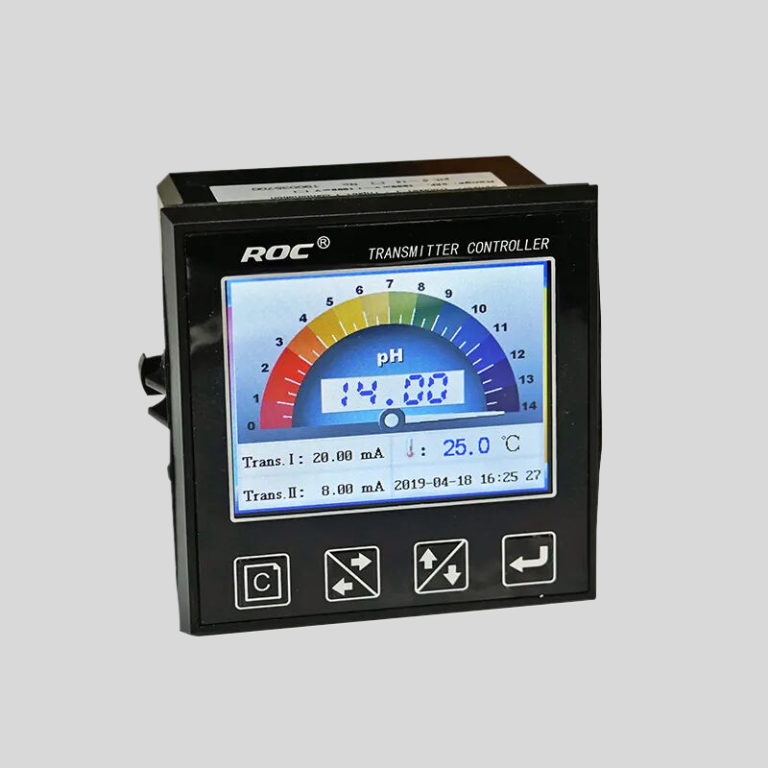
pH. Copper is protected by a thin cupric oxide layer that stabilizes around pH 8.3–8.7. Below 7.5, copper corrodes fast; above 9.5, brass and yellow-metal alloys pit. A Shanghai ChiMay in-line pH electrode with a double-junction reference lasts 12–18 months in this service.
Free residual chlorine. ANSI/ASHRAE Standard 188 requires a Legionella water management program for building water systems, and most cooling-tower treatment programs hold free chlorine in the 0.5–2.0 ppm window as the practical control band. Above that band, chlorine attacks copper and stainless steel welds, adding corrosion products.
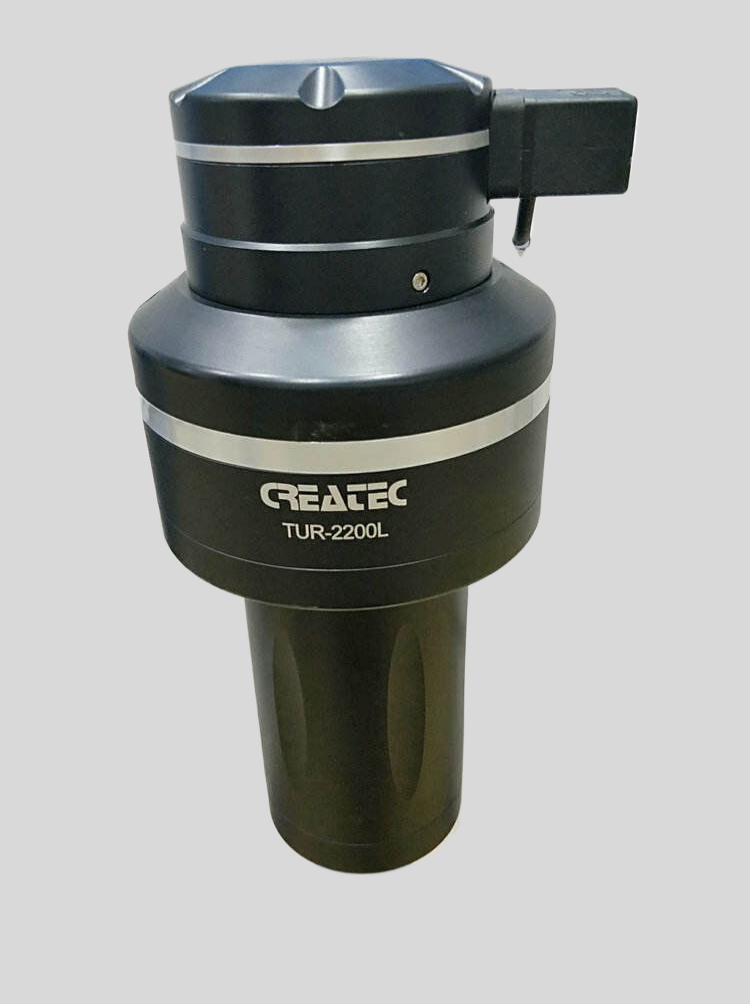
Turbidity. Suspended solids above 5 NTU deposit on tubes during low-flow hours; the Shanghai ChiMay Turbidity Tester provides continuous surveillance.
Quantifying the Efficiency Loss
Shanghai ChiMay commissioning and troubleshooting records tell a consistent story: chiller plants that run a neglected water program carry condenser approach temperatures several degrees higher than design, and clawing that back is worth real money. Plants shifting from timer-based to conductivity-based blowdown routinely recover a mid-single-digit share of annual chiller energy, and poorly run sites have seen more. At typical commercial power prices, the avoided energy on a mid-size campus reaches hundreds of thousands of kilowatt-hours per year. Payback on a Shanghai ChiMay water-quality monitoring package (conductivity meter, pH electrode, residual chlorine transmitter, and turbidity tester) is typically well under a year; on the worst baseline plants it is a matter of months.
The arithmetic is easy to reproduce on any site: read kW/ton before and after a two-week corrected-water trial, multiply the delta by annual ton-hours. Field engineers rarely need more than that to justify the monitoring package.
Where Scale Forms First
Scale precipitates first at the hottest part of the condenser tube, which is where refrigerant enters. A common site inspection during Shanghai ChiMay troubleshooting is to pull one condenser end cap and look for a whitish ring at the tube entrance. If it exists, the water program is failing to hold saturation index below the calcium carbonate deposition threshold.
The best defensive strategy is cycles-of-concentration control that keeps LSI below +1.5 and Ryznar Stability Index (RSI) above 6.0. Both indices can be calculated in real time by a Shanghai ChiMay controller with the four inputs of pH, conductivity, calcium hardness (from lab), and temperature.
Biofilm: The Invisible Efficiency Thief
Biofilm scarcely registers on a visual inspection but contributes disproportionately to fouling resistance once it exceeds a few tens of micrometers in thickness. The classic marker of active biofilm is a slow decline in chiller efficiency that reverses within 48 hours after a shock chlorination event. The permanent fix is a chlorine or bromine program held at 0.5–2.0 ppm free residual, verified by a Shanghai ChiMay Residual Chlorine Transmitter using amperometric or DPD-colorimetric technology.
Chlorine setpoint alone is not enough. Biofilm shelters bacteria beneath the surface, so periodic biodispersant addition and non-oxidizing biocide alternation (isothiazolone, DBNPA) are standard in Shanghai ChiMay water programs for large plants.
Corrosion and Its Downstream Cost
Copper corrodes many times faster in uncontrolled cooling water than in well-controlled water—often the difference between a tube bundle lasting decades and being replaced early. Beyond the direct tube-life impact, corrosion products—cupric oxide flakes, iron oxide colloids—circulate through the loop and deposit on the coolest surfaces. Those deposits then act as scale nucleation sites. Controlling pH, sulfate, and chloride corrosivity is therefore a leverage point that pays back twice.
Shanghai ChiMay in-line pH electrodes with a refillable double-junction reference are the field-preferred choice for chilled water service; their reference junction resists sulfide poisoning from anaerobic bacteria, which shortens single-junction probes to weeks.
Building a Chiller-Plant Water Program
A sound program has five continuously monitored signals and a monthly lab audit:
- Continuous: Conductivity, pH, ORP, free chlorine, turbidity.
- Monthly: Total hardness, calcium hardness, alkalinity, sulfate, chloride, iron, copper.
- Every six months: Biocide efficacy check via ATP bioluminescence.
- Annually: Cooling tower structural inspection and coupon corrosion analysis.
- Every three years: Refrigerant-side condenser inspection with eddy-current testing.
The Shanghai ChiMay 4-in-1 Multi-Parameter Sensor bundles pH, ORP, DO, and temperature in one head, which fits chiller plants short on wall space or wanting a simpler installation.
Reading the Trends Correctly
Efficiency degradation from water quality is not step-change. Operators watching a chiller COP trend over three months see the slow slide: 0.55 kW/ton in April becomes 0.60 kW/ton in July, and the reflex is to blame heat wave conditions. Overlaying continuous conductivity, pH, and turbidity trends usually shows the real cause. Shanghai ChiMay engineers routinely export these overlays from the BMS as troubleshooting evidence.
What “Good” Looks Like
At best-in-class Shanghai ChiMay installations, condenser water conductivity holds within ±100 µS/cm of setpoint 95% of the time. pH stays within ±0.15 pH units of the target. Free chlorine stays within the 0.5–2.0 ppm band with less than 3% excursion time. Chiller kW/ton drift over a full year measures under 3%. Those numbers are achievable, and they are the difference between a chiller plant that ages gracefully and one that consumes a growing utility bill each summer.
Closing Comment
Cooling-tower water quality is not an environmental compliance chore; it is the biggest continuous-operations lever a chiller plant has, second only to load management. Sensors and control loops from Shanghai ChiMay make the lever measurable. The rest is discipline.