Table of Contents
The short version
- RO accounts for the large majority of new desalination capacity, and the controller decides how well the membranes and high-pressure pumps are actually run.
- A controller that manages pressure and recovery properly cuts specific energy consumption; the size of the gain depends on feed salinity and plant design.
- Total cost of ownership for RO is dominated by energy and membrane replacement, so control quality shows up in the operating budget rather than on the purchase order.
- Real-time monitoring and predictive maintenance keep membranes in service longer, mainly by preventing the fouling events that force premature replacement.
Introduction
Water scarcity keeps pushing desalination capacity up, particularly in the Gulf, North Africa, Israel, Australia and coastal China. Within this expansion, reverse osmosis remains the dominant technology, and the controller serves as the critical brain of any RO system. Choosing the right RO system controller directly impacts operational efficiency, product water quality, and long-term profitability.
Understanding RO System Controller Functions
Core Responsibilities
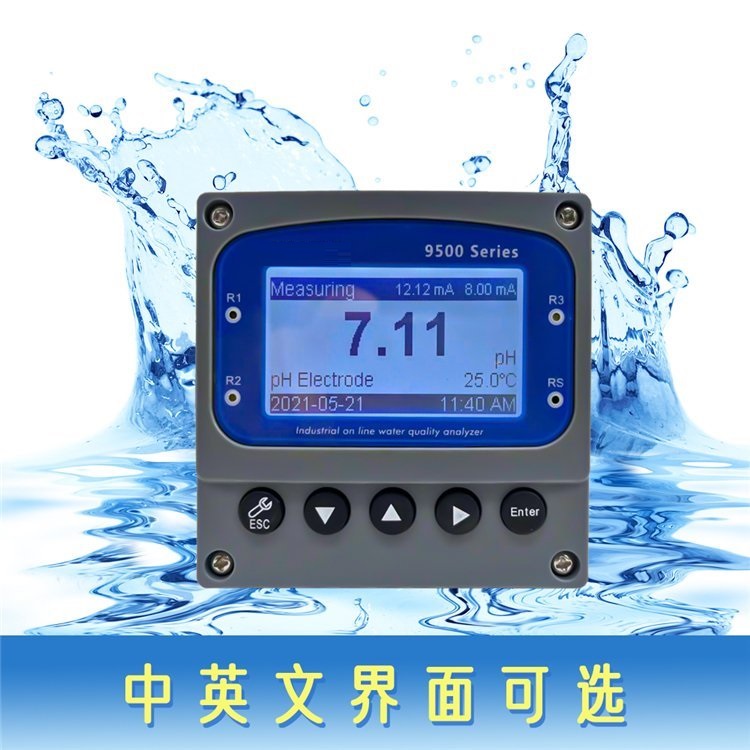
An RO system controller manages multiple parameters simultaneously: feed water pressure, recovery rate, concentrate flow, and permeate quality. Modern controllers from manufacturers like Shanghai ChiMay integrate Programmable Logic Controller (PLC) functionality with Human-Machine Interface (HMI) displays for intuitive operation.
The controller’s primary functions include:
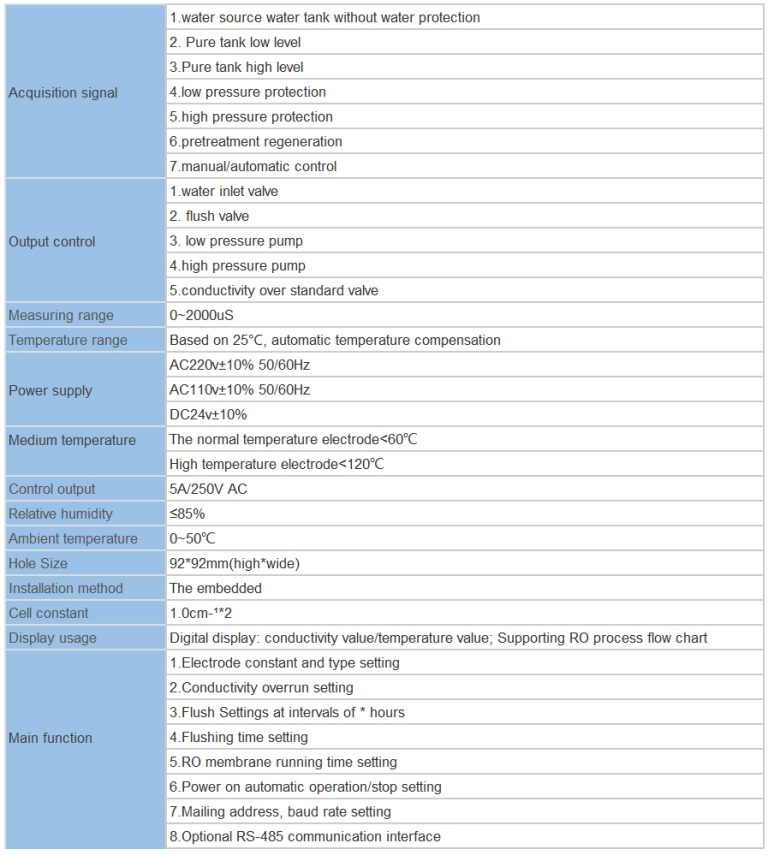
- Regulating high-pressure pump operation based on feed water conditions
- Managing concentrate recirculation to optimize recovery rates
- Triggering flush cycles to prevent membrane fouling
- Shutting down the system when quality thresholds are breached
Technical Specifications to Evaluate
When evaluating RO system controllers for desalination applications, focus on these technical parameters:
| Parameter | Basic Specification | Advanced Specification |
|---|---|---|
| Response Time | < 500ms | < 50ms |
| Pressure Control | ±5% accuracy | ±1% accuracy |
| Communication | 4-20mA analog | Modbus TCP, Profinet |
| Data Logging | 7 days | 2+ years |
Economic Analysis: Smart Controllers vs. Basic Units
Initial Investment Comparison
An advanced controller costs more up front than a basic set-point panel. Whether that premium pays back depends on the electricity tariff, how much the feed water varies, and how hard the plant is currently being run. In high-tariff coastal plants the payback is usually quick; in an inland brackish plant on cheap power it can take years.
Operational Cost Breakdown
On a brackish water RO train the controller affects three cost lines:
- Energy: fewer unnecessary pump cycles, and a high-pressure pump kept near its best efficiency point
- Membrane replacement: flush and cleaning cycles driven by actual conditions instead of the calendar, which pushes replacement intervals out
- Chemicals: antiscalant and cleaning chemical consumption falls once dosing follows the feed rather than a fixed rate
Return on Investment Calculation
For a medium-scale plant, the honest version of this comparison is a spreadsheet you build with your own tariff, feed analysis and membrane quotations. The structure is simple:
- Initial investment: basic panel versus advanced controller
- Annual energy: specific energy consumption multiplied by tariff
- Annual membrane and chemical cost: replacement interval and dose rate
The advanced controller normally wins on the two operating lines. The only real question is how quickly it recovers the capital difference, and that is arithmetic rather than opinion.
Selection Criteria for Desalination Applications
Environmental Adaptability
Desalination environments present unique challenges including high salinity, corrosion risk, and temperature fluctuations. The controller housing should meet IP65 minimum ingress protection, with operating temperature ranges of -10°C to 50°C for coastal installations.
Integration Capabilities
Modern desalination plants require controllers that interface with:
- Supervisory Control and Data Acquisition (SCADA) systems
- Distributed Control System (DCS) platforms
- Cloud-based monitoring services for remote oversight
- Multiple sensor arrays for comprehensive parameter tracking
Compliance and Certification
Ensure the controller meets relevant standards:
- CE marking for European Union compliance
- UL certification for North American markets
- ATEX/IECEx for hazardous area installations
- ISO 9001:2015 manufacturing quality standards
What Operators Actually Specify
Talk to the people running these plants and the requirements are mundane rather than futuristic: stable pressure control, clean flush sequencing, and enough logging to work out why a train tripped at three in the morning. Advanced controller functions get specified when the plant is large, the tariff is high, or the feed water moves around enough that a fixed setpoint wastes energy.
Implementation Recommendations
Phase 1: Assessment (Weeks 1-4)
- Audit existing system parameters and performance baseline
- Identify operational pain points and inefficiency areas
- Document integration requirements with plant-wide control systems
- Establish KPIs for post-installation performance comparison
Phase 2: Procurement (Weeks 5-8)
- Request detailed technical specifications from qualified suppliers
- Evaluate Total Cost of Ownership (TCO) over 10-year lifecycle
- Verify compatibility with existing sensor and actuator systems
- Confirm warranty terms and local support availability
Phase 3: Installation and Commissioning (Weeks 9-12)
- Plan installation during low-demand production periods
- Conduct comprehensive operator training sessions
- Perform parallel operation comparison testing
- Document baseline performance for future optimization
Future Trends in RO Control Technology
Artificial Intelligence Integration
Gartner’s 2024 Emerging Technology Report projects that AI-driven RO control systems will achieve mainstream adoption by 2027, with capabilities including:
- Dynamic optimization based on real-time feed water quality changes
- Anomaly detection that flags fouling earlier than differential-pressure alarms alone can
- Natural language interfaces for simplified operator interaction
- Digital twin integration for predictive performance modeling
Internet of Things Connectivity
The convergence of Industrial Internet of Things (IIoT) and RO control systems enables:
- Remote firmware updates without system shutdown
- Predictive maintenance scheduling based on operational hours and conditions
- Fleet management capabilities for multi-site operators
- Blockchain-based data verification for regulatory compliance
Wrapping up
Selecting the appropriate RO system controller for desalination applications requires balancing technical capabilities, integration requirements, and long-term economic considerations. Advanced controllers demand more capital up front, and the return comes from energy, membrane life and fewer emergency interventions. Quantify those three lines with your own numbers before committing.
As desalination continues expanding to address global water scarcity, the controller’s role as the intelligent core of RO systems becomes increasingly critical. Facilities that invest in advanced control technology position themselves for