The short version:
– On a typical monitoring point, most of the cost is not the sensor: it is the tapping, the tray, the cable and the commissioning
– One mounting point instead of four removes penetrations, cable runs and the labour that goes with them
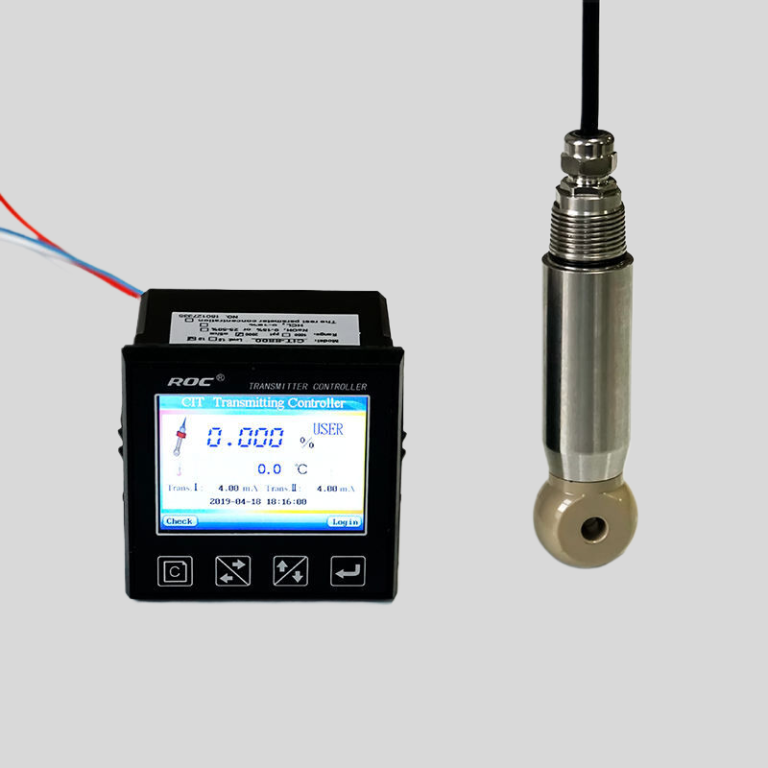
– Shanghai ChiMay 4-in-1 sensors monitor pH, ORP, conductivity, and temperature from one device
– Fewer devices to calibrate means a lighter maintenance load and more consistent records
Table of Contents
The Hidden Cost Challenge in Water Quality Monitoring Infrastructure
Industrial facilities installing or upgrading water quality monitoring systems often focus on sensor accuracy and measurement performance while underestimating infrastructure costs. Ask an estimator rather than a sales engineer and the picture changes: on a typical three-parameter installation the instruments are a minority of the installed cost. Labour, civil works, cable, commissioning and documentation make up the rest.
Instrumentation budgets keep growing because regulators and operators both want more measurement points, not just better instruments. Within this market, multi-parameter sensors have emerged as a strategic solution for facilities seeking to expand measurement coverage while controlling infrastructure costs.
This article examines how multi-parameter water quality sensors significantly reduce installation costs across multiple cost categories, providing facilities with substantial capital savings and improved return on monitoring investments.
Breaking Down the Cost Structure of Traditional Monitoring Installations
Single-Parameter System Requirements
A traditional water quality monitoring station for a typical industrial application—monitoring pH, conductivity, and temperature at a single process point—requires:
Equipment inventory:
– One pH transmitter with electrode
– One conductivity transmitter with cell
– One temperature transmitter with probe
– One sample conditioning system
– Three separate mounting assemblies
Infrastructure requirements:
– Three conduit entries or cable glands
– Minimum 3-meter separation between transmitters (per manufacturer recommendations)
– Three independent signal cables (typically 4-20mA or digital)
– Separate power connections for each transmitter
– Individual grounding connections
– Process connection for each sensor (threaded fitting, flange, or flow cell)
Installation labor components:
– Civil works for mounting panel or structure
– Conduit routing and installation
– Cable pulling and termination
– Grounding system installation
– Process connection fabrication and installation
– Commissioning and configuration for each device
– Documentation and labeling
Total Cost Analysis
Here is a worked example for a three-parameter point on a clean industrial site. It is an illustrative model built from typical instrument list prices and contractor rates, not a quotation, so substitute your own numbers before using it in a business case:
| Cost Category | Typical Cost | Percentage of Total |
|---|---|---|
| Equipment | $3,600 | 35% |
| Civil works | $1,200 | 12% |
| Conduit and wiring | $1,500 | 15% |
| Installation labor | $2,400 | 24% |
| Commissioning | $900 | 9% |
| Documentation | $450 | 5% |
| Total installed cost | $10,050 | 100% |
What matters in this model is the ratio, not the currency: field work and cabling dominate the installed cost.
How Multi-Parameter Sensors Transform Installation Economics
Consolidated Equipment Architecture
Multi-parameter sensors like Shanghai ChiMay’s 4-in-1 sensor integrate four measurement parameters—pH, ORP, conductivity, and temperature—into a single device with one process connection, one transmitter, and one communication interface.
Equipment comparison for equivalent monitoring:
| Component | Single-Parameter Approach | Multi-Parameter Approach | Savings |
|---|---|---|---|
| Sensors | 4 separate sensors | 1 integrated sensor | 75% |
| Transmitters | 4 separate units | 1 multi-channel unit | 75% |
| Process connections | 4 penetrations | 1 penetration | 75% |
| Conduit entries | 4 entries | 1 entry | 75% |
| Signal cables | 4 cables | 1 multi-core cable | 75% |
This consolidation cascades through the entire installation, dramatically reducing every cost category.
Direct Infrastructure Savings
Civil works reduction: A single mounting point eliminates multiple support structures and the design work that goes with them. The smaller footprint suits applications with limited space, potentially eliminating structural modifications entirely.
Conduit and wiring savings: One multi-conductor cable replaces four individual cables, which cuts both the material and the labour needed to pull and terminate it.
Process connection simplification: One process penetration replaces four, reducing valve, fitting, and pipe fabrication requirements. For applications requiring custom fabrication—such as sample panels or skids—this consolidation significantly simplifies design and construction.
Commissioning efficiency: Commissioning a single multi-parameter transmitter requires substantially less time than commissioning four separate devices. Configuration, loop checking, and documentation requirements decrease proportionally.
Quantified Installation Cost Comparison
The same worked example, priced with multi-parameter equipment:
| Cost Category | Traditional | Multi-Parameter | Reduction |
|---|---|---|---|
| Equipment | $3,600 | $2,400 | 33% |
| Civil works | $1,200 | $400 | 67% |
| Conduit and wiring | $1,500 | $750 | 50% |
| Installation labor | $2,400 | $1,100 | 54% |
| Commissioning | $900 | $400 | 56% |
| Documentation | $450 | $200 | 56% |
| Total installed cost | $10,050 | $5,250 | 48% |
In this model the installed cost roughly halves, and the logic scales with the number of parameters: the more measurements you pack into one device, the more infrastructure you avoid buying four times over.
Specific Installation Scenarios and Savings Examples
Greenfield Installation: New Process Line
Scenario: a new process line needs pH, conductivity and dissolved oxygen at three locations.
Traditional approach:
– 9 separate transmitters
– 9 process connections
– 9 conduit runs
– Estimated installation cost: $45,000
Multi-parameter approach (using 4-in-1 sensors):
– 3 integrated transmitters
– 3 process connections
– 3 conduit runs
– Estimated installation cost: $18,000
Total savings: $27,000 (60% reduction)
The facility reallocated these savings to additional monitoring points, achieving more comprehensive process coverage without budget increase.
Retrofit Application: Limited Space Constraints
Scenario: a pharma plant needs to add turbidity monitoring to an existing sample panel with no room left for another transmitter.
Traditional approach:
– Required complete panel redesign
– Estimated cost: $15,000 plus production downtime
Multi-parameter approach:
– Replaced existing pH transmitter with 4-in-1 sensor
– No panel modifications required
– Estimated cost: $2,800
Total savings: $12,200 and eliminated production downtime
Municipal Water Treatment: Budget Optimization
Scenario: a municipal utility wants 12 new monitoring points on a fixed capital budget.
With traditional single-parameter equipment:
– Could install 8 monitoring points within budget
With multi-parameter sensors:
– Installed all 12 planned monitoring points
– Included additional parameters at no extra cost
Outcome: Achieved 50% more monitoring coverage within existing budget through multi-parameter cost savings.
Maintenance Cost Reduction Benefits
Consolidated Calibration
Multi-parameter sensors simplify maintenance through consolidated calibration procedures:
Traditional maintenance requirements:
– Four separate calibration visits
– Four sets of calibration solutions
– Four sensor replacements at different intervals
– Four maintenance records and certifications
Multi-parameter maintenance requirements:
– One calibration visit
– One set of calibration solutions (for all parameters)
– One sensor replacement event
– One maintenance record
Operational cost savings: Maintenance labour and consumables fall substantially, with further savings from a smaller calibration solution inventory and simpler compliance documentation.
Reduced Spare Parts Inventory
Maintaining spare parts inventory for single-parameter systems requires stocking multiple sensor types and transmitter models. Multi-parameter systems reduce inventory complexity:
- One spare sensor type covers multiple parameters
- One transmitter model serves all applications
- Simplified training for maintenance personnel
- Reduced stockroom space requirements
Inventory cost reduction: sites running many monitoring points carry fewer spare part types, which reduces both stock value and stockroom space.
Implementation Considerations and Best Practices
Installation Guidelines for Cost Optimization
Maximizing multi-parameter sensor cost benefits requires attention during installation:
- Plan cable routing early: Consolidate conduit runs to minimize civil works
- Select appropriate mounting locations: Single location must serve all parameters
- Consider sample flow requirements: Ensure adequate flow for all sensor elements
- Verify communication wiring: Single cable must support all parameters
- Document parameter mapping: Clear labeling ensures maintenance efficiency
When Multi-Parameter Sensors May Not Be Optimal
Despite clear cost advantages, multi-parameter sensors may not suit every application:
- Extremely high temperature applications: Sensor housing may not accommodate extreme conditions
- Highly specialized measurements: Some applications require dedicated sensors with specialized features
- Physically separated measurement points: When parameters must be measured at different locations
- Extremely aggressive chemicals: Single housing material may not resist all process chemicals
Shanghai ChiMay application engineers can evaluate specific applications to confirm multi-parameter sensor suitability.
Long-Term Economic Benefits Beyond Installation
Scalability Advantages
Multi-parameter architecture provides inherent scalability for future monitoring expansion:
- Adding parameters requires only software configuration (if spare channels available)
- New parameters can be added without additional infrastructure
- System upgrades use existing installation investment
Total cost of ownership over a 10-year lifecycle, using the same illustrative model:
| Cost Category | 10-Year Traditional | 10-Year Multi-Parameter |
|---|---|---|
| Equipment | $14,400 | $9,600 |
| Installation | $0 | $0 |
| Maintenance | $9,600 | $4,800 |
| Spare parts | $3,200 | $1,600 |
| Total | $27,200 | $16,000 |
Lifecycle savings: $11,200 (41% reduction)
Market Trends Driving Multi-Parameter Adoption
The industrial water monitoring market increasingly recognizes multi-parameter advantages:
- Digital water spending keeps rising: utilities and industrial plants are both expanding instrumentation and analytics budgets
- IoT integration requirements: Connected devices favor consolidated monitoring points
- Operational efficiency focus: Industries prioritize cost reduction alongside measurement capability
- Regulatory pressure: Comprehensive monitoring at minimum infrastructure burden
These trends suggest continued growth in multi-parameter sensor adoption across industrial sectors.
Wrapping up
Multi-parameter water quality sensors provide substantial installation cost reductions through fundamental architectural advantages. By consolidating multiple measurement parameters into single devices, these sensors eliminate redundant infrastructure—mounting points, process connections, conduit runs, and cable systems—that traditional single-parameter approaches require.
The comparisons above are models rather than quotations, but the direction is dependable: consolidating parameters into one device removes infrastructure that would otherwise be bought, installed and maintained four times over. These savings enable facilities to either achieve budget reductions or expand monitoring coverage within existing capital constraints.
Beyond installation, multi-parameter sensors deliver ongoing maintenance benefits through consolidated calibration procedures, simplified spares inventory, and reduced documentation requirements. The combination of capital and operational savings delivers clear return on investment for facilities implementing multi-parameter monitoring strategies.
Shanghai ChiMay’s 4-in-1 and 2-in-1 sensor platforms embody this cost-optimized monitoring approach, providing industrial facilities with comprehensive water quality data while controlling infrastructure investment and operational costs.