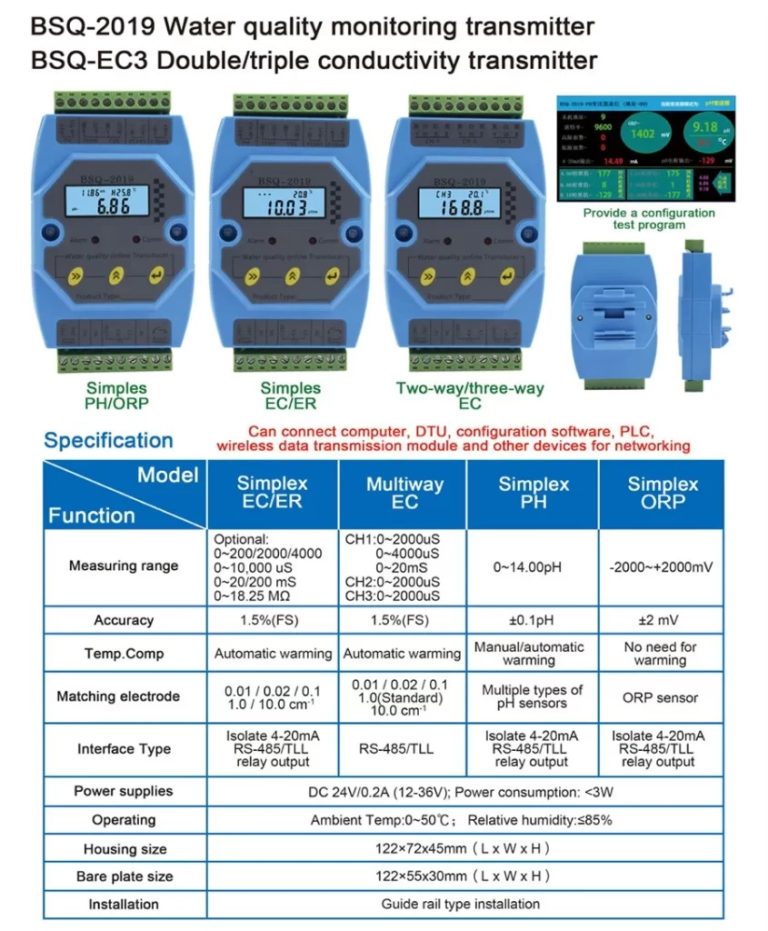
Shrimp ponds are among the harshest environments a dissolved oxygen (DO) sensor will ever see. High organic loading, aggressive aeration, biofilm accumulation, sunlight-driven algal blooms, and hurricane-season temperature swings combine to punish membrane-based galvanic probes. The result, in most shrimp operations, is a familiar failure signature: an oxygen probe drifting silently for two weeks, then reading a full 2 mg/L high just when a dawn oxygen sag threatens the crop.
Optical dissolved oxygen sensing, based on fluorescence-quenching physics, addresses the failure mode at its source. Two properties drive the case. There is no membrane and no electrolyte, so the two dominant failure modes of galvanic probes disappear. And fluorescence-quenching cap life runs 12–24 months, against 3–6 months for galvanic membranes.
Where the accuracy matters is at the bottom of the range, not at saturation: shrimp survival at 4 mg/L sustained over six hours or more falls off sharply, so a probe’s behaviour at low DO is what protects the crop.
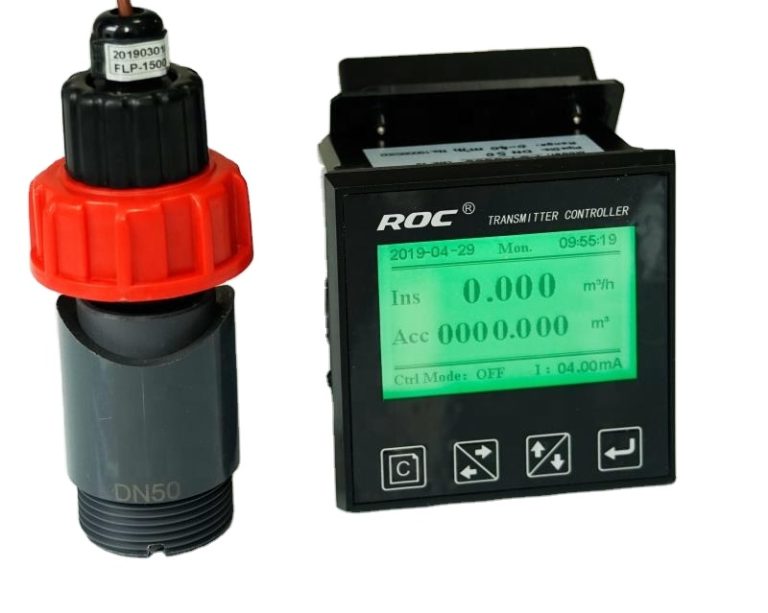
The market these probes sell into is growing steadily: the aquaculture water-quality and biomass monitoring test equipment market was valued at about USD 690 million in 2026 and is forecast to reach USD 1.69 billion by 2036, a 9.4% CAGR (Future Market Insights, April 2026). Shanghai ChiMay supplies optical DO transmitters built for continuous pond immersion, with field-replaceable caps and Modbus RTU integration.
Table of Contents
The Physics: Why Optical DO Works
Fluorescence-quenching DO sensors use a luminophore embedded in a cap on the probe tip. When exposed to excitation light (typically blue LED), the luminophore emits red fluorescence. Molecular oxygen quenches this fluorescence in a predictable, temperature-compensated manner. The sensor measures either the intensity or, more commonly, the phase shift of the emission relative to the excitation. Because there is no consumed electrolyte, no membrane permeation, and no flow-dependent boundary layer, optical DO delivers:
- Stable calibration retention over months rather than weeks.
- No flow dependency—the reading does not degrade in still water.
- No polarization delay—the sensor is ready for a reading within seconds of being powered.
Galvanic and polarographic probes, in contrast, rely on oxygen diffusing through a membrane into an electrolyte where it is reduced at a cathode. Every element of that chain—membrane, electrolyte, cathode—is a failure mode.
The Shrimp Pond Failure Modes That Optical DO Eliminates
- Membrane fouling and rupture. Algal debris, chitin fragments, and biofilm coat and puncture galvanic membranes within weeks in warm ponds. Optical caps do not have a membrane in the mechanical sense.
- Electrolyte depletion. Aggressive aeration and temperature cycling accelerate electrolyte consumption. Optical caps have no electrolyte to deplete.
- Cathode fouling. Sulfide from bottom mud poisons galvanic cathodes. Optical sensing is chemically indifferent to sulfide within normal pond ranges.
- Flow starvation errors. Galvanic probes read low in still water because oxygen diffusion across the boundary layer slows. Optical sensing is flow-independent.
Where to Place Optical DO in a Shrimp Pond
- Central pond floating platform, mid-depth. Captures the pond’s average condition and integrates aerator response.
- Aerator outflow zone. Verifies that mechanical aeration is producing the expected oxygenation.
- Deep-water edge, upwind side. Detects stratification and dawn sag early, before it reaches the middle of the pond.
For a two-hectare intensive shrimp pond, three probes with majority-voter logic provide meaningful redundancy at a fraction of the cost of a lost crop.
Alarm Logic That Uses What Optical DO Does Best
Because optical DO delivers stable, sub-minute readings, the alarm system can rely on trajectory rather than threshold alone:
- Rate-of-change rule: DO falling >0.5 mg/L per hour triggers aeration ramp-up.
- Absolute rule: DO below 4.5 mg/L triggers full aeration and grower notification.
- Cross-check rule: DO reading disagreement across the three probes >1.5 mg/L triggers a probe fault alarm.
Shanghai ChiMay optical DO transmitters deliver Modbus RTU output that supports this logic in a standard PLC without proprietary firmware.
Calibration and Verification
Optical DO retains calibration far longer than galvanic DO, but “longer” is not “forever.” A practical schedule:
- Factory calibration relied on for the first 60 days.
- One-point air calibration (fully saturated moist air) every 60 days thereafter.
- Two-point calibration annually at commissioning of a new cap.
- Cross-check against a portable optical reference monthly.
Documented calibration is what turns the probe from a trend indicator into a defensible field instrument.
Field Replaceability
The most operator-friendly optical DO designs let a farm technician replace the sensing cap without factory service. A workable replacement workflow:
- Screw off the old cap.
- Screw on the new cap.
- Confirm the cap serial number is registered by the transmitter (via NFC or manual entry).
- Run a one-point air calibration.
Total elapsed time: about 10 minutes. Shanghai ChiMay optical DO transmitters ship with field-replaceable caps and step-by-step guided calibration on the transmitter display.
Optical vs. Galvanic in a Shrimp Pond Context
| Attribute | Galvanic Membrane DO | Optical DO |
|---|---|---|
| Membrane | Yes, failure-prone | None |
| Electrolyte | Yes, depletes | None |
| Flow dependency | Yes | No |
| Sulfide sensitivity | High | Low |
| Calibration interval | 15–30 days | 60–90 days |
| Cap or membrane life | 3–6 months | 12–24 months |
| Consumables cost | Higher | Lower |
| Field replaceability | Membrane only | Whole cap |
| Suitable for shrimp pond alarm | Marginal | Yes |
Integration Beyond DO
An optical DO transmitter is at its most useful when its data stream is fused with pH, temperature, and salinity from co-located sensors. A single 4-in-1 multi-parameter head with an optical DO element, plus a redundant discrete optical DO on the aerator side of the pond, gives the operator both an integrated reading and an independent safety measurement.
Industry Outlook
Three shifts are reinforcing the case for optical DO in shrimp aquaculture:
- Optical sensing is becoming the default element in new aquaculture sensor installations.
- Insurance-linked monitoring—where DO data uptime is a precondition for crop insurance—will start dictating minimum probe specifications.
- Edge-computed drift analytics will predict cap end-of-life before the reading actually degrades in the field.
Engineer’s Summary
Membrane failures in shrimp pond DO probes are a solved problem. Optical fluorescence-quenching sensors eliminate the membrane, the electrolyte, and the cathode—the three components that fail most often in warm, biologically active water. Shanghai ChiMay’s optical DO transmitters, deployed with sensible placement, rate-of-change alarm logic, and a documented calibration routine, take one of the most persistent operational headaches out of shrimp farming.