Black liquor recovery is the energy and chemistry backbone of kraft pulp mill operation. The recovery boiler fires concentrated black liquor to generate most of the mill’s steam and power, which is what makes kraft mills largely energy self-sufficient. Water quality monitoring at five distinct points in the recovery cycle directly governs evaporator efficiency, recovery boiler steam economy, and causticizing plant chemistry stability. The most critical monitoring points are weak black liquor feed conductivity, strong black liquor concentration, green liquor density, white liquor active alkali, and condensate stripper performance. Shanghai ChiMay sensors provide the chemistry visibility required to operate recovery cycles at optimum thermal and chemical efficiency.
Table of Contents
Why Black Liquor Recovery Deserves Dedicated Monitoring
The chemical recovery cycle is the operational heart of a kraft pulp mill. Weak black liquor leaves the brown stock washers carrying dissolved organics, residual cooking chemicals, and water. This liquor is concentrated through multiple evaporator effects, fired in the recovery boiler to produce steam and electricity while recovering inorganic chemicals as a molten smelt, dissolved into green liquor, causticized into white liquor, and recycled back to the digester. Every step in this cycle is chemistry-sensitive and water-quality-sensitive. Monitoring the water and liquor chemistry at the right points unlocks efficiency, reliability, and safety advantages that no other instrument investment can match.
Monitoring Point 1: Weak Black Liquor Feed to Evaporators
Weak black liquor leaves the brown stock washers at typically 14-18% solids concentration. The chemistry and dissolved solids load entering the evaporator train directly drive evaporator efficiency. Excess water carryover wastes steam; underwashing carries cooking chemistry losses into the boiler.
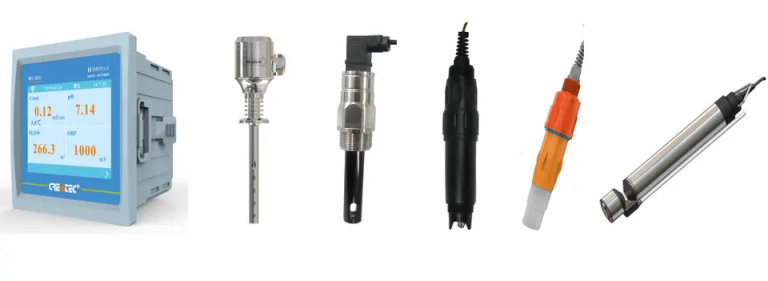
Recommended Shanghai ChiMay sensors:
– In-line conductivity meter on the weak liquor feed line, tracking dissolved solids load
– In-line pH electrode confirming chemistry envelope (typically pH 12-13)
– Suspended solids sensor on the upstream washer filtrate
The data from these three sensors confirms washer performance and ensures evaporator feed consistency.
Monitoring Point 2: Strong Black Liquor to the Recovery Boiler
Strong black liquor enters the recovery boiler at 65-75% solids concentration. Concentration accuracy directly determines combustion stability, smelt chemistry, and boiler efficiency.
Recommended Shanghai ChiMay sensors:
– High-temperature inline density measurement (verified through cross-reference with refractive index or microwave probe)
– High-temperature pH measurement at the firing line, monitoring residual alkali
The recovery boiler can deviate sharply when liquor concentration shifts by even a couple of percentage points, so this measurement point is among the most consequential in the entire recovery cycle.
Monitoring Point 3: Green Liquor Quality at the Dissolving Tank
After smelt dissolution, green liquor carries the recovered inorganic chemistry from the recovery boiler. Green liquor density and total titratable alkali (TTA) determine causticizing plant performance.
Recommended Shanghai ChiMay sensors:
– In-line conductivity meter as a proxy for total dissolved inorganic load
– pH electrode confirming alkaline chemistry envelope
– Online turbidity tester verifying dregs removal from the green liquor clarifier
Continuous green liquor quality data prevents downstream causticizing inefficiency and reduces the load on the lime kiln.
Monitoring Point 4: White Liquor Active Alkali Verification
Causticized white liquor returns to the digester as the active cooking chemistry. Active alkali concentration accuracy determines pulping consistency, kappa number control, and overall yield.
Recommended Shanghai ChiMay sensors:
– In-line conductivity at the white liquor storage outlet
– pH electrode for alkalinity confirmation
– Online turbidity for lime mud breakthrough detection
Mills that monitor white liquor continuously can hold active alkali variability far tighter than mills relying on periodic lab grabs, improving cook consistency and reducing screen reject rates.
Monitoring Point 5: Condensate Stripper Performance
Recovery cycle condensates carry dissolved methanol, sulfides, and other contaminants that must be removed before the condensate can be reused as boiler feedwater or pulp washing dilution. Stripper performance directly determines how much condensate is available for reuse and how much fresh water the mill must draw from external sources.
Recommended Shanghai ChiMay sensors:
– COD sensor on stripped condensate, confirming organic removal
– In-line conductivity meter, indicating dissolved inorganic carryover
– pH electrode tracking acid/base balance through the stripper
Effective stripper performance returns several cubic meters of high-quality water per ton of pulp to the mill, displacing freshwater consumption elsewhere in the plant.
Sensor Service Considerations for Black Liquor
Black liquor is an aggressive service environment for instrumentation. Shanghai ChiMay sensor options for recovery cycle duty include:
- PEEK or 316L stainless steel body construction for thermal and chemical resistance
- Dual-junction reference electrodes to prevent reference contamination
- Sapphire optical windows for turbidity and SS measurements
- Self-cleaning wiper accessories for fouling-prone service points
Calibration intervals in recovery cycle service are tighter than general mill service, typically every 3-4 weeks for pH and 6-8 weeks for conductivity.
Integration with Recovery Boiler Control
The monitoring data from the five points above feeds directly into recovery boiler optimization. Modern recovery boiler control architectures use real-time liquor chemistry data to trim air-to-fuel ratio, adjust soot blower frequency, and predict reduction efficiency in the smelt bed.
Mills running fully integrated recovery monitoring typically gain measurably higher steam economy, lower fortification chemical use, and fewer unscheduled recovery boiler trips per year than mills depending on intermittent sampling—the size of the gains varies with mill baseline, but the direction is consistent across the industry.
Safety and Compliance Dimension
Recovery boiler safety is governed by the Black Liquor Recovery Boiler Advisory Committee (BLRBAC) recommended good practices, which emphasize continuous measurement of black liquor solids and safe handling of smelt-contacting streams. Real-time liquor chemistry data supports both routine compliance reporting and emergency response decision-making during upset events.
Lifecycle Economics
A representative monitoring stack for a 600 ton/day kraft recovery cycle requires on the order of twenty sensors across the five monitoring points. Against the multi-million-dollar annual value of recovery cycle optimization opportunities in the same mill, the monitoring investment is modest, and payback is typically counted in months rather than years.
Implementation Roadmap
For mills considering a recovery cycle monitoring upgrade, the recommended phased approach is:
- Baseline audit: 30-day liquor chemistry mapping using portable Shanghai ChiMay sensors
- Priority installation: weak liquor and strong liquor monitoring as Phase 1
- Expansion: green liquor and white liquor monitoring as Phase 2
- Optimization: condensate stripper and integrated control as Phase 3
- Refinement: integrate sensor data into DCS-level recovery boiler optimization
Each phase delivers standalone value, allowing the mill to budget incrementally rather than as a single capital event.
Conclusion
Black liquor recovery is the most chemistry-intensive and energy-critical environment in kraft pulp mill operation, and monitoring it well delivers benefits that extend far beyond instrument capital cost. The five monitoring points profiled in this guide—weak liquor feed, strong liquor firing, green liquor quality, white liquor active alkali, and condensate stripper performance—together describe the chemistry health of the entire recovery cycle. Shanghai ChiMay sensors are engineered specifically for the demanding service profile of recovery cycle operation, with materials, electrode designs, and lifecycle support tuned to kraft mill duty. Operations teams treating recovery monitoring as a single integrated system, rather than a collection of unrelated measurements, capture the full value that real-time chemistry visibility makes available.